A backlink plan should not treat every link as exactly the same.
Some placements are stronger because the source page, topic, target page, and proof requirements matter more. Other placements support the wider context around your business, services, and content.
VisiblePilot explains this with two simple terms:
- authority-targeted placements;
- supporting contextual placements.
Both can be useful. They just have different jobs.
What is an authority-targeted placement?
An authority-targeted placement is the stronger placement in a backlink plan.
It is selected more carefully. It should connect to an approved target page on your website and be placed inside content that makes sense for the topic. It is not just a random mention. It is meant to be one of the key proof points in the monthly backlink report.
For example, if your business sells outdoor storage, an authority-targeted placement might support a main page about outdoor storage cabinets, sheds, benches, or garden organization. If your business offers local plumbing, it might support a service page about emergency plumbing, blocked drains, or leak repairs.
The goal is not to force a keyword unnaturally. The goal is to create a relevant public context around a page that matters.
What is a supporting contextual placement?
A supporting contextual placement adds broader coverage.
It may be placed on a useful page that mentions a related service, topic, use case, location, or customer problem. It supports the overall visibility picture without needing to be the strongest placement in the plan.
Supporting placements are useful because one strong mention is not always enough. Businesses are usually connected to many topics. A restaurant might be connected to private dining, takeaway, local events, reviews, menus, and family bookings. A garden store might be connected to storage, tools, outdoor shade, watering, seasonal prep, and small space organization.
Supporting placements help build that wider context.
Why a mix is better than one type only
If every placement tries to be the strongest placement, the plan can become expensive, slow, or unnatural.
If every placement is only a weak supporting mention, the plan may not create enough focused proof around the most important pages.
A mix gives the plan structure.
VisiblePilot’s paid backlink plans use a simple ratio:
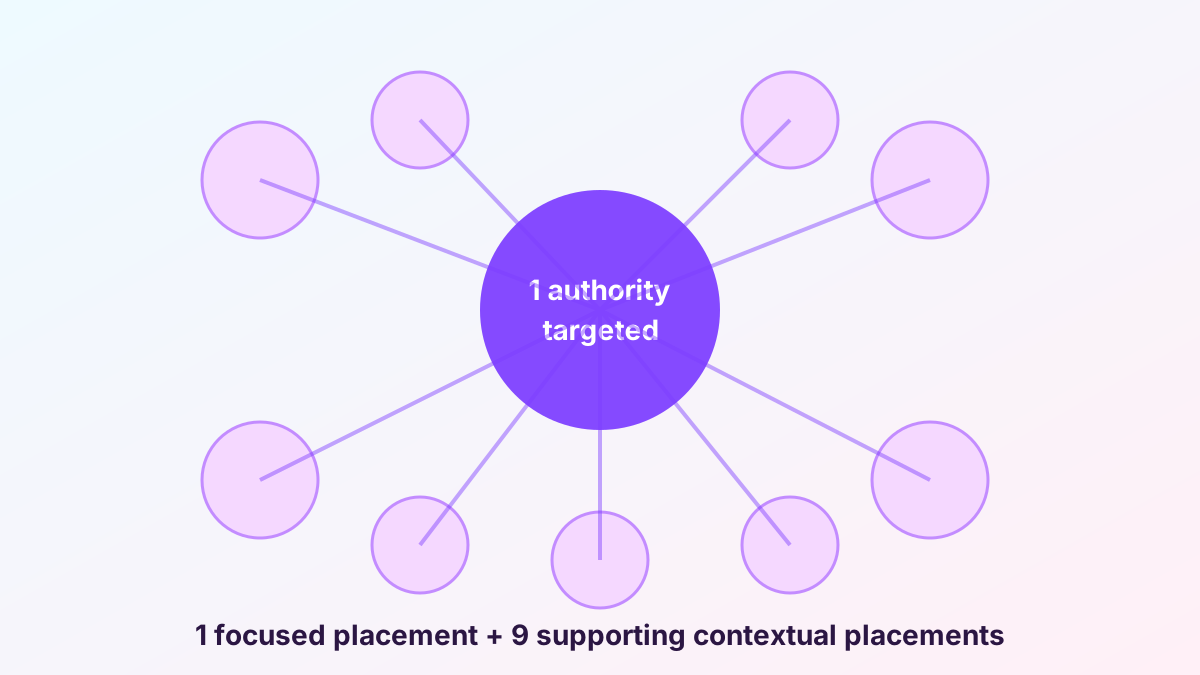
For every 10 paid backlink placements, the plan includes 1 authority-targeted placement and 9 supporting contextual placements.
That means a plan with 10 placements includes 1 authority-targeted placement and 9 supporting placements. A plan with 30 placements includes 3 authority-targeted placements and 27 supporting placements. A plan with 70 placements includes 7 authority-targeted placements and 63 supporting placements.
This makes the plan easier to understand and easier to report.
What the customer should see in the report
The customer should not have to guess which placements are which.
A monthly proof report should label each placement clearly:
- authority-targeted;
- supporting contextual.
It should also show:
- source URL;
- target URL;
- anchor text;
- placement status;
- proof status;
- any issues.
This helps the customer understand the value of the package. It also helps prevent confusion when one placement is more carefully targeted and another is broader supporting context.
Example: a small business backlink plan
Imagine a small business chooses a 10-placement monthly backlink plan.
The plan might work like this:
1 authority-targeted placement:
- Source page: a useful article about a specific customer problem.
- Target page: the business page that best solves that problem.
- Anchor: a natural phrase that describes the service or page.
9 supporting contextual placements:
- Source pages: related notes, guides, use cases, or topic pages.
- Target pages: approved pages on the business website.
- Anchors: natural brand, service, topic, or page phrases.
The authority-targeted placement gives the month a focused proof point. The supporting placements help create broader topical coverage.
What makes a placement unsafe or weak?
A placement can be weak if the page is irrelevant, hard to read, hidden, misleading, or obviously built only to manipulate search engines.
A placement can also be risky if it uses unnatural anchor text, links to the wrong page, appears on a page with unrelated content, or makes claims that cannot be supported.
That is why approval and proof matter. Before a placement is treated as complete, it should pass basic checks:
- Is the source page public?
- Does the content make sense?
- Is the target page correct?
- Is the anchor natural?
- Is the link visible?
- Is the page intended to be crawlable?
- Is the report honest about what has and has not been proven?
Why this matters for small businesses
Small businesses need marketing that they can understand.
If a plan simply says “30 backlinks,” that may sound impressive, but it does not explain what kind of links are being created. A better plan says:
- 30 new backlink placements per month;
- 3 authority-targeted placements;
- 27 supporting contextual placements;
- monthly proof with live URLs after publication.
That gives the customer a clearer picture.
This is not a ranking guarantee
The authority-targeted/supporting split is a delivery model. It is not a ranking guarantee.
A business still needs clear website pages, useful content, accurate information, and a service customers actually want. Backlinks support visibility, but they do not replace the fundamentals.
VisiblePilot’s role is to create useful public pages, place links in a clear and reportable way, and show the work each month.
Choose the placement count that fits the gap
If your business has very few outside mentions, a smaller plan can be a useful start. If the backlink gap is larger, a larger plan may create broader coverage faster.
The right plan depends on the current gap, the target pages, and how much public context already exists around your business.
That is why a marketing report should come first.