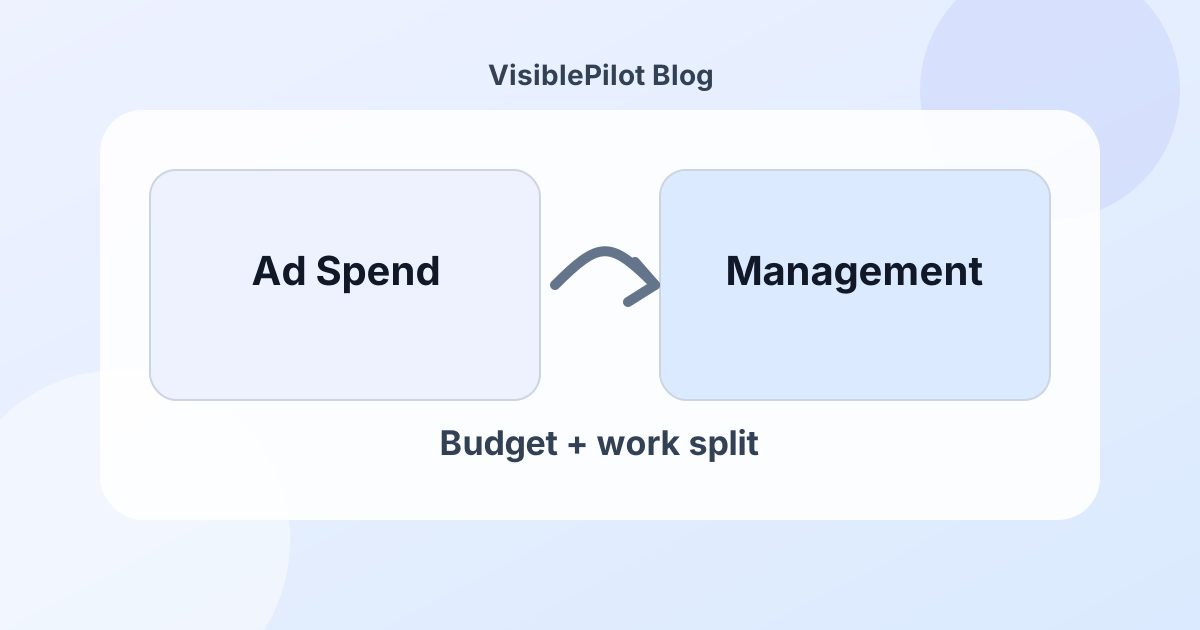
If you are thinking about running Google Ads, Meta Ads, or any other paid campaign, you will usually see two different costs:
- Ad spend
- Management fee
They are not the same thing.
Ad spend is the money that goes to the advertising platform. Management is the work needed to set up, monitor, adjust and report on the campaign.
This matters because many small businesses hear “ads” and think there is one simple price. In reality, the platform takes the ad budget, while the person or system managing the campaign charges separately for the work.
VisiblePilot separates these two costs so the pricing stays clear.
Ad spend is the money paid to the ad platform
Ad spend is the budget used to show your ads.
For example:
- if you run Google Ads, the spend goes to Google;
- if you run Meta Ads, the spend goes to Meta for Facebook and Instagram placements;
- if you set a small daily budget, that budget controls how much the platform can use to show your campaign.
Ad spend is not a fee paid to VisiblePilot. It is the media budget.
A simple way to think about it:
Ad spend buys the opportunity for people to see or click your ads.
It does not automatically mean the ads will be profitable. It also does not replace the work of setting up the campaign properly.
Management is the work around the campaign
Management is the service work that helps the ad spend be used more carefully.
That can include:
- checking the goal of the campaign;
- reviewing the landing page;
- choosing the campaign structure;
- setting locations and audiences;
- writing or reviewing ad copy;
- checking budgets;
- watching spend;
- reviewing early performance;
- suggesting changes;
- reporting what happened.
This is why a management fee exists. The platform does not automatically know your business context, your offer, your profit margin, or whether your website page is ready.
Why separating the two is better for clients
Separating ad spend and management helps avoid confusion.
If a plan says “$100 per month management”, that does not mean the business has $100 of ad spend included.
If a campaign needs $500 of ad spend and $100 of management, those are two different things:
- $500 goes to the ad platform;
- $100 pays for the management work.
This is cleaner for budgeting.
It also prevents a common problem: a client thinks they paid for ads, but most of the money went to management; or the client thinks management is included, but the whole budget was spent on the platform.
VisiblePilot keeps this clear.
Why very small ad budgets need extra care
Small budgets can still be useful, but they need realistic expectations.
If the budget is very low, there may not be enough data to understand what is working quickly. A small campaign can be used to test a landing page, test an offer, or learn which direction makes sense.
But it should not be sold as a magic switch.
A small budget is usually best when:
- the offer is simple;
- the website page is clear;
- the target area is narrow;
- the campaign goal is realistic;
- the business wants proof and learning before spending more.
Why the landing page matters before ad spend
Before paying for clicks, the page people land on should make sense.
A landing page should normally answer:
- What do you offer?
- Who is it for?
- Where do you serve?
- Why should someone trust you?
- What should the visitor do next?
If the page is confusing, ad spend can be wasted. People might click, arrive, feel unsure, and leave.
This is why VisiblePilot may recommend website SEO cleanup, website updates, or blog content before increasing ad spend.
What VisiblePilot does in an ads management plan
VisiblePilot’s low-cost ads management plans are built for businesses that want a careful start.
The work can include:
- basic campaign readiness checks;
- ad account access guidance;
- landing page review;
- budget range selection;
- campaign draft preparation;
- approval before launch;
- simple reporting;
- next-step recommendations.
The goal is not to promise results. The goal is to make the process clearer and reduce wasted confusion.
What you should see in a proof report
A useful report should show practical details, not vague activity.
For ads management, that can include:
- selected service;
- campaign goal;
- selected budget range;
- landing page checked;
- campaign status;
- approvals needed;
- changes suggested;
- spend notes if available;
- next actions.
If the campaign has not launched yet, the report should say that clearly.
When to start with ads
Ads can make sense when:
- you have a clear offer;
- you know what page you want visitors to land on;
- you are ready to test a budget;
- you can handle enquiries;
- you want faster testing than organic work alone.
Ads might not be the first step if:
- your website is hard to understand;
- you do not know which offer you want to promote;
- your service pages are thin;
- your contact details are unclear;
- you cannot review or approve campaign work.
The simple rule
If you remember one thing, remember this:
Ad spend pays the platform. Management pays for the work around the campaign.
Both matter, but they are different.
VisiblePilot keeps them separate so a business owner can choose a small, clear starting point before spending heavily.
Start with a clear plan
Before you spend more money on ads, check whether your website, offer and landing page are ready.
VisiblePilot can help you review the page, choose the right first service, and build a simple proof trail so you can see what was prepared, what was approved and what happened next.