
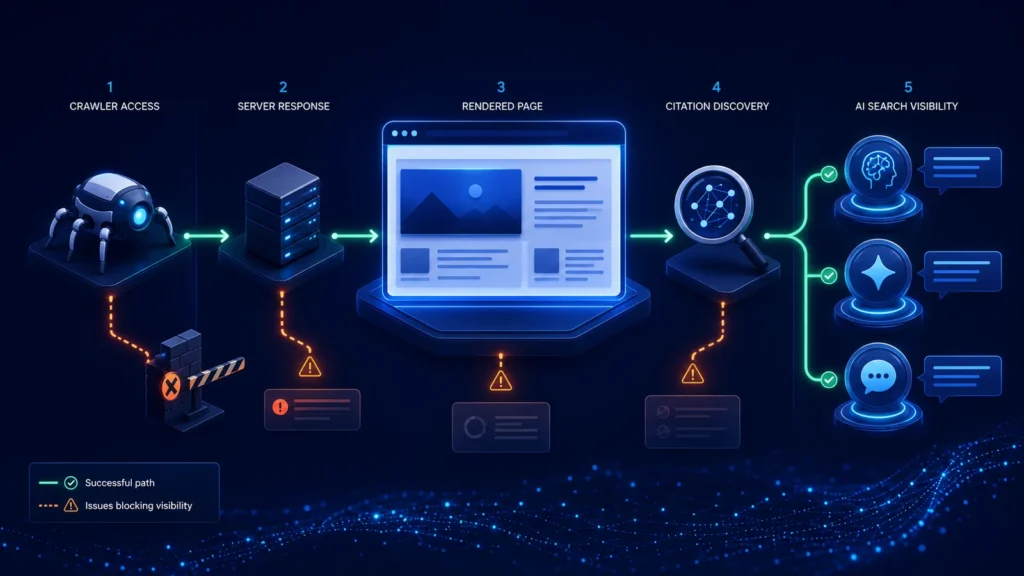
Technical issues affecting AI search visibility are usually not one mysterious “AI SEO” problem. They are failures somewhere along a delivery chain: a system cannot discover the URL, cannot fetch it reliably, cannot see the useful content after rendering, cannot determine what the page is about, or does not select it as a source for a particular answer.
The practical response is to test that chain in order. Start with access and server behaviour, then inspect the HTML an automated system receives, then check index controls and page meaning, and only after those pass evaluate mentions or citations. This guide gives you a repeatable method that works without relying on a proprietary visibility score.
Quick diagnosis of technical issues affecting AI search visibility
| Observed symptom | Most likely layer | First evidence to collect |
|---|---|---|
| Crawler receives 401, 403, 429 or 5xx | Access, security or capacity | Raw HTTP response, response headers and matching CDN/WAF event |
| Browser looks fine but fetched HTML is thin or empty | Rendering or content delivery | Initial HTML, rendered DOM, resource failures and consent state |
| Canonical points elsewhere or page carries noindex | Index control | Final canonical, robots meta and X-Robots-Tag after redirects |
| Only some templates disappear | Template or routing rule | Comparison across homepage, commercial page and article |
| Pages are healthy but answers do not cite them | Discovery, relevance or source selection | Internal links, sitemap, entity evidence and fixed-prompt observations |
Do not begin by changing every robots.txt rule or installing another schema plugin. A broad change can remove useful controls while leaving the actual failure untouched. Reproduce the symptom on a small, representative sample and preserve the evidence before making a change.
A three-layer symptom map
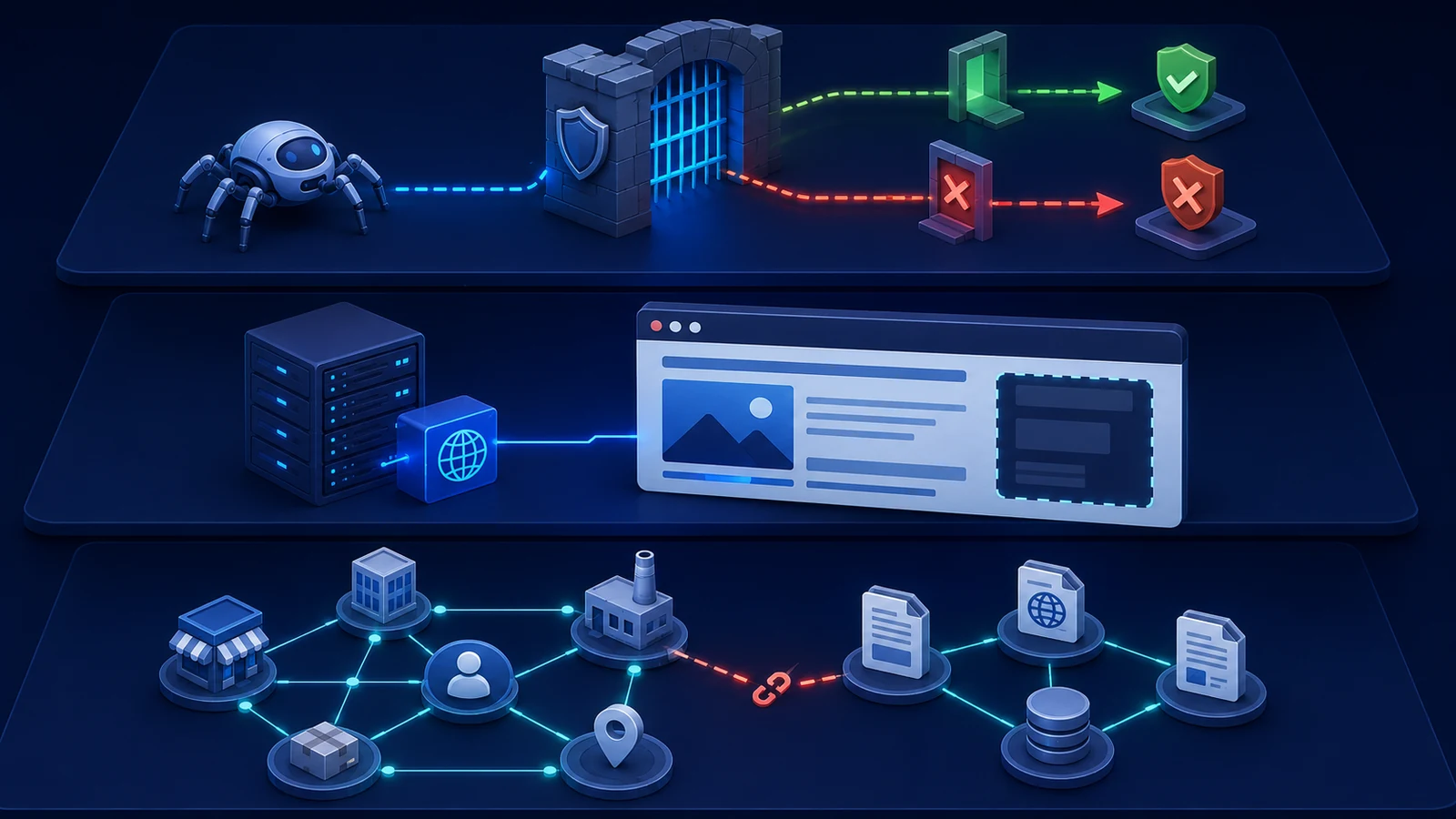
Layer 1: access and transport
At this layer, the requested URL is never delivered normally. Common causes include an accidental robots.txt disallow, password protection, IP or country restrictions, a WAF bot rule, a JavaScript challenge, rate limiting, TLS errors, redirect loops, DNS instability or a server timeout. The result may differ by user agent, IP range, protocol, subdomain or time of day.
Robots.txt is only one control. A crawler can be allowed there and still be blocked downstream by a CDN or security product. Conversely, an ordinary browser request can succeed while a controlled crawler request receives a challenge or a different response.
Layer 2: rendering and index controls
A 200 response is not proof that the main content was delivered. Client-side applications may return a nearly empty shell and load the decisive copy later. Cookie gates, hydration errors, blocked JavaScript, failed APIs and lazy-loaded sections can leave automated systems with a title but little substance.
Index controls add a separate risk. A robots meta directive or X-Robots-Tag can mark a page noindex, a canonical can consolidate it into another URL, and redirects can carry a crawler away from the intended page. Check the final response after every redirect rather than inspecting only the CMS setting.
Layer 3: discovery, meaning and citation eligibility
A technically available page can still be difficult to retrieve or cite. Weak internal linking, orphaned pages, stale sitemaps, ambiguous titles, missing authorship or organisation context, unsupported claims, unclear dates, and content that never answers a narrow question all reduce usable evidence.
Structured data can reinforce meaning when it accurately describes visible content, but it cannot compensate for inaccessible or unhelpful pages. Treat schema as corroboration, not a substitute for clear copy, crawlable links and verifiable sources.
Test 1: reproduce the issue on representative URLs
Choose three URLs that exercise different templates and business purposes:
- Homepage: confirms brand identity, global navigation and the default delivery path.
- Commercial page: tests product or service copy, conversion components and structured business information.
- Knowledge article: tests long-form rendering, author and date signals, citations and related-content links.
For each URL, record the test time, requested URL, final URL, HTTP status, redirect chain, content type, canonical, robots directives, visible title, main heading and whether the central answer appears in both the initial HTML and rendered page. Keep the same URLs throughout the repair so the before-and-after evidence is comparable.
A single successful homepage request cannot clear the whole site. Template rules, edge caching and application routes often fail differently.
Test 2: run the same readiness checks across all three pages
| Check | Pass condition | Failure clue |
|---|---|---|
| Discovery | URL appears in navigation, contextual links or a current sitemap | Orphaned URL or sitemap points to redirected/canonicalised version |
| Crawler policy | Relevant search crawler is not disallowed for the tested path | Broad wildcard or crawler-specific rule blocks the directory |
| Transport | Stable 200 response for the canonical page without an interstitial | 403, 429, 5xx, timeout, challenge or inconsistent redirect |
| Rendered content | Title, H1 and decisive copy are present and readable | Empty app shell, consent overlay, failed API or hidden main copy |
| Index controls | Intended canonical plus compatible robots meta/header | noindex, conflicting directives or canonical to an unrelated URL |
| Meaning | Page identifies subject, organisation, author/date where relevant and evidence | Generic claims, unclear entity relationships or unsupported statements |
| Citation readiness | Claims have direct support and sources are accessible | Circular claims, missing dates, inaccessible references or promotional-only copy |
Use a normal browser request as a control, then use the documented identity for the crawler you are evaluating. Do not assume a user-agent string proves the request is genuine; when a platform publishes IP ranges or verification guidance, compare the source network with that official data. Preserve request and response details without exposing private tokens or visitor information.
Root-cause checks: directives, status, security, delivery and entities
1. Separate search crawlers from training crawlers
Crawler names do not all represent the same purpose. OpenAI documents OAI-SearchBot for surfacing websites in ChatGPT search and GPTBot for content that may be used to improve generative models; the controls are independent. Anthropic and Perplexity also publish bot guidance. Audit the crawler relevant to the visibility goal rather than treating every AI-labelled agent as interchangeable.
2. Read the final HTTP exchange
Capture the status and headers at each redirect hop. Look for authentication, bot-management cookies, cache variations, geo routing, Retry-After values, incorrect content types and X-Robots-Tag. A cached 200 shown to an administrator does not disprove a 403 served at the edge to another request profile.
3. Compare source HTML with rendered output
Search the initial response for the title, main heading, primary explanation, links and structured data. Then compare it with a rendered view. If the information appears only after scripts run, test whether required resources are accessible and whether the application completes without interaction. Server rendering or static generation can reduce dependencies, but the right fix is the smallest stable change that makes essential content available consistently.
4. Audit canonical and index directives together
Inspect the canonical, robots meta and X-Robots-Tag on the final URL. Conflicts often arise when staging rules, faceted-navigation settings or SEO plugin defaults leak into production. Remember that a crawler must access a page to observe a noindex directive; robots.txt and noindex solve different problems.
5. Trace internal discovery
Verify that important pages receive ordinary HTML links from relevant hubs and are represented by their preferred canonical URLs in the sitemap. Avoid relying exclusively on form submissions, JavaScript click handlers or an XML sitemap with no internal context.
6. Strengthen entity and source clarity
State what the organisation does, who is responsible for the content, when factual material was updated and what evidence supports important claims. Use descriptive headings and concise definitions that can stand alone. Link to original sources where possible and keep citations adjacent to the claims they support.
Fixes ordered by impact, effort and risk
| Priority | Typical fix | Impact | Effort | Risk and guardrail |
|---|---|---|---|---|
| Critical | Remove unintended authentication, 403/429 rules, redirect loops or 5xx failures on public canonical pages | Very high | Varies | Limit the rule change to verified public paths; retain security controls elsewhere |
| Critical | Remove accidental noindex or wrong canonical from pages intended for discovery | Very high | Low–medium | Confirm duplicates and staging URLs remain controlled |
| High | Make decisive page content available in stable HTML or reliable rendering | High | Medium–high | Maintain parity between user and crawler-visible content |
| High | Repair internal links and sitemap URLs to preferred destinations | High | Low–medium | Avoid creating crawl traps or linking to parameters |
| Important | Clarify page purpose, entities, authorship, dates and sources | Medium–high | Medium | Do not add markup unsupported by visible content |
| Improvement | Tune caching, resource delivery and monitoring thresholds | Medium | Medium | Measure before changing global cache or bot rules |
Verification: the evidence that proves a technical fix

A fix is verified when the original failure can no longer be reproduced under the same controlled conditions and the intended page state is observable. Record both a technical pass and its scope.
- Repeat the identical URL, request identity, location or network condition and rendering method used for the baseline.
- Capture the redirect chain, final status, headers and response body again.
- Confirm the title, H1 and decisive content are present in the initial or reliably rendered output.
- Recheck canonical and index directives after caches and deployments settle.
- Confirm the WAF or CDN no longer records the request as blocked while unrelated protections remain active.
- Store the timestamp, tool version, screenshots or logs, and a short explanation of the pass condition.
Visibility in an answer engine should be measured separately with a fixed set of prompts, dates, locations where relevant and exact cited URLs. A clean crawl test proves that a barrier was removed; a citation observation shows what happened in a particular retrieval context. Neither alone proves universal visibility.
When the website is healthy but the platform still does not cite it
Source selection is platform-dependent. A system may prefer a page that answers the question more directly, has stronger corroboration, is fresher for the topic, is better connected to known entities or is already present in the platform’s retrieval index. The query may also not require an external citation at all.
When access, rendering and index controls pass, shift from technical repair to content and evidence questions: Does this page provide the best direct answer? Are factual claims specific and supported? Is the organisation clearly connected to the subject? Can the page be discovered from authoritative and relevant pages? Is the information current? Test improvements over a defined window without presenting correlation as proof of causation.
Evidence and screenshots to include in an audit
- A timestamped robots.txt extract for the relevant crawler and path.
- The complete redirect chain with status codes and final content type.
- Response headers showing cache, robots and security behaviour.
- A redacted CDN/WAF event tied to the controlled request.
- Initial HTML and rendered output showing whether decisive content is present.
- Canonical, robots meta and structured data from the final page.
- Internal-link and sitemap evidence for the preferred URL.
- A fixed-prompt observation log that separates mentions, links and citations.
Redact IP addresses, session cookies, authentication tokens, personal data and sensitive security configuration. The evidence should make the finding reproducible without turning the audit into a blueprint for attacking the site.
A common interpretation mistake
The most common mistake is treating conventional rankings—or a single answer-engine mention—as proof that every AI system can discover and use the website. Search products have different crawlers, retrieval systems and controls. A page may rank in Google while a separate search crawler is blocked at the CDN, or it may be fully accessible yet not selected for a specific prompt.
Use a staged conclusion: accessible, delivered, index-control compatible, understandable, and observed in a defined platform test. This prevents a healthy technical result from being oversold as guaranteed citation visibility.
Frequently asked questions
Can robots.txt alone cause AI search visibility problems?
Yes, a relevant disallow rule can prevent a compliant crawler from fetching a path. But robots.txt is not the only access layer. A CDN, WAF, login requirement, rate limit or server failure can still block a crawler that robots.txt allows.
Does allowing GPTBot make a site appear in ChatGPT search?
OpenAI documents separate controls: OAI-SearchBot is used for ChatGPT search visibility, while GPTBot relates to potential model-training use. Audit and configure the agent that matches your goal.
Is a 200 status enough to prove the page is usable?
No. A 200 response can contain an empty application shell, a soft error, a consent wall, the wrong canonical or a noindex directive. Inspect the body, rendered result and page controls as well as the status.
Should I whitelist every AI user agent?
No. Decide which product behaviours you want, use official documentation, scope rules carefully and verify published network information where available. Broad exceptions can create avoidable security and capacity risks.
How long should I wait after fixing a technical issue?
Transport and rendering repairs can be retested immediately after deployment and cache expiry. Recrawling, indexing and visible source selection may take longer and vary by platform. Keep the technical retest separate from the later visibility observation.
Continue your AI search readiness work
Technical diagnosis is strongest when it follows a consistent checklist. Review the AI search readiness checklist for business websites, compare the wider causes in why a website is invisible in AI search, or use the repeatable AI readiness testing method before changing site-wide rules.
Official references
- OpenAI: Overview of OpenAI Crawlers
- Google Search Central: Introduction to robots.txt
- Google Search Central: JavaScript SEO basics
- Google Search Central: Robots meta tag and X-Robots-Tag specifications
- Anthropic: Web crawler guidance for site owners
- Perplexity: Crawler documentation
Reviewed 27 July 2026. Crawler policies and product behaviour can change; verify current official documentation before modifying production controls.