

Learning how to measure brand visibility in ChatGPT starts with a fixed test, not a one-off screenshot. Build a representative prompt panel, run it under documented conditions, record whether your brand is mentioned or cited, and repeat the same test on a fixed cadence. The result is a comparable visibility baseline that shows movement without pretending ChatGPT has a permanent ranking system.
Short answer: Measure five separate outcomes: brand mention rate, owned-domain citation rate, cited URL coverage, mention position and competitor share of voice. Keep branded prompts separate from unbranded discovery prompts, preserve the exact wording and denominator, and record the ChatGPT mode, date, location and login context for every run.
What “how to measure brand visibility in ChatGPT” means in practical terms
Brand visibility in ChatGPT is the observed frequency and context in which a brand appears across a defined set of responses. It is not the same as Google rankings, website traffic or a vendor’s proprietary score. ChatGPT may answer from model knowledge, use web search, show inline citations, or expose sources in a separate panel. OpenAI’s ChatGPT Search documentation confirms that searched answers can include clickable citations and a Sources panel.
A useful measurement therefore separates mentions from citations. If ChatGPT names your company without linking to your website, you earned a mention but not an owned-domain citation. If it cites your page without naming the brand in the prose, you earned source visibility but not a conventional mention. Recording both prevents a single number from hiding important differences.
| Metric | Transparent calculation | What it reveals |
|---|---|---|
| Brand mention rate | Responses naming the brand ÷ valid responses × 100 | How often the brand enters the answer |
| Owned-domain citation rate | Responses citing your domain ÷ valid responses × 100 | How often your site supports an answer |
| Cited URL coverage | Unique owned URLs cited ÷ tracked representative URLs × 100 | Whether visibility extends beyond one page |
| Average mention position | Sum of first-mention positions ÷ responses with a mention | How early the brand appears in lists |
| Competitor share of voice | Your tracked mentions ÷ all tracked brand mentions × 100 | Relative presence in the same prompt set |
Measurement rule: Never combine branded prompts such as “Is Acme reliable?” with unbranded prompts such as “best payroll software for a small agency.” Branded prompts test recognition and reputation; unbranded prompts test discovery. Report the two segments separately.
Step 1 — Establish a clean baseline and choose representative URLs
Start with the business questions that matter. Choose 20–40 prompts across discovery, comparison, problem-solving, product selection and trust. Include buyer language rather than only SEO keywords. For a technical-audit SaaS, examples might include “Why is my website missing from ChatGPT answers?”, “tools for checking AI crawler access” and “AI visibility audit software for agencies.”
Define the market, country and audience for every prompt. Local context matters because OpenAI says search can use approximate location and may rewrite a question into targeted search queries. Keep location services, account state, memory settings and search mode consistent where possible. Record anything you cannot control.
Select five to ten representative URLs that should support those prompts: the homepage, product page, one pillar guide, relevant comparison pages and evidence-rich tutorials. Check that each URL is public, returns a successful response and exposes useful HTML. OpenAI identifies OAI-SearchBot as the crawler used for ChatGPT search inclusion, so crawler access belongs in the baseline.
Step 2 — Use a documented prompt panel and fixed cadence
Version the prompt panel before testing. Give each prompt an ID, intent, funnel stage, target audience, expected brand set and target URL. Run the complete panel on the same day and note the ChatGPT experience used—for example, standard chat with search or another documented mode. Do not switch modes halfway through a batch.
One response per prompt is too fragile for strong conclusions. A practical small-business baseline is 20 prompts repeated three times, creating 60 observations. More repetitions improve stability, but consistency matters more than an impressive sample size. Re-run weekly during an active experiment or monthly for monitoring. Archive the raw response, citations, Sources panel and timestamp.
Step 3 — Inspect the evidence and separate failure layers
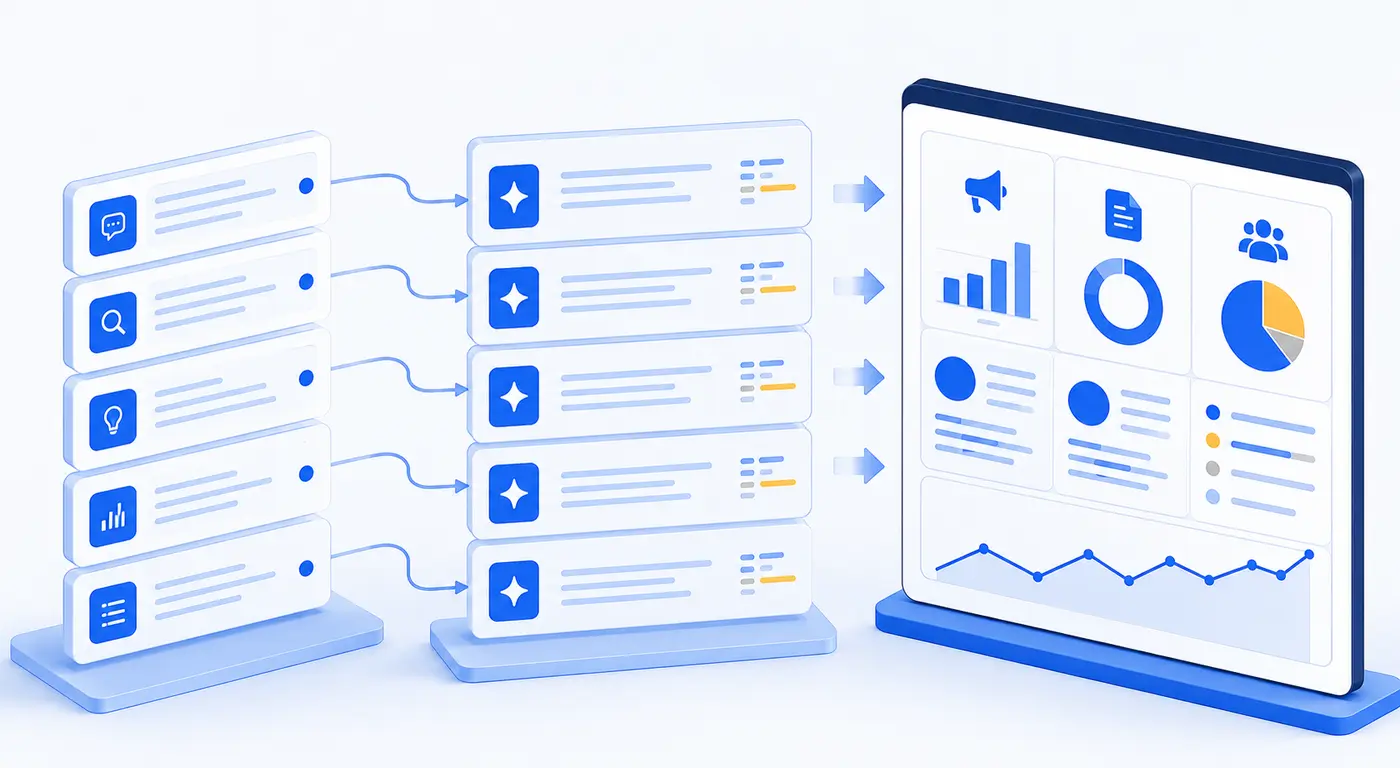
Score each response at the response level first. Record whether the brand appears, whether a tracked competitor appears, the first mention position, descriptive sentiment, whether the owned domain is cited and the exact cited URL. Use “not applicable” instead of zero when a response fails, refuses or does not answer the intended question.
| Failure layer | Evidence to inspect | Do not confuse it with |
|---|---|---|
| Access | robots.txt, OAI-SearchBot allowance, WAF logs, HTTP status | Poor content quality |
| Rendering | Visible HTML, server output, structured page sections | Crawler blocking |
| Content | Direct answer, facts, definitions, proof, clear entity naming | A technical fetch error |
| Retrieval | Prompt relevance, source selection, cited competitors | Permanent ranking position |
| Answer use | Brand wording, citation placement, sentiment, accuracy | Website traffic or conversions |
This separation changes what you fix. A 403 response needs access work. An accessible page whose essential answer exists only after client-side rendering needs a rendering fix. A crawlable page with vague claims may need clearer evidence. A strong page that is not selected for one run may require more repeated observations before any conclusion.
Important limitation: No public metric can prove a universal “ChatGPT rank.” Results can vary by time, model behavior, search activation, location and prompt wording. Treat each report as a dated sample of observable behavior, and keep raw evidence so another analyst can reproduce your calculations.
Step 4 — Apply the smallest safe fix and document the change
Choose one failure with a plausible connection to the outcome. If the site blocks the search crawler, adjust only the relevant robots or security rule and verify access. If a page buries the answer, add a concise definition, evidence table or source-backed comparison while preserving the page’s purpose. If entity naming is inconsistent, make the relationship between company, product and category explicit.
Create a change log with the URL, baseline evidence, implementation date, exact modification and expected pass condition. Avoid rewriting the page, changing internal links, updating metadata and opening crawler access at the same time. Multiple simultaneous changes may improve results, but they destroy your ability to learn which intervention mattered.
Step 5 — Retest with identical inputs and define a pass condition
Allow the agreed observation window, then repeat the original prompt panel with the same wording, mode, location and repetitions. Compare like with like. If the baseline used 60 valid responses, do not compare it with a later 12-response sample without labeling the difference. Preserve both percentages and counts—“citation rate rose from 5% to 15%” is incomplete without “3 of 60 to 9 of 60.”
Define success before viewing the result. For example: owned-domain citations must appear in at least 9 of 60 valid responses, across three or more unique prompts, and the improvement must be visible in two consecutive weekly runs. A predeclared pass condition reduces the temptation to celebrate one favorable answer.
Worked example: inputs, observation, fix and verified result
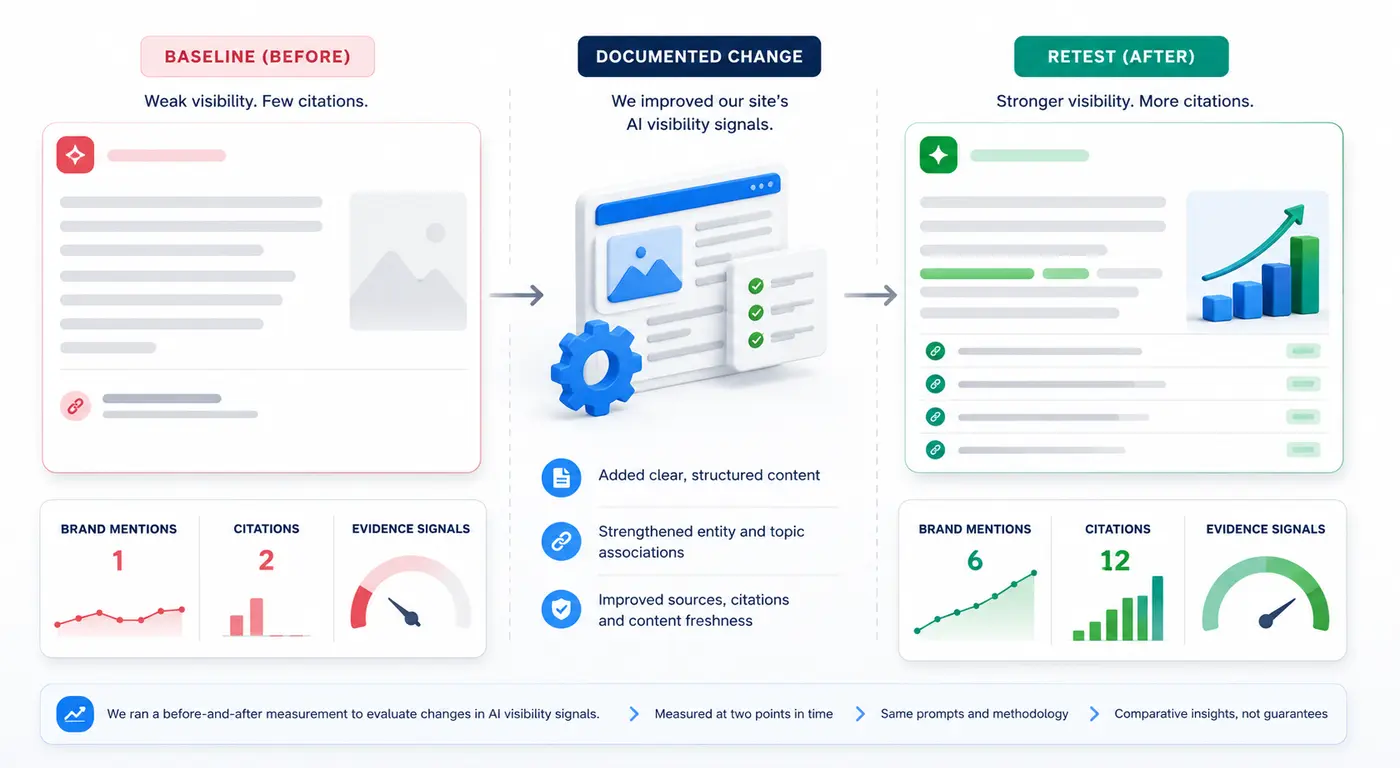
Imagine a fictional analytics brand, Northstar Metrics, testing 20 unbranded buyer prompts three times. The baseline contains 60 valid responses. The brand appears in 6 responses, producing a 10% mention rate. Its domain is cited in 3 responses, producing a 5% citation rate. Two competitors collect 18 and 12 mentions, so Northstar’s share of voice is 6 ÷ 36, or 16.7%.
The audit finds that the best comparison page is crawlable, but its main differentiators are displayed as vague marketing copy. The team changes one section: it adds a visible comparison table, names the product category consistently, cites primary documentation and states which customer profiles each option suits. Nothing else changes during the test window.
After the agreed interval, the same 60-observation test produces 11 mentions and 9 owned-domain citations across four unique prompts. The result passes the predeclared citation condition. The correct conclusion is narrow: visibility improved within this fixed prompt panel after the documented content change. It does not prove that the page will appear for every user or that the table alone caused all improvement.
Evidence and screenshots to include in your report
- The complete prompt panel with version number and prompt IDs.
- ChatGPT mode or model label visible at test time, plus date, timezone and location context.
- Valid-response count and exclusions for every measurement period.
- Mention rate, citation rate, cited URLs, first mention position and sentiment classification.
- Competitor mentions and the exact denominator used for AI share of voice calculation.
- Screenshots or exported transcripts showing the answer, inline citations and Sources panel.
- Access and rendering evidence for representative URLs.
- Change log, observation window, retest results and predeclared pass condition.
Common interpretation mistake: combining incomparable scores
The most common mistake is merging prompts, platforms, modes and vendor scores into one “AI visibility” number. A score built from branded prompts may look high even when the company never appears during unbranded discovery. A tool may count citations, another may count mentions, and a third may weight answer position. Without a shared denominator and formula, those values are not comparable.
Keep a raw measurement layer and a reporting layer. The raw layer stores one row per response. The reporting layer calculates segment-level metrics from documented formulas. If you use a commercial monitoring platform, export the observations and map its definitions to your own framework before comparing periods. For a broader diagnostic process, follow the AI Visibility Audit and Measurement Framework.
Frequently asked questions
How many prompts do I need to measure brand visibility in ChatGPT?
Start with 20–40 representative prompts and repeat them consistently. A smaller, stable panel is more useful than hundreds of poorly defined prompts. Expand only when new audiences, products or buying situations require separate segments.
How often should I run a ChatGPT visibility test?
Run weekly during a controlled optimization experiment and monthly for ongoing monitoring. Use the same cadence for baseline and retest periods, then preserve dated snapshots because platform behavior can change.
Should branded and unbranded prompts use the same score?
No. Branded prompts measure recognition, reputation and factual accuracy. Unbranded prompts measure discovery and competitive presence. Report both, but keep their rates and denominators separate.
Is a ChatGPT mention the same as a citation?
No. A mention is the brand name appearing in the answer. A citation is a linked source supporting the response. Track owned-domain citations, third-party citations about the brand and uncited mentions as different outcomes.
Can better content guarantee more ChatGPT citations?
No. Clear, accessible and evidence-rich content can improve eligibility and usefulness, but source selection also depends on the prompt, relevance, available web results and platform behavior. Use controlled retesting instead of guarantees. The related guide on making website content easy for AI to quote explains how to improve a passage without overstating the result.
Next step — create a repeatable AI visibility baseline
Save your prompt panel, observation fields and formulas before making changes. Then run the baseline, identify the first failed layer, apply one safe fix and retest against a written pass condition. This process turns scattered ChatGPT screenshots into evidence your SEO, content and product teams can actually use.