
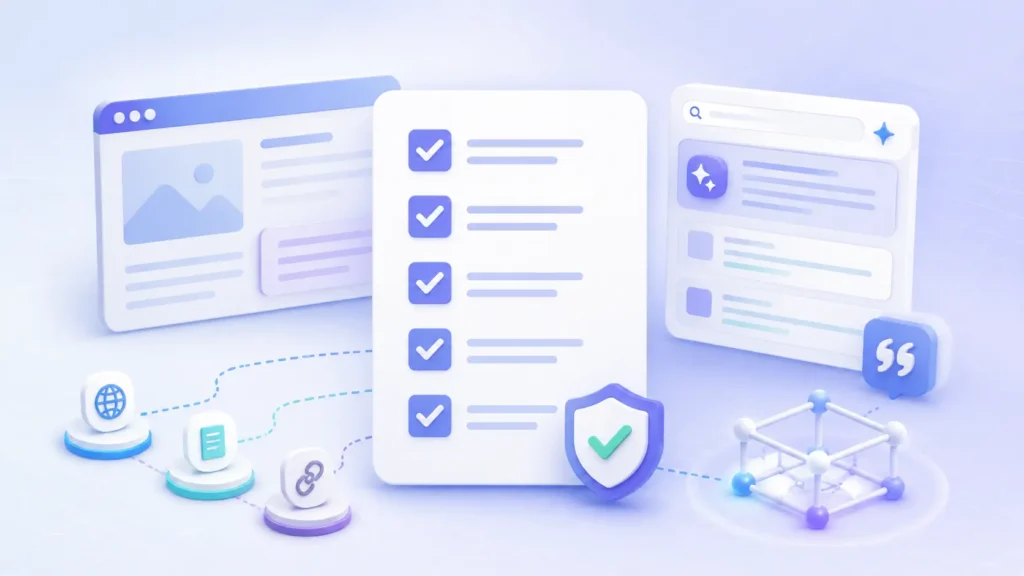
An AI citation optimization checklist should do more than add schema or shorten paragraphs. It should confirm that a page can be discovered, fetched, rendered, understood, trusted, and tested in real AI-search experiences. Use this checklist on a homepage, one commercial page, and one knowledge article so you can compare different templates instead of judging the entire site from a single URL.
Quick answer: AI citation optimization means improving a page’s eligibility and usefulness as a source. It does not guarantee a citation. Start with access and index eligibility, then strengthen factual support, entity clarity, passage completeness, and repeatable testing.
Before you start: gather a clean baseline
Choose three representative canonical URLs and record their current state before changing anything. A useful baseline prevents you from attributing normal platform variation to your optimization work. Save the test date, query or prompt, location, account state, device, cited domains, cited URLs, and a screenshot or exported result.
- Page set: homepage, key service or product page, and one detailed article.
- Access evidence: robots.txt rules, HTTP status, response headers, rendered HTML, canonical tag, and index directives.
- Content evidence: author or organization details, named entities, dates, sources, examples, and original observations.
- Visibility baseline: a fixed set of prompts or queries tested across the same platforms.
- Measurement sheet: pass, warning, fail, evidence URL, owner, and retest date for every check.
Check 1: discovery and crawler access requirements
Citation work cannot help a page that the relevant system cannot retrieve. OpenAI states that OAI-SearchBot is used for ChatGPT search and recommends allowing it in robots.txt and through published IP ranges. Google says pages must satisfy normal Search technical requirements to be eligible for its AI features; there is no separate AI-only technical requirement.
- The canonical URL returns a stable 200 OK response without login, consent wall, CAPTCHA, or JavaScript challenge.
- Robots.txt does not block the search crawler you want to reach the content.
- The page is not excluded by
noindex, anX-Robots-Tag, or a conflicting canonical. - Important URLs are linked internally and included in an accurate XML sitemap.
- Verified crawler requests are not repeatedly returning 403, 429, 5xx, timeouts, or challenge pages.
- Security rules rely on official IP verification or published ranges rather than trusting a spoofable user-agent string.
Do not confuse access with selection: allowing a crawler only makes retrieval possible. It does not prove that a platform indexed the page, considered it relevant, or chose it as a cited source.
Check 2: technical delivery, rendering, and index controls
Fetch both the raw HTML and a rendered browser view. The response body should contain the main title, answer, supporting facts, and important links without requiring a delayed interaction. A 200 status can still deliver an empty application shell, an error message, or a bot challenge.
- The main answer and key facts appear in server-rendered HTML or render reliably with accessible resources.
- JavaScript, CSS, APIs, and fonts needed to understand the page are not blocked or failing.
- The canonical points to the preferred, indexable URL and is consistent with internal links.
- Duplicate versions, faceted URLs, staging pages, and print views do not create conflicting signals.
- Title, description, visible heading, body copy, structured data, and update date describe the same page.
- Images that carry evidence have descriptive alt text and crawlable, permanent URLs.

Check 3: content clarity, entities, and source signals
Once delivery is reliable, make the page easy to interpret accurately. The strongest passages answer a narrow question, identify the subject precisely, include enough context to stand alone, and support claims with evidence. This is good information design; it is not a magic “AI chunking” formula.
Write answer-complete passages
Open each important section with a direct answer, then add explanation, conditions, and proof. Avoid pronouns whose subject is unclear when a passage is read in isolation. Use descriptive headings that match the question answered below them, but keep the prose natural for human readers.
Name entities precisely
State the full names of products, companies, people, standards, locations, and dates when they matter. Keep spellings consistent across the title, copy, author profile, organization page, and relevant structured data. Link to authoritative entity pages when that helps a reader verify identity or meaning.
Support claims and expose provenance
- Link factual claims to primary documentation, original research, or clearly identified first-party data.
- Give statistics a denominator, measurement period, sample source, and method.
- Separate observed facts from interpretation, estimates, and recommendations.
- Show the author, publisher, publication date, and meaningful update date.
- Include examples, screenshots, logs, calculations, or test conditions that readers can inspect.
- Remove unsupported superlatives, invented benchmarks, and claims that promise guaranteed citations.
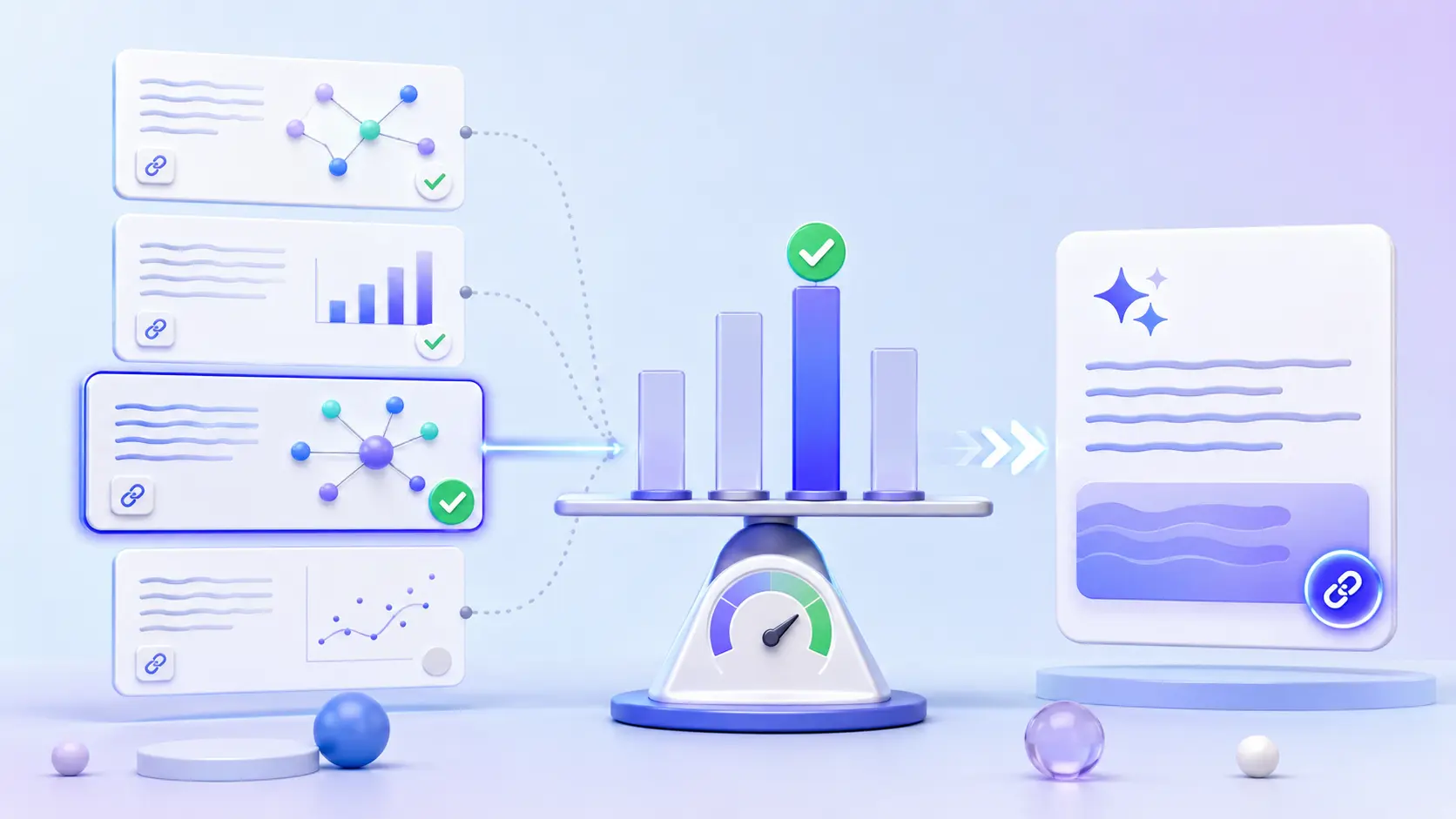
Use structured data accurately, not as a shortcut
Google explains that structured data helps it understand a page and may make content eligible for supported rich results. The markup must match visible content and use the most specific applicable type. However, Google’s current generative-AI guidance says structured data is not required for AI features and no special schema guarantees inclusion. Validate markup, but improve the underlying content first.
Common interpretation mistake: adding FAQ schema, short summaries, or more headings without improving factual support, clarity, and sourceworthiness. Formatting can expose weak content more neatly; it cannot make unsupported claims trustworthy.
Check 4: run a repeatable platform test
AI answers vary by prompt wording, time, location, model, and available web results. One successful citation is not proof of a durable improvement. Use a small fixed protocol and compare patterns over time.
- Create 10 to 20 realistic prompts that cover definitions, comparisons, problem solving, product or service discovery, and follow-up questions.
- Freeze the prompt wording and record the platform, date, location, account state, and whether web search was active.
- Run a baseline before changes and a retest after the page has been recrawled or refreshed.
- Record mention, citation, cited URL, citation accuracy, competitor citations, and whether the cited passage supports the answer.
- Repeat important prompts several times and report the denominator—for example, cited in 3 of 10 runs.
- Inspect referral analytics. OpenAI says ChatGPT search referral URLs include
utm_source=chatgpt.com, which can help separate visits from guesswork.
| Test result | Pass condition | Failure clue |
|---|---|---|
| Access | Correct public HTML returns 200 to the verified crawler | 403, 429, 5xx, challenge, timeout, or empty body |
| Index eligibility | Preferred canonical is indexable and internally discoverable | Noindex, canonical conflict, orphan page, or duplicate confusion |
| Content clarity | Key section gives a direct, contextual, supported answer | Vague subject, missing conditions, or unsupported assertion |
| Entity consistency | Names, roles, dates, and relationships agree across the page | Conflicting names, stale facts, or ambiguous identity |
| Citation outcome | Platform cites the correct URL and passage across repeated tests | Wrong URL, weak passage match, or one unrepeatable result |
Prioritize fixes by impact and risk
| Priority | Examples | Action |
|---|---|---|
| Critical | Blocked crawler, 4xx/5xx, noindex, wrong canonical, empty rendered content | Fix before editing copy; retest the exact response path |
| Important | Unclear answer, unsupported claims, ambiguous entities, missing provenance | Rewrite the affected sections and add verifiable evidence |
| Improvement | Weak internal links, incomplete alt text, generic headings, valid but thin schema | Improve after access, eligibility, and evidence are sound |
Evidence and screenshots to keep
A defensible AI citation audit stores evidence, not only a proprietary score. Keep screenshots of answer outputs and source panels, raw HTML or rendered captures, robots and header checks, structured-data validation, server-log samples for verified crawlers, the exact prompt set, and a change log. For every result, record what changed and what remained constant.
- Answer completeness: the exact passage that answers the target question.
- Named entities: where the person, organization, product, place, or standard is identified.
- Source support: primary links, methodology, dates, sample sizes, and calculations.
- Passage structure: heading, direct answer, context, limitations, and supporting evidence.
- Citation outcomes: platform, prompt, cited URL, run count, date, and accuracy.
- Competitor mentions: which sources recur and what evidence or coverage they provide that your page lacks.
Success condition: the page is publicly retrievable, technically eligible, clear about its subject, supported by inspectable evidence, and tested with a repeatable method. A citation is an outcome to measure—not a switch you can turn on.
Frequently asked questions
What is AI citation optimization?
AI citation optimization is the process of making web content easier to discover, retrieve, interpret, verify, and select as a source in AI-assisted search. It combines technical access, conventional search eligibility, content clarity, entity consistency, evidence quality, and outcome measurement.
Can schema markup guarantee an AI citation?
No. Accurate structured data can help search engines understand content and support eligible rich results, but no official guidance says a schema type guarantees an AI citation. Mark up visible facts accurately and treat schema as supporting metadata.
How often should citation tests be repeated?
Retest after meaningful content or technical changes and after the page has had time to be recrawled. For important commercial topics, a monthly fixed-prompt check can reveal trends. Keep the same prompts and conditions where possible, and report variability rather than hiding it.
Should every paragraph be written as a standalone answer?
No. Important passages should be understandable with limited surrounding context, but forcing every paragraph into a rigid template can make the article repetitive. Use clear headings, direct answers, definitions, evidence, and logical transitions for readers first.
What should I fix first if a page is never cited?
Start with access, response status, rendering, index eligibility, canonicalization, and internal discovery. If those pass, compare the page’s factual depth, freshness, entity clarity, and source support with pages that are cited. Change one layer at a time and retest.
Next step: turn the checklist into an evidence-led audit
Use the How to Make Website Content Citable by AI guide for the full strategy, then review structured data for AI search citations without treating schema as a guarantee. Apply this AI citation optimization checklist to three representative URLs, save the baseline, fix critical failures first, and repeat the same test set.