
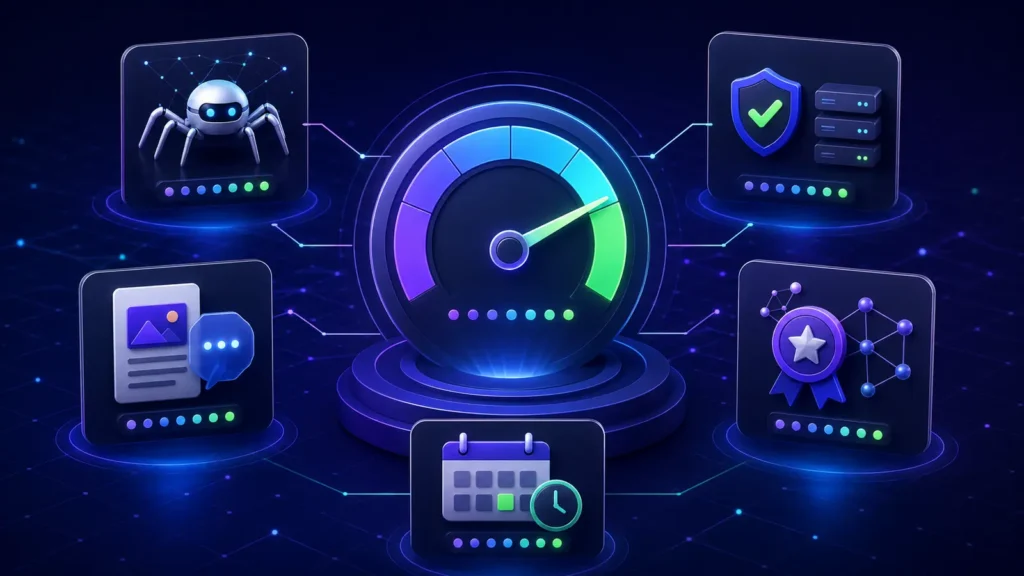
An AI search readiness score is a diagnostic summary of how easily AI crawlers and answer engines can access, process, understand, and potentially use a website. It is not a prediction of whether ChatGPT, Gemini, Claude, or Perplexity will mention your brand. A useful score turns technical and content evidence into priorities; a weak score merely compresses uncertain signals into an impressive-looking number.
AI search readiness score explained: the short answer
A readiness score should answer one practical question: what could prevent this website from being discovered, understood, or selected as a source by AI systems? It combines evidence for crawler access, technical delivery, content clarity, authority, and freshness. Treat it as website-health triage—not a promise that an AI platform will cite the site.
What an AI search readiness score can measure reliably
The strongest inputs are reproducible. Two people running the same test against the same URL at roughly the same time should reach the same conclusion. These checks create an evidence-based baseline:
- Crawler accessibility: robots.txt rules, page-level robots directives, authentication barriers, and relevant bot permissions.
- HTTP delivery: status codes, redirect chains, timeouts, rate limiting, CDN challenges, and WAF blocks.
- Rendered content: whether essential copy and links exist in the delivered HTML or become available after dependable rendering.
- Machine-readable structure: canonical signals, titles, headings, schema markup, semantic relationships, and internal links.
- Content clarity: identifiable authorship, dates, entities, sources, concise answers, and claims supported by evidence.
- Freshness and consistency: current information, stable facts across pages, and visible update practices.
For a broader preparation workflow, use the complete AI search readiness guide. These checks complement—not replace—the crawlability, indexing, content, and authority work in a conventional SEO program.
What remains platform-dependent
No external audit can see every system behind an AI answer. Model training data, retrieval indexes, query rewriting, source selection, personalization, geography, licensing arrangements, and live-web access can all change the response. A platform may also retrieve a healthy page but choose another source because it better matches the question or carries stronger evidence.
Important limitation: Readiness is not visibility, and visibility is not attribution. A technically healthy site can remain uncited for a competitive topic. A cited site can also have weaknesses because a platform encountered it through another source, an older crawl, or a licensed dataset.
A practical five-part scoring model

A transparent score should show its components rather than hide them behind one proprietary number. The following model is a sensible way to organize evidence. Weighting can change by site type, but critical access failures should cap the overall result because excellent content cannot compensate for an unreadable page.
| Score area | Example weight | What a low subscore usually means |
|---|---|---|
| Crawler access | 25% | Robots rules, authentication, bot protection, or server controls restrict retrieval. |
| Technical delivery | 20% | Errors, redirects, slow responses, or rendering dependencies hide essential content. |
| Content clarity | 25% | The page lacks a direct answer, clear entities, useful structure, or supporting evidence. |
| Authority and citations | 20% | Claims are weakly sourced or the site has limited corroboration and recognition. |
| Freshness and consistency | 10% | Information is stale, conflicting, undated, or poorly maintained. |
The exact weights are less important than the rules behind them. A score is credible when every deduction links to a URL, observation, severity, and recommended retest. It should also distinguish a failed test from an inconclusive one.
Practical examples with contrasting site conditions
Example 1: strong content, blocked access
A research article has named authors, original data, citations, descriptive headings, and relevant schema. However, a CDN challenge returns a 403 response to automated clients. Its content quality may be excellent, but readiness should remain low because retrieval fails before the content can be evaluated.
Example 2: accessible page, weak information value
A product page returns 200, loads quickly, and contains clean HTML. Yet it uses vague marketing language, does not explain who the product is for, offers no verifiable specifications, and has few internal or external references. Access is healthy; usefulness and citability are not.
Example 3: healthy site, inconsistent platform visibility
A knowledge hub passes access, rendering, structure, and clarity checks. It appears for some research prompts but not others. This does not automatically expose an audit error. Query intent, competition, platform coverage, source diversity, and model behavior can explain the variation.
A simple diagnostic you can run today
Choose three representative URLs: your homepage, one commercial page, and one knowledge article. Use the same pages throughout the test so the before-and-after comparison remains meaningful.
- Check access. Review robots.txt, meta robots, canonical tags, HTTP status, redirects, and any bot protection affecting automated requests.
- Inspect delivery. Compare the initial HTML with the rendered page. Confirm that the primary answer, entity names, headings, and internal links are available.
- Evaluate clarity. Ask whether a reader can identify the page topic, publisher, author, date, main claim, evidence, and next step without guessing.
- Test representative prompts. Record the platform, date, prompt, response, cited sources, and whether your page appeared. Keep prompts fixed for later comparisons.
- Fix and retest. Prioritize access failures first, then delivery, clarity, evidence, and authority gaps. Repeat the identical checks and save proof.
If you need a more structured starting point, follow the AI search readiness checklist for business websites.
How to interpret the result without overclaiming causation
Read the overall number only after reviewing the failed checks. A move from 58 to 82 can show that observable barriers were removed; it cannot by itself prove that the change caused more AI citations. To investigate causation, preserve a baseline, record implementation dates, control your test prompts, compare similar periods, and note other changes such as new backlinks, updated content, or platform releases.
Use score bands as communication aids, not scientific laws. For example, 0–39 may indicate critical blockers, 40–69 substantial gaps, 70–84 a solid foundation with improvements available, and 85–100 few detected readiness problems. The evidence matters more than the label.
Best interpretation rule: Use the score to decide what to inspect next—not to declare that an AI platform will rank or cite the site. A good audit leaves you with testable fixes and a repeatable verification method.
Common mistakes when reading readiness scores
- Treating one aggregate score as more important than a critical failed check.
- Confusing conventional Google rankings with evidence that an AI system can retrieve and use the page.
- Assuming every AI crawler, training crawler, retrieval bot, and user-triggered fetch behaves the same way.
- Changing prompts between tests and calling the results a trend.
- Ignoring test dates, geographic differences, authentication state, and platform updates.
- Optimizing for the score while weakening user experience or publishing unsupported claims.
Frequently asked questions
What is a good AI search readiness score?
A good score indicates that no major access, delivery, or content-understanding barriers were detected. The threshold depends on the methodology, so compare subscores and evidence instead of assuming that 80 from one tool equals 80 from another.
Does a high score guarantee ChatGPT citations?
No. It improves the conditions under which a page can be discovered and understood, but source selection depends on the prompt, platform, retrieval coverage, relevance, authority, freshness, and competing sources.
How often should I check my score?
Retest after significant releases, migrations, CDN or firewall changes, template updates, and important content revisions. For active sites, a monthly baseline plus post-change checks is usually more useful than daily score watching.
Can I calculate a readiness score manually?
Yes. Define the checks, weights, pass conditions, caps for critical failures, and rules for inconclusive results. Record every observation. Manual scoring takes longer but forces transparency and can expose weaknesses hidden by a single automated number.
Is AI search readiness different from SEO?
It overlaps heavily with technical SEO and content quality, then adds platform-specific access, retrieval, citability, entity clarity, and fixed-prompt measurement. The best approach combines both rather than replacing established SEO fundamentals.
Check your website’s AI discoverability.
Visible Pilot is being built to identify technical, content, SEO, and AI-search issues that can prevent websites from being discovered, understood, and recommended. Explore the AI search readiness guide, document your baseline, and prioritize evidence-backed fixes.