

ChatGPT vs Perplexity website discovery is not a contest with one universal winner. Both can surface and cite public web pages, but they use different search systems, crawler identities and answer-selection processes. For a website owner, the practical decision is not which platform is “better.” It is how to make important pages technically accessible, test each platform consistently and measure discovery without confusing one favorable answer with permanent visibility.
Short answer: optimize and test both. Allow the relevant search crawlers, deliver useful HTML without security challenges, connect important pages through internal links and sitemaps, and publish clear evidence that matches real questions. Then track four separate outcomes—found, mentioned, cited and successfully retrieved—because each proves something different.
ChatGPT vs Perplexity website discovery: the meaningful difference
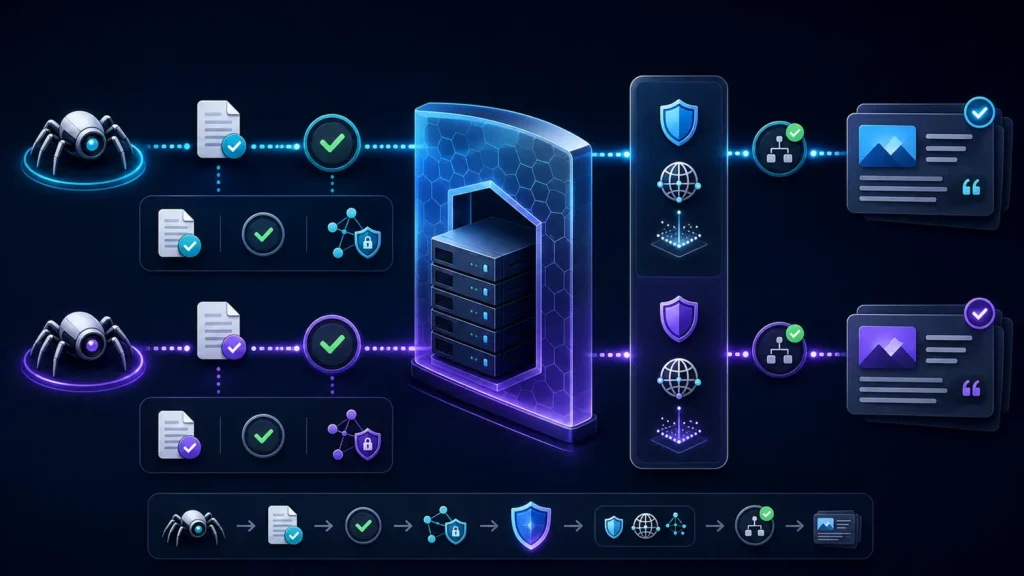
ChatGPT search can search the web and return linked sources. OpenAI identifies OAI-SearchBot as the crawler associated with search discovery, while ChatGPT-User supports certain user-triggered visits. Perplexity identifies PerplexityBot as the crawler intended to surface and link sites in its search results, while Perplexity-User supports user actions that may fetch a page for an answer.
That distinction matters because a direct URL can open during a user request even when automatic discovery is weak or blocked. Conversely, a crawler may fetch a page successfully without that page being selected as a citation for your test question. Technical access is an eligibility layer, not a promise of visibility.
Decision rule: use ChatGPT and Perplexity as separate measurement channels. Do not infer one platform’s access, index state or citation behavior from the other platform’s result.
Definitions and boundaries
ChatGPT website discovery
For publishers, the relevant search control is OAI-SearchBot. OpenAI’s publisher guidance says sites that allow it can appear in ChatGPT search answers and can track referrals that include utm_source=chatgpt.com. GPTBot is a separate control for potential model training; allowing or blocking GPTBot does not substitute for an OAI-SearchBot decision.
ChatGPT-User is different again. It may visit a page because a user asked ChatGPT to open or work with that URL. A successful visit is useful evidence that the page can be retrieved in that situation, but it does not establish automatic search discovery.
Perplexity website discovery
Perplexity’s official crawler documentation says PerplexityBot is designed to surface and link websites in Perplexity search results and is not used to crawl content for foundation-model training. Perplexity-User supports user-triggered requests and is not the automatic web crawler. The company publishes separate IP ranges for each identity.
Neither system exposes a publisher-facing, complete index report comparable to a list of every eligible URL. That means testing should combine infrastructure evidence, analytics and repeatable prompt observations rather than relying on a single answer screen.
Side-by-side comparison
| Dimension | ChatGPT | Perplexity |
|---|---|---|
| Search crawler | OAI-SearchBot | PerplexityBot |
| User-triggered retrieval | ChatGPT-User | Perplexity-User |
| Training control | GPTBot is controlled separately | Perplexity says PerplexityBot and Perplexity-User are not training crawlers |
| Publisher evidence | Server/CDN logs, ChatGPT referral URLs, cited pages, repeat prompt tests | Server/CDN logs, cited pages, published crawler IP ranges, repeat prompt tests |
| Best interpretation | Access enables consideration; it does not guarantee a citation | Access enables consideration; it does not guarantee a citation |
| Cost to be crawlable | No platform fee; implementation and monitoring effort may apply | No platform fee; implementation and monitoring effort may apply |
| Main limitation | Results vary with query, source mix and session context | Results vary with query, source mix and session context |
Discovery and access implications
Start at the delivery layer. For each representative page, confirm the relevant crawler is not disallowed in robots.txt, the final response is a useful 200 HTML page, and the request is not replaced by a CAPTCHA, cookie wall, login form or JavaScript challenge. Inspect CDN, WAF and origin logs because the robots file cannot reveal downstream blocking.
Keep crawler controls explicit when your policy requires different treatment. A simple example might allow search discovery while independently restricting training:
User-agent: OAI-SearchBot
Allow: /

User-agent: PerplexityBot
Allow: /

User-agent: GPTBot
Disallow: /
Security note: a crawler name in a user-agent header is not authentication. Anyone can copy it. Use a controlled user-agent request to reveal how your infrastructure behaves, but verify genuine traffic with the source IP captured in trusted logs and the platform’s current official IP ranges.
Measurement, evidence quality and repeatability
A reliable comparison needs stable inputs. Select a small group of URLs: the homepage, a commercial page, a recent knowledge article and an older deep page. For each platform, run the same prompt set in fresh sessions at the same interval. Record the date, exact prompt, whether web search was active, answer text, cited URLs and whether a direct URL request succeeded.
| Outcome | What it proves | What it does not prove |
|---|---|---|
| Found | The platform identified the site or page for that test | That every important URL is discoverable |
| Mentioned | The brand or source influenced the answer or was named | That the tested page was fetched or cited |
| Cited | A URL was selected as a source for that answer | Permanent ranking or repeat selection |
| Retrieved | A user-triggered request opened the page | Automatic search-crawler access or citation eligibility |
| Crawler 200 in logs | The verified crawler received the page successfully | That the content was understood or chosen |
Run enough repetitions to spot a pattern. Five fixed prompts repeated weekly for four weeks create a more useful baseline than fifty improvised prompts on one afternoon. Keep the prompt wording and target URL list unchanged, then annotate technical or content changes so an improvement is not assigned to the wrong cause.
Best choice by scenario
| Scenario | Prioritize first | Why |
|---|---|---|
| New website | Both platforms plus conventional indexing hygiene | Early evidence is sparse; broad accessibility prevents avoidable blind spots |
| Suspected technical block | Verified crawler access and logs | Prompt testing cannot diagnose a WAF or robots failure by itself |
| Strong rankings but few AI citations | Query fit, original evidence and answer clarity | The site may be accessible but not selected as the best source |
| Brand monitoring | Both with a fixed prompt matrix | Their answers and source selection can differ |
| Incident response | The platform showing the symptom, then cross-check the other | This isolates platform-specific behavior from a site-wide failure |
| Ongoing reporting | Separate dashboards, shared definitions | Combining results hides which system actually changed |
Combined workflow: when both should work together
- Choose representative URLs. Include the homepage, one revenue page and at least two useful articles.
- Verify delivery. Check robots rules, redirects, final status, rendered main content, canonical and index controls.
- Authenticate crawler evidence. Match logged source IPs against each operator’s current published ranges.
- Run fixed prompts. Use brand, category, problem and exact-page questions in fresh sessions.
- Classify the result. Mark found, mentioned, cited and retrieved separately.
- Make one controlled change. Fix the highest-confidence access or content gap without changing everything at once.
- Retest on schedule. Compare the same pages and prompts, preserving screenshots and logs.
Healthy pass condition: each important URL returns useful HTML to verified search-crawler traffic, shows no conflicting index controls, is internally discoverable, and can be retrieved directly. Citation frequency should be reported as an observed rate across a defined prompt sample—not as a guaranteed ranking.
Test ChatGPT vs Perplexity website discovery yourself
Create a matrix with four prompt types. Use a navigational query for your brand, a category query describing the service, a narrow problem solved by a specific article and an exact-URL request. Repeat every test in a fresh session and avoid follow-up wording that supplies the answer or domain name unless that is the test’s stated purpose.
| Prompt type | Example structure | Record |
|---|---|---|
| Navigational | What is [brand] and what does it offer? | Found, mentioned, cited domains |
| Category | Which tools help with [specific task]? | Rank/order is less important than source selection |
| Problem | Why does [narrow symptom] happen? | Whether the most relevant article is cited |
| Exact URL | Open and summarize [URL] | Retrieval success, final URL and content accuracy |
If the direct URL opens but category and problem prompts never surface the site, focus on discovery, topical relevance and source quality. If neither platform can retrieve the page and trusted logs show 403 or challenge responses, fix access first. If one platform works and the other fails on the same URL, compare crawler-specific rules, IP verification and security events before rewriting content.
Evidence to capture
Save dated screenshots of answers and citations, but pair them with stronger machine evidence: the requested URL, final response code, redirect chain, response headers, robots rule evaluated, CDN/WAF event, source IP, verified IP-range match and analytics referral. Also record publication and update dates, canonical URLs, sitemap membership and the internal page linking to the target.
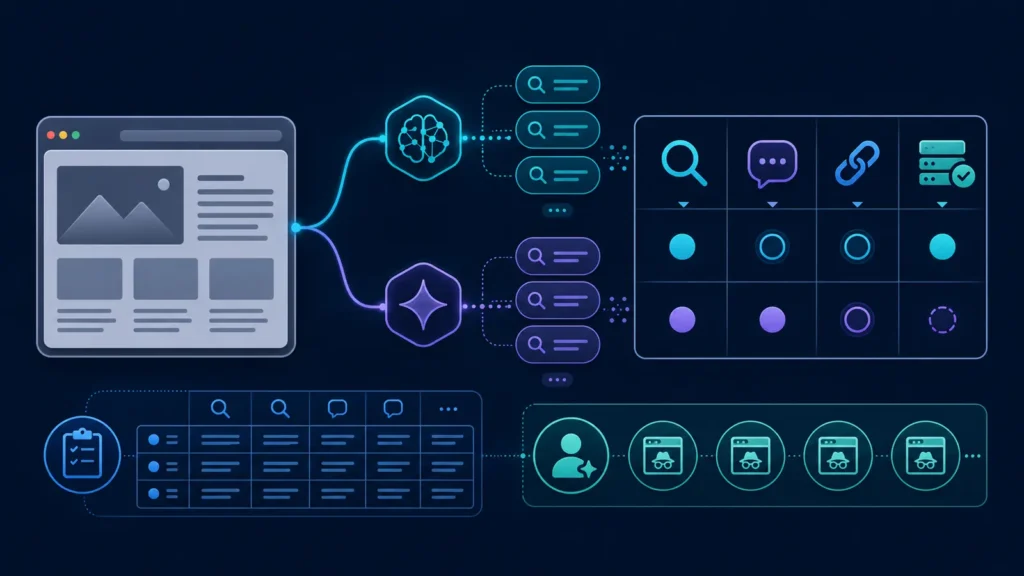
This evidence separates a platform observation from a root cause. A missing citation could be ordinary source selection; a verified crawler receiving a 403 is a technical fact. Treat those with different confidence levels.
Common mistakes
- Treating a single answer as a stable index. AI answers vary; use a defined sample and schedule.
- Testing only the homepage. Directory rules and templates often behave differently on deep pages.
- Confusing user retrieval with automatic discovery. The user-triggered agents and search crawlers have different roles.
- Trusting a copied user-agent. Authenticate genuine traffic using trusted logs and official IP data.
- Assuming access guarantees citation. Relevance, originality, freshness and answer fit still affect selection.
- Changing technical and content variables together. Make the smallest safe change so the result remains interpretable.
Frequently asked questions
Is ChatGPT better than Perplexity for website discovery?
Not universally. Both can discover and cite web pages, but their search systems and source selection differ. Measure the prompts and audiences that matter to your business on both platforms.
Should I allow OAI-SearchBot and PerplexityBot?
If you want eligible public pages to be available for their search experiences, their official publisher guidance recommends allowing the relevant search crawler. Apply the decision only to content you intend to expose, and keep security controls narrow and verified.
Does blocking GPTBot remove my site from ChatGPT search?
GPTBot is the training crawler, while OAI-SearchBot is the search-discovery crawler. OpenAI documents them as separate controls, so define each policy independently.
Why does Perplexity cite my page while ChatGPT does not?
The difference may come from access rules, source availability, query interpretation, freshness or answer composition. Compare verified crawler access and repeat the same prompt sample before concluding that one platform has permanently indexed or excluded the page.
How often should I retest?
Weekly testing is usually enough for a new baseline or active fix; monthly testing is more practical for steady monitoring. Use the same URLs, prompts and evidence fields each time.
Official references
Next step: check your website’s AI discoverability
Use the same evidence-led process across both platforms, then work through the AI search readiness checklist for business websites and the AI search indexing problems guide. The goal is not to manufacture a one-off citation; it is to remove access barriers, publish useful source material and build a repeatable record of how each platform discovers your site.
Final takeaway: ChatGPT vs Perplexity website discovery should be measured independently with shared definitions. Make important pages accessible, verify real crawler traffic, test fixed prompts and distinguish being found from being cited. That produces evidence you can improve—without pretending either platform offers guaranteed placement.