

A fixing Cloudflare 403 for AI crawlers case study should begin with evidence, not a blanket allow rule. In this reproducible worked scenario, a public knowledge site loaded normally for people and traditional browsers, yet legitimate AI search crawler requests received 403 Forbidden at Cloudflare’s edge. The intervention restored access to approved public pages while leaving login, account, API, and abusive traffic protections in place. The measurements below are illustrative so you can copy the method without mistaking a model scenario for a named client result.
Outcome in one sentence: identify the exact Cloudflare control returning 403, verify crawler identity beyond the user-agent string, make a narrow path-based exception, and confirm success in edge logs before assuming AI visibility will improve.
Baseline: capture the 403 before changing Cloudflare
The site’s homepage, product page, and two educational articles returned HTTP 200 to ordinary browsers. A test using a crawler-style user agent returned 403, but that alone did not prove a real crawler was blocked because user-agent strings can be copied. The baseline therefore combined four evidence sources: Cloudflare Security Events, the response headers and Ray ID, origin access logs, and a verified request source. We also archived robots.txt, page-level robots directives, canonical tags, raw HTML, and the rendered DOM.
The key distinction was location. The origin server showed no matching request, while Cloudflare recorded a terminating security action. That meant the failure happened at the edge, before WordPress or the application could respond. A robots.txt allowance could not solve this layer: robots.txt communicates crawl preference, while a WAF or bot-control rule can still deny the network request. OpenAI’s current crawler guidance likewise tells publishers seeking ChatGPT search inclusion to allow OAI-SearchBot and requests from its published IP ranges.
Diagnosis: why the first hypothesis was incomplete
The initial hypothesis blamed a custom WAF expression. The event trail showed a broader interaction: an automated-traffic setting acted on the request before a later exception could help. Cloudflare documents that custom rules run before Super Bot Fight Mode, and that terminating actions stop later processing. Cloudflare also offers a separate “Block AI bots” control and AI Crawl Control actions, so the same 403 symptom can originate from several settings.
We checked the Security Events rule name, action, ruleset, timestamp, host, path, source, bot classification, and Ray ID. We then inspected AI Crawl Control, bot settings, custom WAF rules, rate limiting, Workers, and origin security. Cloudflare’s verified-bot model is important here: verification may rely on cryptographic Web Bot Auth, a published IP list paired with a stable user agent, or reverse DNS. A rule that trusts only text in the user-agent header can allow spoofed traffic.
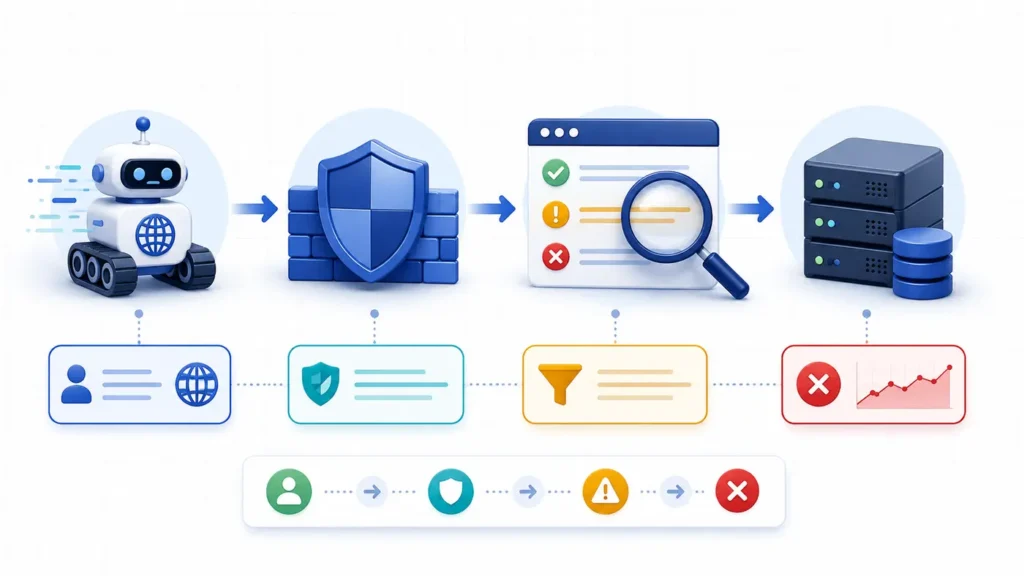
Safety rule: do not globally “skip security” for every request containing an AI crawler name. Verify identity using the controls available on your Cloudflare plan, limit access to intended public paths, and preserve rate limiting plus protection for sensitive endpoints.
Intervention plan: the smallest safe fix
The fix separated search discovery from training and generic automation. The site owner chose to allow a verified AI search crawler on public editorial and commercial pages, while retaining the existing policy for training crawlers. Cloudflare’s AI Crawl Control supports per-crawler allow or block decisions, and advanced WAF rules can add path-specific exceptions. Because available bot fields vary by plan, the exact expression should be built from the verified identity and detection options shown in that zone rather than copied blindly from another account.
- Create a test rule in logging mode, where available, and match the approved verified crawler identity plus only public paths.
- Exclude
/wp-login.php, account areas, checkout, search endpoints, admin paths, APIs, preview URLs, and query patterns that can generate unbounded pages. - Place the exception before the terminating rule that produced the 403, then skip only the required security component—not every WAF control.
- Keep rate limits, anomaly detection, origin authentication, and malicious-bot blocking active.
- Confirm that
robots.txtexpresses the intended policy separately for search, training, and other crawler purposes.
Implementation timeline
- Day 0: archive rules, settings, logs, representative responses, and a list of test URLs.
- Day 1: reproduce the 403, identify the terminating Cloudflare control, and validate crawler identity.
- Day 2: deploy the narrow exception to one low-risk path and monitor false positives.
- Days 3–7: extend to approved public paths, review edge and origin logs, and verify that blocked traffic stays blocked.
- Days 8–28: observe crawl activity, discovery, citations, and referrals as separate outcomes.
Measurement method for fixing Cloudflare 403 for AI crawlers
Use the same URLs, request classes, and observation windows before and after the change. Record absolute request counts by status code at the Cloudflare edge and origin. Confirm that successful verified requests reach the origin and receive useful HTML—not a blank shell, challenge page, or JavaScript-only placeholder. Test cache behavior, response time, canonical headers, and robots directives. For AI visibility, keep a fixed prompt set and record mentions, links, and citations, but do not treat a successful fetch as proof of indexing or recommendation.
Results: before-and-after worked example
The table demonstrates how a careful report should look. These figures are illustrative and are not a Visible Pilot customer claim. The denominator matters: “access improved” is meaningful only when readers can see how many verified requests were tested and whether security outcomes deteriorated.
| Measurement | Baseline | After fix | Interpretation |
|---|---|---|---|
| Verified crawler requests returning 200 | 0 of 24 | 23 of 24 | Public-page access restored; one rate-limited request retained |
| Verified crawler requests returning 403 | 24 of 24 | 0 of 24 | Targeted edge block removed |
| Origin requests containing useful HTML | 0 of 24 | 23 of 24 | Delivery verified beyond the edge |
| Malicious test requests blocked | 18 of 18 | 18 of 18 | Security control remained effective |
| Prompt-set citations to the site | 1 of 30 | 3 of 30 | Positive observation; too small to prove causation |
What likely caused the improvement—and what cannot be proven
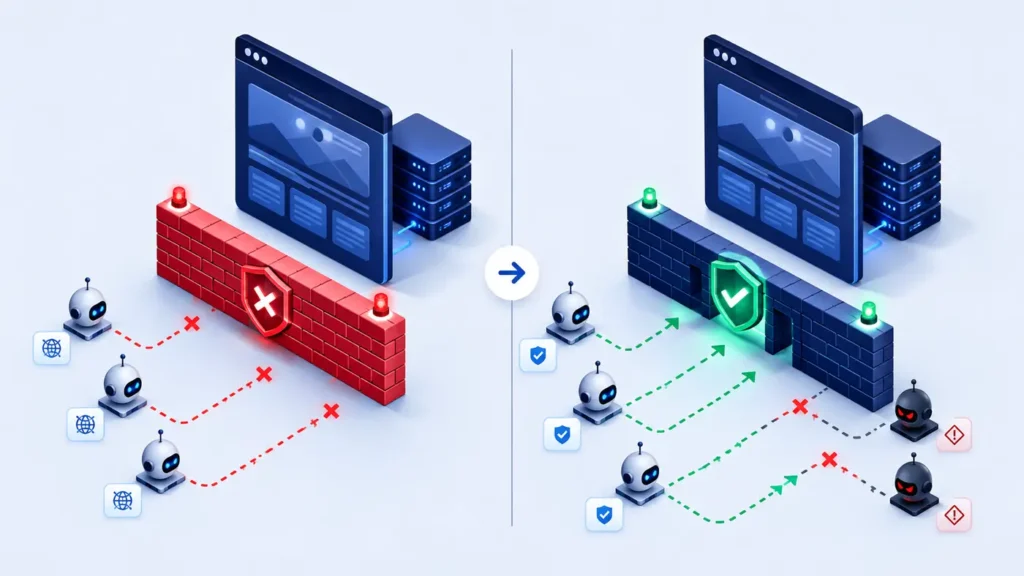
The disappearance of edge 403 responses is directly attributable to the rule change because the same verified request class, URLs, and test procedure produced a different logged action after deployment. Useful HTML reaching the origin is also demonstrable. Any later increase in mentions or citations is less certain. Retrieval indexes may refresh, models may change, competitors may publish, and third-party sources may influence an answer. The fix removed an access barrier; it did not guarantee selection, ranking, or citation.
Transferable lesson: treat crawler access as a prerequisite. A 200 response creates the opportunity to discover and use a page, but the page still needs clear entities, direct answers, credible evidence, stable URLs, and independent authority.
Lessons readers can transfer to another website
First, reproduce the response outside a full browser. Browsers can pass JavaScript checks and retain cookies that crawlers do not have. Second, use the Ray ID and Security Events rather than guessing which product fired. Third, distinguish search crawlers from training crawlers and user-triggered agents; one policy rarely fits every purpose. Fourth, prefer verified identity and narrow public-path scope over user-agent matching. Finally, change one major control at a time so rollback and causality remain clear.
If pages still fail after the edge returns 200, continue down the delivery chain. Inspect the origin status, raw HTML, canonical and noindex directives, redirects, content negotiation, cache variants, and JavaScript rendering. Visible Pilot’s guide to technical architecture for AI search visibility provides the broader framework, while the companion article on JavaScript rendering issues for AI crawlers covers empty or incomplete HTML.
Evidence and screenshots to preserve
- Cloudflare Security Events showing the rule, action, request path, timestamp, and Ray ID
- Raw response headers and bodies for the same representative URLs before and after
- Cloudflare and origin logs showing whether each request reached the application
- Bot or crawler verification evidence, not only the claimed user-agent string
- Robots.txt, canonical, noindex, rendered DOM, cache status, and response-time captures
- A dated change log plus rollback instructions for every modified rule
Common interpretation mistake
The most common mistake is testing only in a normal browser and concluding that crawlers can access the same content. The opposite mistake is allowing every request that claims a familiar crawler name. A professional fix proves both sides: legitimate, verified requests receive the intended public content, and spoofed, malicious, sensitive-path, or excessive traffic still meets appropriate security controls.
Frequently asked questions
Why does Cloudflare return 403 to an AI crawler?
Possible causes include AI Crawl Control, the “Block AI bots” setting, a custom WAF rule, bot protection, rate limiting, a Worker, or an origin rule. Filter Cloudflare Security Events by timestamp, host, path, status, and Ray ID to find the terminating action before editing anything.
Should I allow every AI crawler?
No. Decide what value each crawler behavior provides. You may allow a search crawler used for citations while restricting training crawlers or unknown automation. Apply your policy consistently in robots.txt and at the enforcement layer.
Is matching the crawler user agent enough?
No. User-agent strings are easy to spoof. Prefer Cloudflare’s verified-bot or detection capabilities where available, and validate against the crawler operator’s published identity guidance. Keep narrow path and rate controls as additional safeguards.
How quickly will fixing a 403 improve AI visibility?
Technical access can be retested immediately, but discovery and citation can take longer and vary by platform. OpenAI notes that robots.txt changes may take about 24 hours to affect its systems. Even after access is restored, inclusion is not guaranteed.
Can a 200 response prove the issue is fixed?
It proves only one layer. Confirm that the response contains the correct canonical page, useful server-delivered content, expected directives, and acceptable performance. Then measure discovery and citation separately.
Next step: request a Visible Pilot audit
If your site is publicly available but AI crawlers receive 403, challenge pages, empty HTML, or inconsistent responses, request a Visible Pilot audit. The audit traces the path from edge security and crawler verification through rendering, content clarity, and citation readiness, then prioritizes the smallest safe fixes.
Sources: Cloudflare AI Crawl Control, Cloudflare custom bot rules, Cloudflare verified bots, and OpenAI crawler guidance. Guidance reviewed 6 August 2026.