

How long does it take to appear in AI search? For a technically healthy page, discovery may begin within days or weeks, but there is no guaranteed deadline for an AI platform to mention or cite it. A page must first be discoverable and accessible, then indexed or available to the platform’s retrieval systems, relevant to a specific prompt, and finally selected as a useful source. Each stage can finish at a different time.
Quick answer: Use days to weeks as a practical monitoring window for crawling and conventional indexing—not as a promise of an AI citation. Google says recrawling can take a few days to a few weeks, while OpenAI explains the access controls needed for ChatGPT Search but publishes no fixed inclusion timetable. If a new page remains undiscovered after several weeks, diagnose the pipeline instead of simply waiting.
The short answer to “how long does it take to appear in AI search”
There are two honest answers. The first is that a crawl or recrawl can happen relatively quickly when a site is established, internally linked, technically accessible and frequently updated. The second is that appearing in an AI-generated answer is not a scheduled consequence of that crawl. The system must decide that the page is relevant, trustworthy and useful for a particular question.
For Google’s AI Overviews and AI Mode, a supporting page must be indexed and eligible to appear in Google Search with a snippet. Google states that there are no extra technical requirements beyond normal Search eligibility. Its documentation also warns that crawling, indexing and serving are never guaranteed. ChatGPT Search has a different control path: publishers should allow OAI-SearchBot if they want their content included in summaries and snippets. Access enables consideration; it does not reserve a place in an answer.
A realistic timing framework
| Stage | What you can observe | Practical interpretation |
|---|---|---|
| Discovery | URL appears in a sitemap, internal links or crawler logs | May happen quickly on active sites; new or isolated sites can take longer |
| Crawl and rendering | Successful 200 response, usable HTML and required resources | Often days to weeks, but blocks, timeouts and queues can delay it |
| Index or retrieval eligibility | Search Console indexing evidence or platform-specific access evidence | Necessary for some systems, but not proof of AI visibility |
| Mention or citation | A controlled prompt returns the brand, page or linked source | Variable by query, location, freshness, model and competing sources |
| Stable visibility | Repeated tests show similar results over time | Requires monitoring; one answer is not a permanent listing |
Do not turn this table into a countdown. The ranges describe what to monitor, not a service-level guarantee. A page can be crawled today yet remain absent from answers because the query does not need it, stronger sources exist, or the platform is using a different retrieval route.
What can be measured reliably—and what remains platform-dependent
Reliable evidence lives on your side of the connection. You can confirm that the URL returns a 200 status, is not blocked by robots.txt, does not carry a noindex directive, renders its main information in the delivered HTML, appears in an XML sitemap, receives internal links and is requested by verified crawlers. For Google, Search Console can show whether a URL is indexed and allow a crawl request for selected pages.
What you cannot measure as a universal fact is an “AI indexing date.” AI products do not all use one shared database or refresh schedule. Some answers may use live web search, some may combine several searches, and some may not need the web at all. Even when a page is available, selection changes with the wording of the question, the user’s location, current events and the competing evidence.
Important distinction: crawl access, indexing, retrieval, mention and citation are five different outcomes. Passing the first four does not force the fifth.
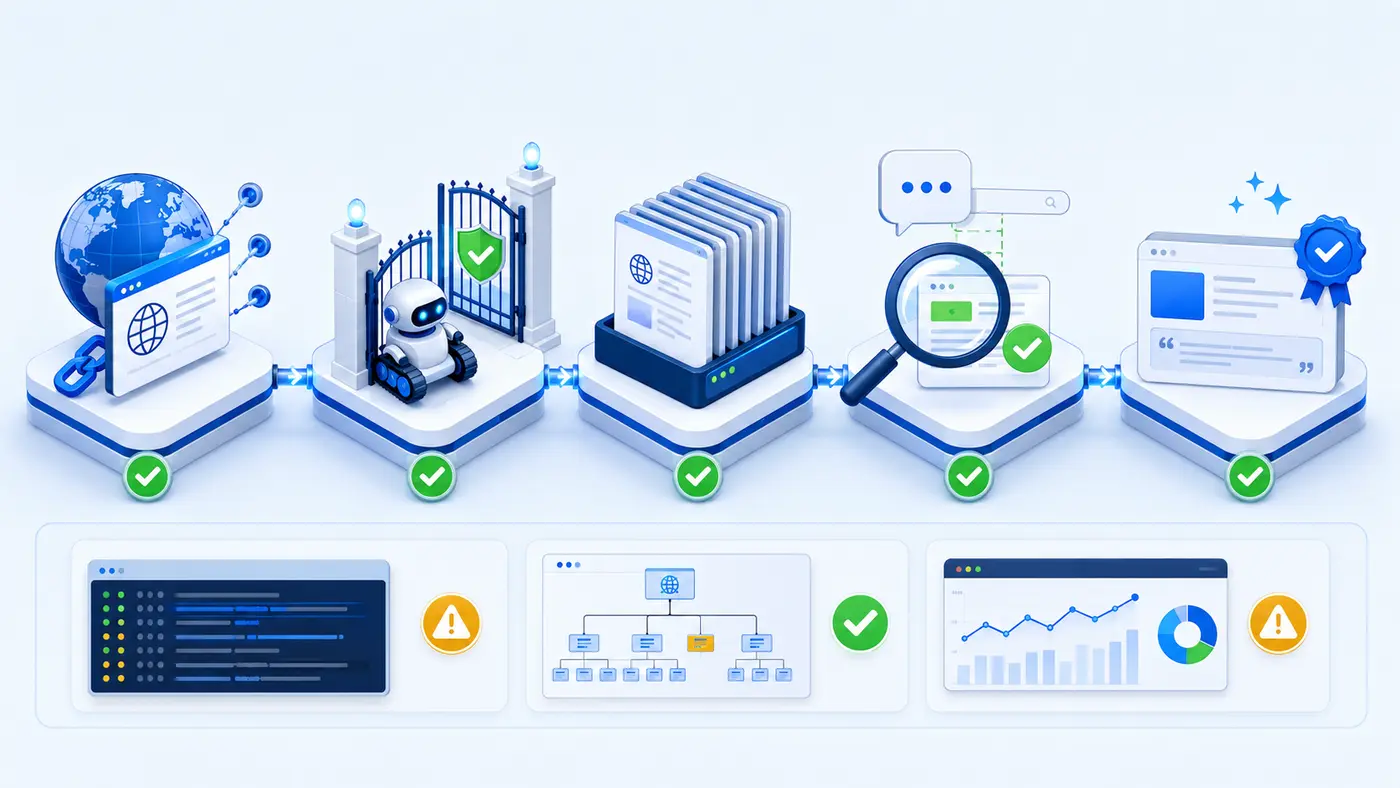
Five factors that change how long it takes
1. Crawler access and HTTP delivery
A crawler cannot evaluate content it cannot fetch. Check robots.txt, meta robots directives, authentication, redirect loops, rate limits, CDN bot rules and web application firewall events. Test several representative inner pages, not only the homepage. A homepage can return 200 while deeper URLs are blocked by path rules or security challenges.
2. Discovery paths and site freshness
New pages are normally found through crawlable internal links and sitemaps. Google notes that sitemaps help discovery but do not guarantee crawling or indexing. A new website with few external links may take longer because crawlers have fewer established paths into it. Link the article from a relevant hub, keep the sitemap current and avoid publishing orphan pages.
3. Authority and evidence quality
A technically perfect page can still lose to a source with stronger first-hand evidence, clearer attribution or broader recognition. Include identifiable authorship, a precise publication or update date, primary references, concrete examples and claims that can be checked. AI visibility is not only a technical waiting problem; it is also a source-selection problem.
4. Content fit for the prompt
A broad landing page may be discoverable but poorly matched to a narrow question. Make the page answer one identifiable intent, state the qualified answer early, use descriptive headings and explain limitations. This does not guarantee selection, but it gives retrieval systems clearer material to match and quote.
5. Platform and model behavior
The same page can appear in Google AI Mode, remain absent from one ChatGPT Search response and surface in another platform. Google says its AI features can use query fan-out across related searches and that AI Overviews and AI Mode may use different models and techniques. That variability is a reason to test platforms separately rather than declaring the entire site “indexed by AI.”
Practical examples with contrasting site conditions
- Established publisher: a well-linked article on an actively crawled domain may be discovered within days. It can still wait longer for a relevant AI citation because selection depends on the question and competing sources.
- New business website: a crawlable page may take weeks to gain conventional indexing evidence, especially when the site has few links and little publishing history. Improve discovery signals before assuming an AI-specific block.
- Technically blocked site: weeks of waiting will not solve a robots.txt disallow, noindex directive, 403 response or JavaScript-only content failure. Repair the failed stage and restart measurement.
- Indexed but rarely cited page: the next improvement is usually clearer query fit, original evidence and entity clarity—not repeated indexing requests.
A simple diagnostic you can run today
Use the same small test set every time so that changes are comparable. Choose the homepage, one commercial page and one knowledge article. Record the date, URL, platform, prompt and exact outcome.
- Confirm that every test URL returns a normal 200 response without a login, challenge page or redirect loop.
- Review robots.txt and page-level robots directives for the relevant crawler and for conventional search indexing.
- Inspect the rendered page and verify that the main answer, title, canonical URL and important links are available without interaction.
- Confirm sitemap inclusion and add a relevant internal link from an already discoverable page.
- For Google, check URL Inspection and request indexing once when appropriate; repeated requests do not make recrawling faster.
- Run a fixed set of specific prompts in fresh sessions. Record four outcomes separately: not found, brand mentioned, page mentioned, and linked citation.
- Retest on a consistent schedule—such as weekly for four weeks—without changing several variables at once.
Evidence beats guesswork: save screenshots of platform answers, Search Console status, the rendered HTML, sitemap membership and verified server-log requests. A dated evidence trail tells you whether the delay is discovery, access, indexing, relevance or selection.
How to interpret the result without overclaiming causation
If crawler requests begin after a sitemap or internal-link update, you can reasonably say discovery improved. If a page becomes indexed after a technical fix, you can document the sequence, but you still cannot prove that one change alone caused the timing. If a citation appears, repeat the prompt across sessions and related phrasings before calling it stable visibility.
Avoid publishing a claim such as “AI search takes 14 days.” A fixed number hides the most useful question: which stage has not completed? The correct next action depends on that answer. Access failures need technical fixes; discovery failures need stronger crawl paths; indexed pages with weak visibility need better evidence and query fit.
Common interpretation mistake
The most common mistake is treating a single AI answer as if it were a permanent search index. Generated answers can vary, and platforms discover sources differently. One successful citation is encouraging evidence, not a guaranteed position. Likewise, one failed prompt does not prove that the website is blocked.
Frequently asked questions
Can I submit my website directly to every AI search engine?
There is no universal submission console for all AI products. Use established discovery methods—crawlable links, XML sitemaps and valid search indexing—then follow each platform’s documented crawler controls. Avoid services promising guaranteed AI inclusion by a specific date.
Does allowing OAI-SearchBot make my site appear immediately?
No. Allowing OAI-SearchBot helps make content accessible for ChatGPT Search summaries and snippets, according to OpenAI’s publisher guidance. It removes a potential access barrier but does not guarantee when or whether a page will be selected.
Does Google indexing mean I will appear in AI Overviews?
No. Indexing and snippet eligibility are technical requirements for supporting links in Google’s AI features, but Google does not guarantee that an AI Overview will appear for a query or that a particular page will be used.
Should I request indexing every day?
No. Google states that requesting recrawling multiple times for the same URL will not make it happen faster. Request it once when appropriate, then monitor the URL and fix any reported problems.
When should I stop waiting and investigate?
Investigate immediately if the page returns an error, is blocked, has noindex, lacks crawlable links or is absent from the sitemap. When those basics pass, a weekly four-week observation window is more informative than daily random prompts. Escalate based on the failed stage, not simply elapsed time.
Official sources and further reading
- OpenAI: Publishers and Developers FAQ
- Google: AI features and your website
- Google: Ask Google to recrawl your URLs
- Google: How Search works
For a broader diagnostic path, read Why AI Search Engines Cannot Find Your Website. To compare discovery behavior between platforms, continue with ChatGPT vs Perplexity Website Discovery.
Next step: Check your website’s AI discoverability. Start with access, rendering and indexing evidence before spending another week waiting.