

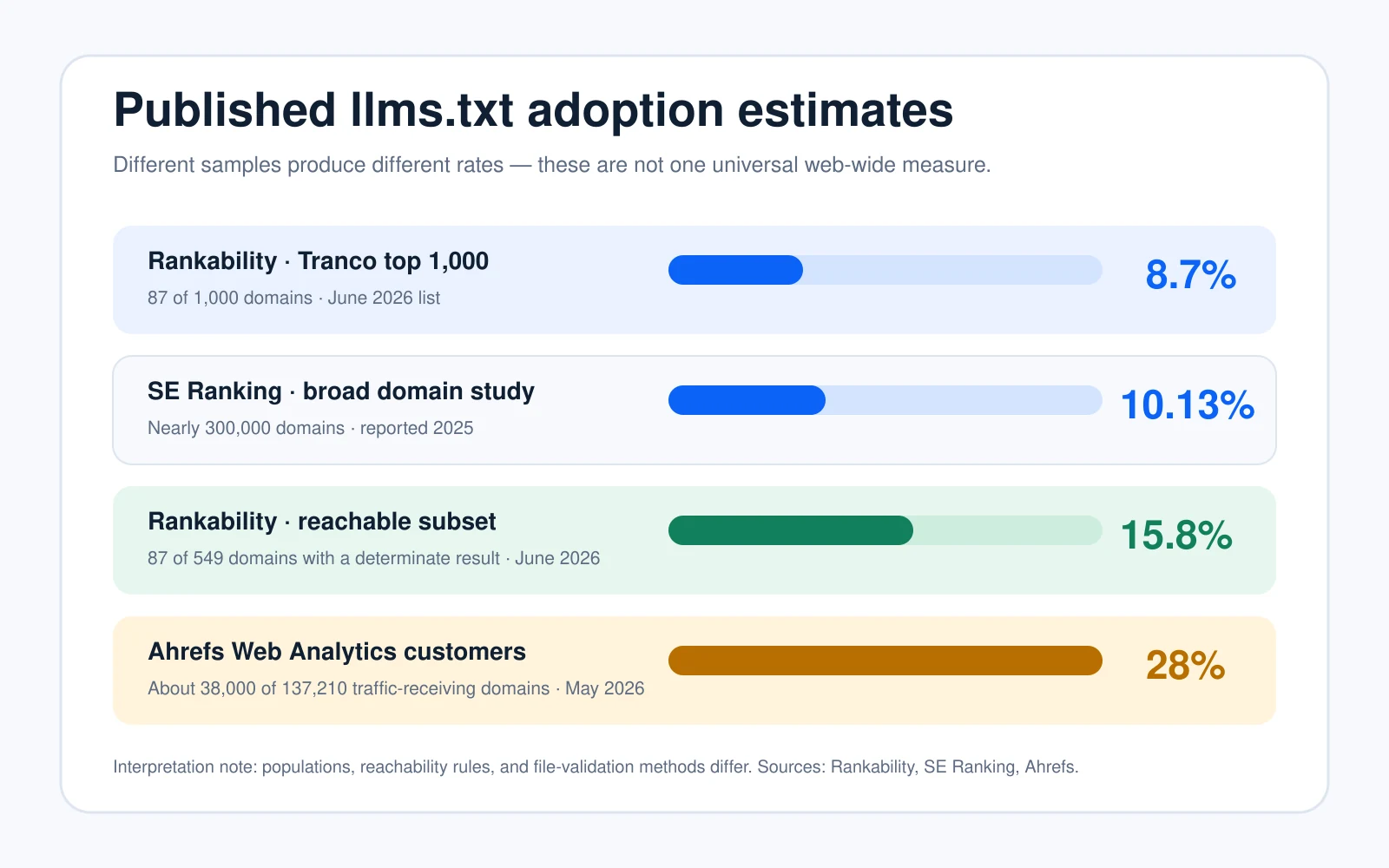
Llms.txt adoption statistics are easy to quote and surprisingly hard to compare. As of 6 August 2026, published studies put adoption between 8.7% in a broad top-1,000 domain list and 28% in a technically engaged analytics-customer sample. That range does not mean the research is contradictory. It means each study measured a different population, used different inclusion rules, and handled unreachable domains differently.
Quick answer: llms.txt remains a minority practice across broad website samples. The strongest current evidence suggests roughly one in ten domains in large general studies has a file, while adoption is higher among SEO-aware and technical website owners. File presence has not been shown to produce a reliable AI-citation lift.
Key llms.txt adoption statistics
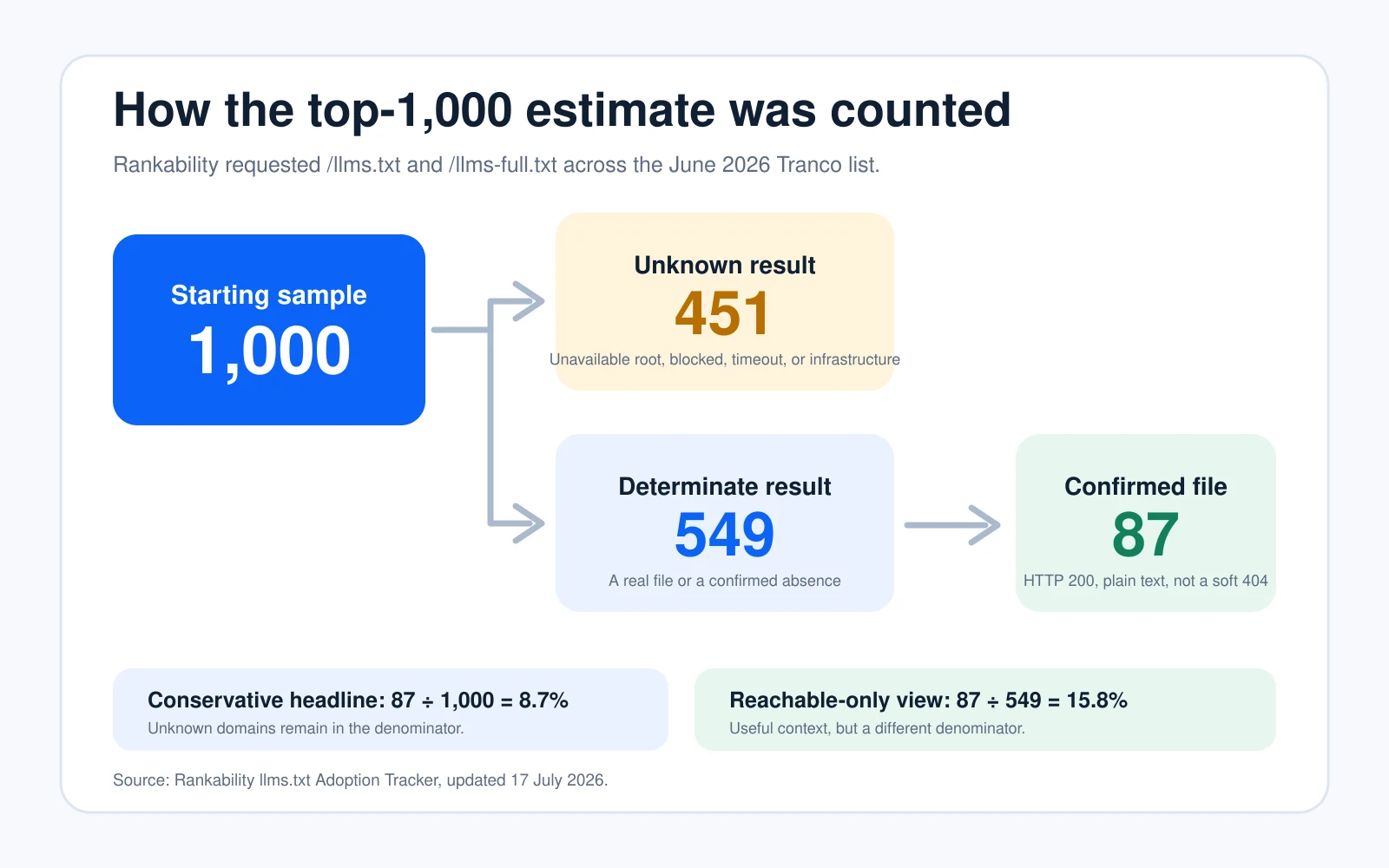
- 8.7% of the Tranco top 1,000: Rankability confirmed 87 files across 1,000 domains in its June 2026 list. It deliberately kept 451 unknown results in the denominator.
- 15.8% among reachable domains: the same Rankability crawl found 87 files among the 549 domains where it could make a definite decision.
- 10.13% across nearly 300,000 domains: SE Ranking found approximately one in ten sites had an llms.txt file in its broader study.
- 28% in an SEO-aware population: Ahrefs found about 38,000 valid files among 137,210 Ahrefs Web Analytics customers that received traffic in May 2026. Ahrefs describes this as an upper-bound estimate because its customers skew technical and SEO-aware.
- 97% of files received no requests: among the Ahrefs population, almost all valid files recorded zero traffic during May 2026. Only about 1,100 domains received any request to the file.
- Adoption is not proof of citation impact: ALLMO found llms.txt on only 1 of 50 highly cited domains and observed just 1 direct llms.txt-page citation among 94,614 cited URLs.
Read the denominator first: “8.7% of all sampled domains” and “15.8% of domains with a determinate result” come from the same crawl. Both calculations are correct, but they answer different questions.
Overall results: adoption is real but not yet mainstream
Across the broadest samples, the practical centre of gravity is close to 10%, not 28%. Rankability’s conservative 8.7% and SE Ranking’s 10.13% are reasonably aligned despite different source lists and validation processes. Ahrefs’ 28% result is valuable, but its customer base is more likely than the general web to use analytics, SEO plugins, technical tooling, and emerging machine-readable formats.
The format is also unevenly implemented. Rankability found 87 top-1,000 domains with /llms.txt, but only 15 with /llms-full.txt; all 15 published both files. That pattern supports the idea that the short index file is the primary experiment, while the full-content variant remains much less common.
Methodology: what this report measures
This Visible Pilot report is a dated synthesis of published primary research, not a claim that we crawled the entire web. We reviewed the study population, research period, file-detection rule, denominator, and stated limitations for each source. The comparison includes Rankability’s Tranco crawl, SE Ranking’s domain-level study, Ahrefs’ live analytics population, and ALLMO’s cited-domain and cited-URL checks.
Rankability used a clearly identified crawler to request both root-level files over HTTPS. A domain counted as an adopter only when it returned HTTP 200 with real plain-text content; HTML pages, empty responses, and soft 404s were rejected. Timeouts, DNS or TLS failures, blocks, and certain server errors were labelled unknown rather than silently counted as non-adoption.
Breakdown by site type and traffic level
Rankability’s category view suggests concentration in technical sectors, but several denominators are small. Technology reached 36.4% (4 of 11), video streaming 16.7% (1 of 6), publishing 14.3% (1 of 7), ecommerce 6.9% (2 of 29), and news and media 4.8% (1 of 21). Social media and government each recorded 0 of 10. These figures are directional signals, not stable industry benchmarks.
SE Ranking’s traffic buckets were much closer together: 9.88% for sites with 0–100 visits, 10.54% for the reported 1,001–5,000 bucket, and 8.27% for sites above 100,001 visits. In that dataset, higher traffic did not correspond with higher adoption. The file therefore looks more like a distributed experiment than an established practice led only by major brands.
Failure-pattern analysis
- Unknown roots: infrastructure, CDN, DNS, and API domains may not serve a normal public website at the apex, which makes a root-file test inconclusive.
- False positives: a 200 response can still be an HTML error page, empty file, redirect target, or soft 404. File validation must inspect the response body.
- Published but unread: Ahrefs found that 97% of valid files in its population received no requests during the study month.
- Bot-heavy traffic: 96% of the requests that did reach a file came from bots; named AI tools accounted for 19.5% of those fetches.
- Presence without proven outcome: adoption studies count files. They do not, by themselves, prove improved retrieval, ranking, mentions, or citations.
Important distinction: llms.txt is a proposed context and navigation convention. It is not an access-control file, cannot replace robots.txt, and should not be presented as a guaranteed Google or AI-search ranking mechanism.
What the statistics mean for website owners
Publishing a concise, accurate file can be a reasonable low-risk experiment, especially for developer documentation, API references, product knowledge bases, or content used by coding assistants and retrieval systems. Keep it current, link only to canonical public pages, and measure whether any crawler or user actually fetches it.
Do not move llms.txt above fundamentals such as stable HTTP access, crawl permissions, indexability, useful HTML, clear entities, internal links, original evidence, and accurate source attribution. The available statistics do not support selling the file as a shortcut to AI visibility. Use the llms.txt and machine-readable website guide to place the experiment inside a complete readiness process.
Reproducibility and calculation notes
A reusable benchmark should store: domain, source-list rank or cohort, crawl timestamp, requested host, final URL, HTTP status, content type, response size, soft-404 result, validated file status, llms-full.txt status, retry outcome, platform or technology label, and whether the result was determinate. Adoption should be reported twice when unknowns are material: confirmed adopters divided by the full sample, and confirmed adopters divided by determinate results.
Update policy
Visible Pilot will treat this page as a dated benchmark. Future editions should retain the same definitions, publish absolute counts beside every percentage, separate new samples from trend lines, and record methodology changes before comparing periods. That is the only reliable way to tell genuine adoption growth from crawler or denominator changes.
Get the full benchmark dataset: Visible Pilot is building a reproducible AI-search readiness dataset with transparent fields, validation rules, and update dates. Join Visible Pilot for the benchmark release.
Frequently asked questions
How many websites use llms.txt?
There is no defensible single web-wide percentage yet. Broad published studies currently report 8.7% and 10.13%, while an SEO-aware analytics population reached 28%. Always quote the sample and denominator with the rate.
Does llms.txt improve AI citations?
No reliable causal lift has been demonstrated. SE Ranking found no useful citation signal in its modelling, and ALLMO found extremely limited direct use among highly cited domains and cited URLs. Treat the file as an optional machine-readable aid, not a ranking promise.
Is llms.txt the same as robots.txt?
No. Robots.txt expresses crawler permissions. The llms.txt proposal supplies a curated, human-readable map of important content. It does not override authentication, robots directives, noindex controls, firewall rules, or platform selection systems.
Should every website publish one?
Not necessarily. It is more compelling for documentation-heavy or agent-facing sites than for a small brochure site. If you publish it, keep the cost low, validate the file, log requests, and avoid expecting visibility gains without stronger supporting evidence.
Sources
- Rankability: llms.txt Adoption Tracker — updated 17 July 2026.
- SE Ranking: 300,000-domain llms.txt study — published 2025.
- Ahrefs: 137K-site traffic and bot analysis — 15 June 2026.
- ALLMO: llms.txt for AI Search Report 2026 — 23 January 2026.
- The llms.txt proposal — format and implementation context.