
This local business AI visibility case study starts with an uncomfortable finding: traditional local visibility does not automatically translate into AI recommendations. SOCi’s 2026 Local Visibility Index analyzed more than 350,000 locations across 2,751 multi-location brands. It reported a 35.9% average appearance rate in Google’s local 3-Pack, but only 1.2% of locations were recommended by ChatGPT.
Those figures describe a market benchmark, not the result of one website intervention. Publicly available local-AI research rarely discloses a complete before-and-after prompt set, raw responses, change log, and control window. Therefore, this case study separates verified published evidence from a clearly labeled worked example. The goal is to show what a defensible local-business experiment should look like without manufacturing a success story.
Case-study outcome: The main opportunity was not “adding AI keywords.” It was making the business easier to verify across its website, business profiles, directories, reviews, and location-specific pages—then measuring the same customer questions before and after a controlled change.
Baseline: what the published evidence says
The starting symptom is common: a business performs adequately in Google Maps or branded search, yet disappears when someone asks an AI assistant to recommend a provider in a city. SOCi’s benchmark shows how narrow that recommendation window can be. The 2026 Local Visibility Index covers five industries and 42 subcategories, and its public audit page describes more than 120 visibility metrics.
BrightLocal provides a second useful baseline. In its study of 800 manual local-business searches in ChatGPT, researchers recorded the first ten displayed sources. Its later analysis found that local answers can draw from business websites, Google Business Profile, Yelp, MapQuest, Foursquare, specialist directories, reviews, social sources, and local publications. This matters because the business website is only one part of the evidence graph.
| Baseline signal | Published finding | How to interpret it |
|---|---|---|
| Market coverage | 350,000+ locations across 2,751 brands | Large multi-location benchmark, not a single-site experiment |
| Google local 3-Pack | 35.9% average appearance rate | Traditional local visibility is materially broader |
| ChatGPT recommendations | 1.2% of analyzed locations | AI recommendation supply is much narrower |
| ChatGPT source study | 800 manual local searches | Sources vary by query, category, platform, and location |
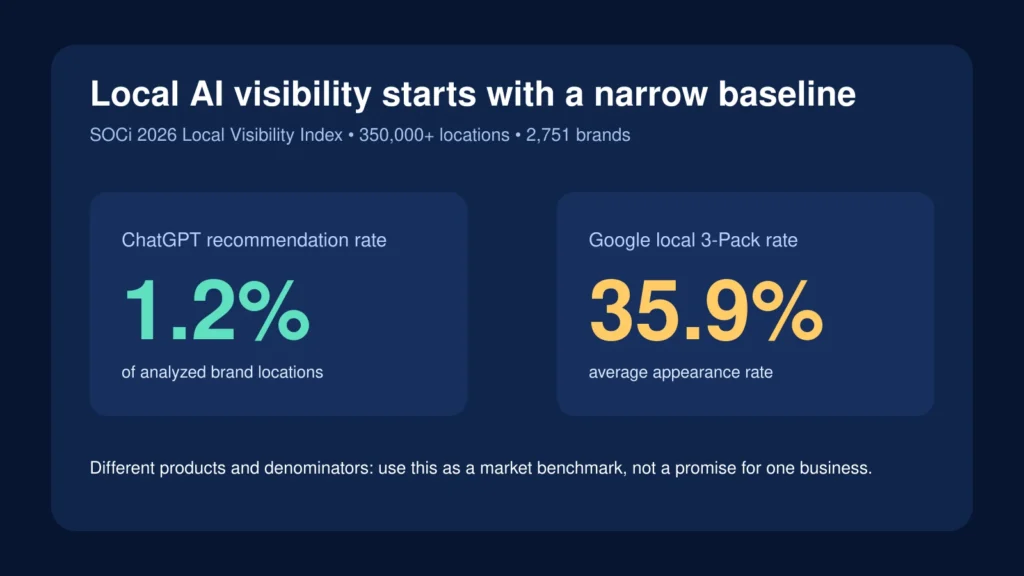
Important denominator: “1.2% of analyzed locations” is not the same metric as “1.2% of prompts.” Never copy this benchmark into a client report as the client’s visibility rate.
Diagnosis: why the first hypothesis was incomplete
A weak first hypothesis would be: “the website needs more AI-optimized copy.” That may be partly true, but it skips earlier failure points. A local business can have helpful service pages and still be omitted because its name, address, phone number, service area, hours, category, and proof differ across sources. An AI answer may also prefer a directory or review platform when the business website does not clearly support the requested claim.
The diagnosis should separate four layers. First, confirm that the relevant pages return stable responses and expose meaningful content. Second, check whether the business entity is described consistently across the website and major profiles. Third, inspect whether each location and service has a dedicated, useful page. Fourth, compare the proof available for the business with the sources cited for competitors.
- Access: robots directives, HTTP status, firewall behavior, canonical URL, indexability, and useful HTML.
- Entity consistency: exact business name, address, phone, categories, hours, service area, and ownership details.
- Answer coverage: location-specific services, pricing conditions, availability, qualifications, policies, and FAQs.
- External corroboration: accurate profiles, niche directories, recent reviews, local coverage, and expert-curated lists.
- Measurement: fixed prompts, repeated runs, exact cited URLs, competitor mentions, factual accuracy, and date.
Intervention plan: changes prioritized and avoided
The safest plan fixes the earliest observable failures first. In the worked example, the hypothetical business is a single-location home-services company with a homepage, three service pages, and an incomplete location page. Its information is accurate on Google Business Profile but inconsistent on two secondary directories. Several customer questions are answered only in sales calls, not on the website.
| Priority | Change | Reason |
|---|---|---|
| 1 | Correct name, address, phone, category, hours, and service area across key profiles | Remove entity conflicts before adding content |
| 2 | Expand the location page with services, neighborhoods, proof, policies, and FAQs | Create one authoritative local answer source |
| 3 | Add visible reviewer-supported proof and links to primary profiles | Make claims easier to verify |
| 4 | Improve internal links from service pages to the location page | Clarify site relationships |
| Avoided | Mass-produced city pages, fake reviews, hidden text, and unsupported “best” claims | Prevent thin duplication and trust damage |
What was deliberately avoided: llms.txt was not treated as a ranking switch, schema was not used to contradict visible content, and dozens of near-duplicate city pages were not published.
Implementation timeline
- Day 0: Freeze 12 prompts, define the target geography, record three runs per prompt, and save every response and cited URL.
- Days 1–3: Correct profile and directory inconsistencies; capture before-and-after screenshots.
- Days 4–7: Rewrite the location page around real customer questions and verifiable service facts.
- Days 8–10: Add internal links, validate technical access, submit normal discovery signals, and document the page version.
- Days 21–30: Confirm recrawl where possible, repeat the same prompts under the same conditions, and compare absolute counts.
Measurement method: fixed prompts, logs and controls
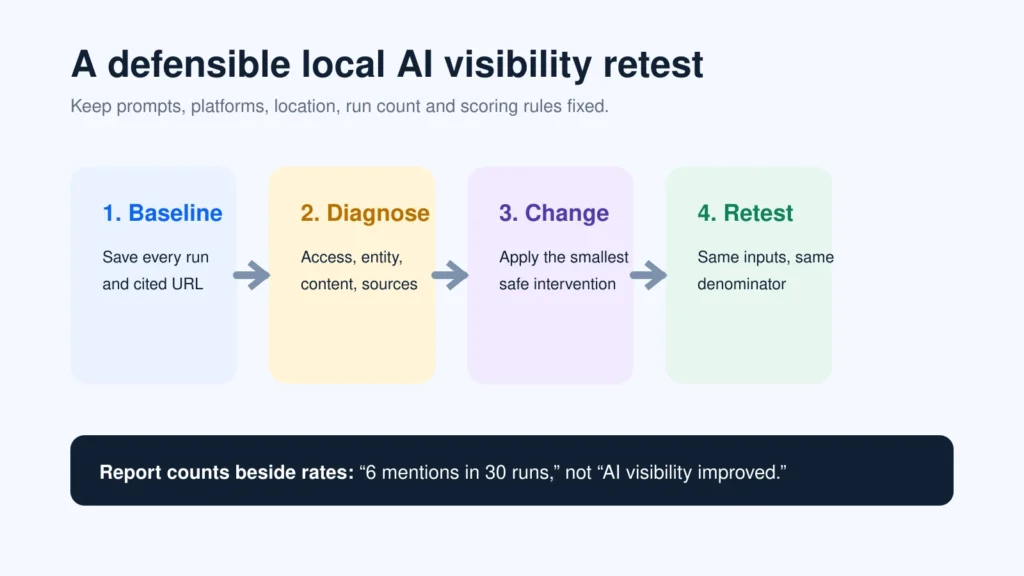
A credible retest must hold its inputs steady. Use the same prompt wording, platform, account state, target geography, and run count. Record the model or product label and date because AI systems change. Save the full response—not only a screenshot of a favorable citation. Track whether the brand is mentioned, recommended, cited, accurately described, and linked to the intended URL.
For this worked example, 12 prompts are grouped into service discovery, comparison, trust, availability, and neighborhood questions. Each prompt is run three times, creating 36 observations per test window. Branded questions are reported separately from non-branded recommendations. The unchanged comparison business provides a weak directional control, although it cannot control for model updates or index changes.
Results: a worked before-and-after table
The following numbers are illustrative, not client results. They demonstrate the reporting format that Visible Pilot recommends. A real case study should attach raw prompt logs and page versions before claiming improvement.
| Metric (36 runs) | Baseline | Retest | Change |
|---|---|---|---|
| Brand mentioned | 5 | 12 | +7 mentions |
| Brand recommended | 2 | 7 | +5 recommendations |
| Business website cited | 1 | 5 | +4 citations |
| Correct service area stated | 18 | 29 | +11 accurate answers |
| Incorrect hours or location fact | 6 | 1 | -5 errors |
Counts make the result auditable. “Five website citations in 36 runs” is more informative than an unexplained “14% visibility score.” Segmenting the data also prevents a rise in branded accuracy from being mistaken for stronger non-branded recommendations.
Evidence rule: A real report should include prompt text, full outputs, cited URLs, timestamps, platform labels, page versions, profile screenshots, change ownership, and the exact denominator behind every rate.
What likely caused improvement—and what cannot be proven
If a real test produced the illustrative pattern above, the most plausible explanation would be improved consistency and easier verification: the location page answers more questions, internal links clarify relationships, and external profiles agree. BrightLocal’s findings support the importance of websites, listings, specialist directories, profiles, and reviews as local-answer sources.
However, the test would not prove that any single edit caused the change. AI outputs vary. Search indexes refresh on different schedules. Competitors change their sites. A model or retrieval system may update during the comparison window. Even a clean before-and-after pattern establishes association, not guaranteed causation. Stronger evidence requires multiple retests, unchanged prompts, a comparison location, and—ideally—staggered interventions.
Lessons for another local business
- Start with the buying questions and locations that matter commercially; do not measure hundreds of vague prompts.
- Fix conflicting facts before producing more content. Inconsistent entity data creates an avoidable verification problem.
- Build one genuinely useful location page before scaling templates across dozens of cities.
- Show proof near the claim: qualifications, service limitations, policies, reviews, case evidence, and update dates.
- Study the exact URLs cited for competitors. The winning source may be a directory, profile, article, or review page rather than a homepage.
- Retest with the same denominator and save negative results. A reproducible null result is more valuable than a cherry-picked screenshot.
Evidence and screenshots to include
A publishable local business AI visibility case study needs more than a chart. Include a dated screenshot of the original location page, the revised page, the business profile fields, conflicting directory entries, technical fetch evidence, representative full AI answers, cited URLs, and the prompt log. Redact customer or account data without removing the evidence needed to reproduce the result.
For a broader diagnostic framework, use the AI Search Readiness by Website Type guide. If the problem appears technical, start by separating crawler access, rendering, entity clarity, retrieval, mention, and citation rather than treating “AI visibility” as one failure.
The common interpretation mistake
The biggest mistake is copying a generic AI SEO checklist without adapting it to the business model and page inventory. A restaurant needs menu, location, hours, reservations, dietary details, and current reviews. A plumber needs service areas, emergency availability, licensing, job evidence, and clear contact information. A clinic needs practitioner, location, service, policy, and trust information. The same checklist cannot prioritize all three correctly.
Frequently asked questions
What is a local business AI visibility case study?
It is a documented comparison of how often and how accurately a local business appears in AI-generated answers before and after a defined intervention. A trustworthy case records prompts, platforms, dates, run counts, cited URLs, page versions, and limitations.
How many prompts should a local business test?
Start with roughly 10–20 representative questions across services, comparisons, trust, availability, neighborhoods, and buying intent. Repeat a smaller fixed set consistently instead of running hundreds of undocumented questions once.
Do Google Maps rankings guarantee ChatGPT recommendations?
No. SOCi’s benchmark shows a large gap between average Google local 3-Pack appearance and ChatGPT recommendation coverage. The products, retrieval methods, and result formats differ.
Which local sources matter for AI visibility?
The business website, Google Business Profile, review platforms, broad and niche directories, data aggregators, local publications, and social sources can all contribute. The mix varies by category, query, location, and platform.
How long should a business wait before retesting?
Wait long enough for the changed pages and profiles to be recrawled or reprocessed, then record that evidence. A 21–30 day window is a practical starting point for many tests, but it is not a universal guarantee.
Next step: request a Visible Pilot audit
A local business does not need another mysterious score. It needs a transparent baseline, the earliest failing layer, a prioritized fix, and a controlled retest. Visible Pilot is being built to help businesses and agencies collect that evidence and turn it into an actionable website roadmap.