

Orphan pages invisible to AI search are URLs that exist but sit outside the normal internal-link paths people and crawlers follow. A sitemap may list them, and the server may return a perfect 200 response, yet the pages can still receive weak discovery signals, limited recrawling, and little chance of being retrieved or cited.
The fix is not simply to add one random link. First confirm where the chain breaks: discovery, crawler access, rendering, index eligibility, comprehension, or citation readiness. Then reconnect the page in a way that helps users understand why it belongs on the site.
Quick answer:
An orphan page needs at least one useful, crawlable link from an indexable page that is already part of the site architecture. Also verify its canonical, robots directives, HTTP response, rendered HTML, sitemap entry, and content quality. Internal links improve discovery; they do not guarantee an AI platform will retrieve or cite the page.
Quick diagnosis: why orphan pages become invisible to AI search
Start by comparing three lists: URLs in your CMS, URLs in your XML sitemap, and URLs found by crawling from the homepage. A page that appears in the first two lists but not the crawl is a strong orphan-page candidate. Investigate these likely causes:
- The page was published but never added to a hub, category, navigation, or related-content module.
- A redesign, migration, or pagination change removed the only internal link.
- Links exist only after a user action or JavaScript event that a crawler may not reproduce.
- The URL conflicts with a noindex directive, blocked path, redirect, or canonical pointing elsewhere.
- The page is technically accessible but too thin, duplicated, outdated, or unclear to deserve retrieval.
A sitemap helps search engines discover URLs, but Google explains that sitemap inclusion does not guarantee crawling or indexing. Treat a sitemap as a discovery aid, not proof that the page is healthy.
Symptom map: locate the real failure
| Stage | Typical symptom | Evidence to collect |
|---|---|---|
| Discovery | No crawl path from important pages | Internal crawl, link report, sitemap comparison |
| Access | Bot receives a block, challenge, or error | robots.txt, server logs, WAF events, HTTP status |
| Rendering | Main content is missing from delivered HTML | Raw HTML and rendered-page comparison |
| Index eligibility | Signals say another URL should be indexed | Canonical, noindex, redirects, duplicate clusters |
| Comprehension | Page purpose or entity is unclear | Title, headings, copy, structured data, surrounding links |
| Citation readiness | Page is accessible but rarely used as a source | Answer quality, evidence, freshness, prompt tests |
Test 1: reproduce the issue on representative URLs
Choose three to five URLs that represent the pattern rather than testing one convenient example. Include a commercially important page, a recent page, an older page, and a page from the same template that works correctly. Record the test date so later changes are auditable.
- Crawl from the homepage without seeding the suspect URLs.
- Search the crawl database for incoming internal links and anchor text.
- Fetch each URL as an anonymous visitor and record status, redirects, headers, and final URL.
- Compare source HTML with the browser-rendered page.
- Check whether important AI and search crawlers are allowed by both robots.txt and infrastructure rules.
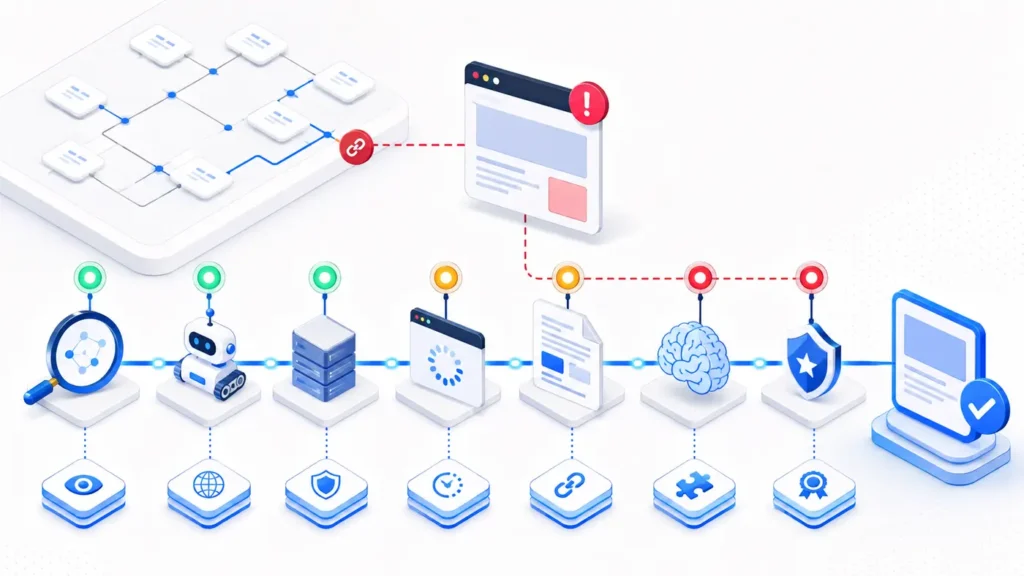
Test 2: trace the URL from discovery to citation readiness
Follow the page as a chain, not a single pass/fail test: discovery → access → delivery → index eligibility → comprehension → retrieval → citation. A 200 response proves delivery only. It does not prove that a system selected the page for an answer.
For ChatGPT search specifically, OpenAI documents OAI-SearchBot as the crawler used to surface sites in search results. Confirm that your robots rules and CDN or firewall allow it. GPTBot has a different purpose, so do not assume one rule covers every OpenAI crawler.
Root-cause checks beyond internal links
Directives, status codes, security rules, and canonicals
Verify that the page returns 200 at its preferred URL, is not blocked by authentication or a bot challenge, and has no accidental noindex directive. The canonical should normally reference the intended version of the page. Conflicting canonicals, redirects, internal links, and sitemap URLs create ambiguity. Google recommends linking internally to the canonical URL, which makes your preference clearer.
Review canonical tag mistakes affecting AI discovery if the suspect page points to another URL or multiple versions compete.
Content delivery and entity signals
The main answer, product details, author information, and supporting evidence should appear in accessible HTML. Give the page a descriptive title and one clear primary purpose. Links from relevant pages should use natural anchor text that explains the relationship; a footer link labelled “more” gives weaker context than a link inside a closely related guide.
Do not manufacture links at scale.
Add an internal link only where a visitor would benefit from the destination. Sitewide keyword-heavy anchors can clutter the experience and make the architecture less meaningful. One contextual link from a strong hub may be more useful than dozens of unrelated footer links.
Fixes ordered by impact, effort, and risk
| Fix | Impact | Effort | Risk |
|---|---|---|---|
| Add contextual links from the pillar, hub, and one related article | High | Low | Low |
| Restore category, breadcrumb, or related-content paths | High | Medium | Low |
| Align the sitemap, canonical, and preferred final URL | High | Medium | Medium |
| Remove an accidental noindex, bot block, or WAF challenge | High | Medium | Medium |
| Improve thin or duplicated content before reconnecting it | Medium | High | Low |
| Redirect a page that has no distinct user value | Medium | Low | Medium |
Prioritize pages tied to revenue, customer questions, or a core topical cluster. Link the page from the relevant Website Health for Search and AI Discovery hub rather than placing every orphan page in the main menu.
Verification: evidence that the issue is resolved

- A fresh crawl starting at the homepage now discovers the URL.
- The incoming-link report shows relevant source pages and descriptive anchors.
- The preferred URL returns 200 without a challenge, redirect loop, or inconsistent response.
- Canonical, index directives, sitemap entry, and internal links agree.
- Important content appears in the delivered and rendered HTML.
- Server or CDN logs later show legitimate crawler requests to the URL.
Recheck after an appropriate crawl cycle. OpenAI notes that crawler systems may take about 24 hours to adjust after robots.txt changes, but discovery and citation timing are not guaranteed. Preserve before-and-after evidence instead of declaring success from an immediate manual fetch.
When the site is healthy but the platform still does not cite the page
A healthy page can remain uncited because the query does not require it, another source provides stronger evidence, the content is not distinctive, or the platform has not refreshed its retrieval signals. Improve answer clarity, original evidence, named entities, source transparency, and freshness. Then test a fixed set of realistic prompts and record mentions separately from citations.
OpenAI’s publisher guidance says allowing OAI-SearchBot helps content become discoverable, surfaced, and cited. It does not promise placement. Separate the technical requirement you control from the external selection decision you do not.
Evidence and screenshots to include
- Crawl-path diagram before and after the new internal links.
- Canonical and robots meta evidence from source HTML.
- Sitemap membership and the page’s last-modified value.
- Anonymous HTTP responses and relevant WAF or CDN log entries.
- Rendered content showing the primary answer and entity context.
- Dated AI-search prompt tests showing whether the URL was mentioned or cited.
The common interpretation mistake
Existing in a sitemap is not the same as being discoverable.
A useful diagnosis requires aligned evidence: crawl paths, status codes, canonicals, index directives, rendered content, internal links, and platform tests. If those signals conflict, the sitemap alone cannot prove that the page is ready for search or AI retrieval.
Frequently asked questions
Can an orphan page be indexed?
Yes. A crawler may discover it through a sitemap, an external link, or an older crawl. However, missing internal links can weaken discovery, context, prioritization, and recrawl signals.
How many internal links should an orphan page receive?
There is no universal number. Add enough contextual links to make the page a natural part of its topic cluster. A hub link plus links from one or two closely related pages is a sensible starting point.
Does adding a page to navigation fix AI visibility?
It can fix a discovery gap, but it cannot resolve blocking, canonical, rendering, quality, or citation problems. Use navigation only when the page deserves that prominence for users.
Should low-value orphan pages be linked or removed?
If a page has no distinct purpose, improve, consolidate, redirect, or retire it instead of forcing links to it. Reconnecting weak duplicates creates clutter rather than authority.
Next step: audit the full discovery chain
When you find orphan pages invisible to AI search, reconnect the page thoughtfully and test every stage from discovery to citation readiness. The goal is not merely to make the URL crawlable. It is to make the page easy to find, understand, trust, and use.
Get the AI Search Readiness checklist:
Review crawler access, rendering, index signals, internal links, and citation readiness in one practical workflow.
Check your website with Visible Pilot and prioritize the issues you can verify.