
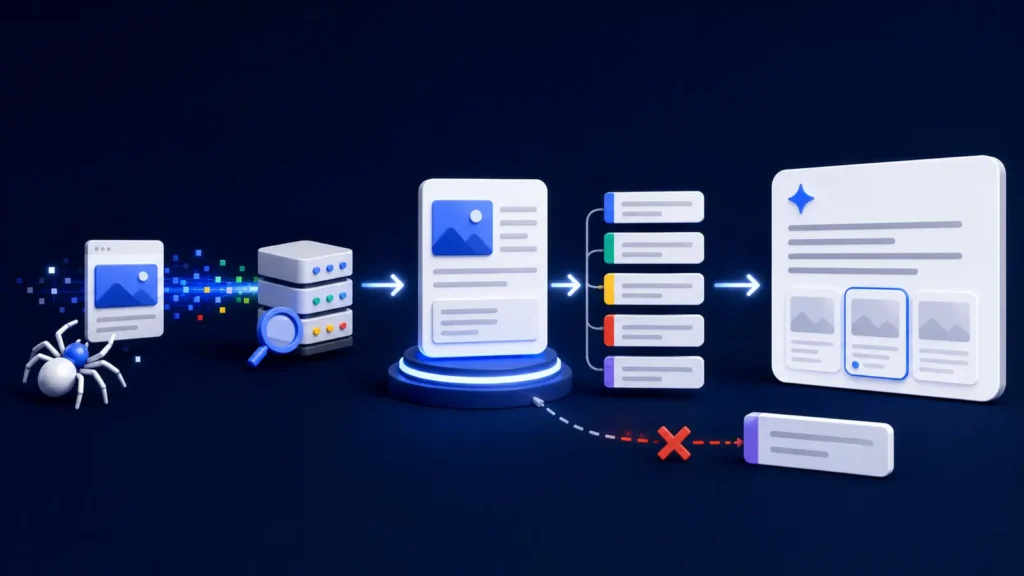
If your website is not cited in Google AI Overviews, the problem is not automatically a technical block. A page may be crawlable, indexed, and visible in ordinary search yet still not be selected as a supporting link for a particular AI-generated answer. The useful question is not simply “Why am I missing?” but “At which stage does the evidence stop?” This guide shows how to separate eligibility problems from query-specific citation selection.
Fast answer: Google says there are no extra technical requirements or special schema for AI Overviews. A page must be indexed and eligible to appear in Google Search with a snippet. After that, selection depends on the query, relevance, usefulness, quality systems, and the sources Google’s AI features retrieve. Fix eligibility first; then improve the page for the exact information need.
Quick diagnosis: why a website is not cited in Google AI Overviews
Most cases fall into one of five buckets. Identify the observable failure before rewriting content or installing another plugin.
- Not indexed: Google has not indexed the URL, selected another canonical, or excluded it because of a directive or quality issue.
- Snippet-ineligible: a
nosnippetrule or an overly restrictivemax-snippetsetting prevents the page from being used as a supporting link. - Poor query fit: the page discusses the topic but does not directly answer the question or subtopic generated during query fan-out.
- Weak evidence: the content repeats common advice without original experience, data, examples, clear authorship, or primary sources.
- Normal citation variation: the page is eligible, but Google selects different supporting pages for that query, location, time, device, or answer composition.
Important: there is no separate “AI Overview index” that a site owner can inspect. Google’s AI features are grounded in the core Search index and ranking systems. A successful eligibility check proves that selection is possible; it does not promise that the page will be cited.
Symptom map: eligibility failure or citation-selection gap?
1. Crawling and indexing failure
Start with the URL Inspection tool in Google Search Console. Confirm whether Google knows the canonical URL, whether crawling is allowed, and whether the page is indexed. Check the final HTTP status, redirects, robots.txt, page-level robots meta tag, X-Robots-Tag response header, canonical target, and whether the main content is available after rendering. If the page is not indexed, AI Overview troubleshooting is premature.
2. Snippet eligibility failure
Google states that a page must be eligible to appear in Search with a snippet to serve as a supporting link in AI Overviews or AI Mode. Review nosnippet, max-snippet, and data-nosnippet. These controls can intentionally limit how text is used, but accidental or overly broad settings can remove useful answer passages from consideration.
3. Query-specific citation gap
When the URL is indexed and snippet-eligible, the remaining issue is usually retrieval or selection. Google may issue multiple related searches—often called query fan-out—to gather information across subtopics. Your page may rank or be relevant to the original phrase but fail to provide the precise fact, comparison, procedure, evidence, or freshness needed for one of those related searches.

| Observed evidence | What it proves | What it does not prove |
|---|---|---|
| URL is indexed | The page exists in Google’s index | It will be selected for an AI Overview |
| Page ranks organically | Google considers it relevant for that result set | It matches every fan-out subquery |
| Snippet is allowed | The page is technically eligible as a supporting link | Its passage is the best support for the answer |
| One citation appears | The page was selected in that test | The citation is stable across sessions or locations |
Test 1: inspect three representative URLs
Do not test only the homepage. Choose the homepage, a core product or service page, and a focused article that answers a narrow question. Record the same fields for each URL so template-specific problems become visible.
- Check the live URL and its final status code. It should return the intended content without a login wall, soft 404, redirect loop, or server error.
- Use Search Console URL Inspection to review indexing status, Google-selected canonical, crawl result, and rendered page.
- Confirm that robots.txt does not block required resources and that the page itself does not carry an unintended
noindex. - Inspect the robots meta tag and X-Robots-Tag for
nosnippetor restrictive snippet settings. - Compare the rendered content with the visible page. The main answer, headings, author or organization, dates, evidence, and internal links should be present and understandable.
Capture screenshots and export the relevant Search Console evidence before changing anything. A baseline prevents you from crediting the wrong fix later.
Test 2: use a fixed query matrix
Citation checks are volatile, so use a small, repeatable test rather than one vanity query. Select five to ten searches that represent real customer needs. Keep the wording fixed, note the country and device, and run the set on several dates.
| Query type | Example pattern | Evidence to record |
|---|---|---|
| Branded fact | What does [brand] offer for [audience]? | Mention, linked source, URL |
| Problem query | How do I fix [specific problem]? | Whether the exact article is used |
| Comparison | [Option A] vs [Option B] for [constraint] | Claims supported and cited sources |
| Procedure | Steps to complete [narrow task] | Passage and source selected |
| Fresh fact | Current requirement or change for [topic] | Date, freshness, primary source |
For every test, record whether an AI Overview appeared, whether your brand was mentioned, whether your domain was linked, which exact URL was cited, and which competing sources appeared. A missing AI Overview is not a site failure; Google does not show one for every query.
Measurement rule: separate “no AI Overview,” “AI Overview with no brand mention,” “brand mentioned without a link,” and “domain cited.” Combining these outcomes into one visibility score hides the actual problem.
Root-cause checks that matter
Indexing and canonical signals
A page intended for citation should have one stable, indexable URL. Resolve accidental canonicalization, redirect chains, duplicate parameter versions, orphan pages, and inconsistent sitemap entries. Link to it from relevant hub and supporting pages with descriptive anchors. Google does not guarantee indexing, but mixed signals make selection less likely.
Snippet controls
Search the HTML and response headers for snippet restrictions. A site-wide nosnippet directive is a direct eligibility blocker for supporting links. A low max-snippet value can also limit available text. Use data-nosnippet only around sections you intentionally want excluded, not around the main answer.
Content usefulness and evidence
Google’s current guidance emphasizes unique, non-commodity, people-first content. Give the reader something a generic summary cannot: first-hand observations, a worked example, original measurements, clearly stated limitations, screenshots, a decision framework, or primary-source interpretation. Put the direct answer near the relevant heading, then support it with evidence.
Entity and publisher clarity
Make it obvious who created the page, what the organization does, and why the source is credible for this subject. Use consistent names across the site, accurate author information, a clear About page, contact details, and appropriate structured data for existing Search features. Structured data can help Google understand eligible content, but Google says there is no special AI Overview schema.
Local and ecommerce details
For local businesses and merchants, maintain accurate Google Business Profile and Merchant Center information where relevant. These systems can help Google understand business, product, and availability details across Search experiences. Keep feeds and on-page facts consistent; conflicting names, addresses, prices, or availability weaken trust.
Fixes ordered by impact, effort, and risk
| Priority | Fix | Impact / risk |
|---|---|---|
| 1 | Remove accidental noindex, canonical, access, or nosnippet blocks | Highest impact; validate carefully before changing intentional controls |
| 2 | Correct the page’s main answer, heading alignment, and evidence | High impact, low technical risk |
| 3 | Strengthen internal links, sitemap consistency, authorship, and entity details | High value; usually low risk |
| 4 | Add original examples, data, images, or first-hand analysis | Medium-to-high impact; requires real editorial work |
| Avoid | Mass variations, fake freshness, special “AI schema,” or keyword stuffing | High spam and quality risk; unsupported by Google guidance |
Make the smallest change that addresses the proven failure. If Search Console shows an indexing problem, do not start by adding FAQs. If indexing and snippet eligibility pass, do not weaken security or remove controls repeatedly; move the investigation to content fit and evidence.
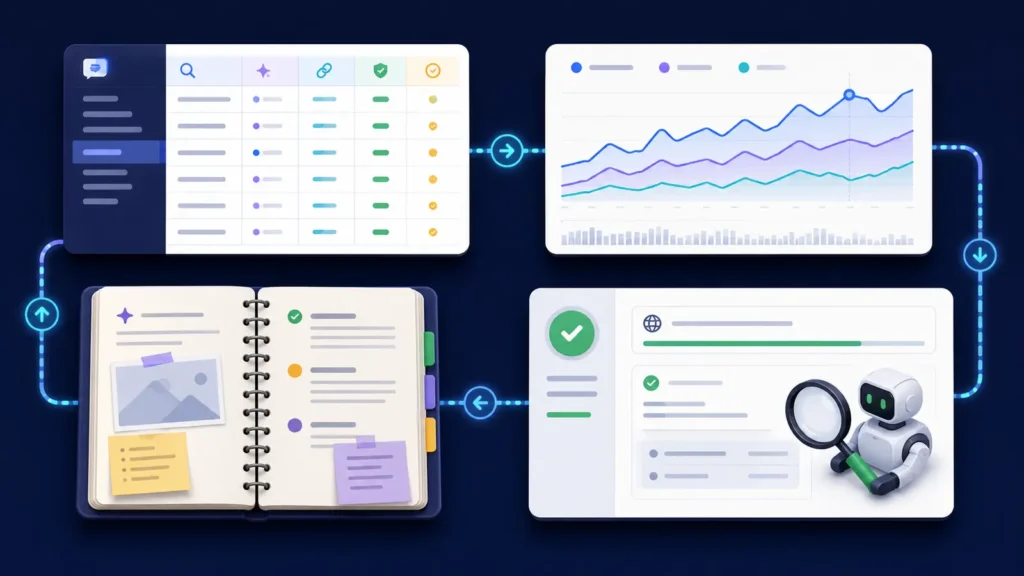
Verification: what proves the issue is resolved
Use two pass conditions. A technical eligibility pass means the intended canonical URL is indexed, serves the expected rendered content, and is eligible for a Search snippet. A visibility improvement means the fixed query matrix shows a repeatable increase in mentions or citations across multiple tests—not merely one favorable answer.
- Reinspect the changed URL in Search Console and document the indexed canonical and crawl result.
- Check the rendered HTML and response headers again for robots and snippet controls.
- Run the same query matrix without changing the wording to make the result easier.
- Record dates, locations, devices, AI Overview presence, cited URLs, and competing sources.
- Review Search Console performance trends. Do not expect a single report or third-party tool to reveal Google’s internal selection logic.
Healthy but still uncited? Stop treating the outcome as a crawler defect. Improve the page’s fit for one narrow information need, add defensible evidence, and test over time. Google explicitly says that meeting requirements and best practices does not guarantee crawling, indexing, serving, or selection.
Common interpretation mistakes
- Assuming an ordinary organic ranking guarantees an AI Overview citation.
- Treating one answer as a stable index rather than a query-specific output.
- Creating an
llms.txtfile for Google; Google says it does not use the format for Search or its generative AI features. - Adding unsupported “AI schema” instead of fixing normal indexing, snippet, content, and trust signals.
- Publishing many near-duplicate pages for every fan-out variation. Google warns that scaled content created mainly to manipulate rankings or generative answers can violate spam policies.
- Using a third-party visibility score as proof of Google’s internal state.
Frequently asked questions
Is there a special crawler for Google AI Overviews?
No separate site-owner crawler control is required for AI Overviews. Google says these features rely on the core Search index and ranking systems. Focus on normal Google Search crawlability, indexing, and snippet eligibility.
Do I need special schema to appear in AI Overviews?
No. Google says there is no special structured data required. Continue using valid structured data where it helps the page qualify for established Search features, and ensure the markup matches visible content.
Can nosnippet prevent an AI Overview citation?
Yes. Google states that supporting links must be eligible to appear with a snippet. The nosnippet rule blocks snippets, while max-snippet and data-nosnippet can limit usable text.
Does ranking on page one guarantee a citation?
No. Organic visibility is useful evidence, but AI features can use query fan-out and select pages that best support specific parts of an answer. Citation depends on the query and available sources.
How long should I test before judging a change?
There is no universal waiting period. First confirm that Google has recrawled and indexed the changed page. Then repeat the same query set on multiple dates. Separate technical recrawl timing from the slower editorial question of whether the page becomes a stronger source.
Next step
If your website is not cited in Google AI Overviews, begin with evidence: three representative URLs, Search Console inspection, snippet controls, and a fixed query matrix. Fix the first failed layer, preserve the before-and-after proof, and avoid promises that any setting can force a citation. Continue with the AI Search Readiness checklist and the AI Search Readiness vs traditional SEO audit guide.
Official sources: Google: AI features and your website; Google: optimizing for generative AI features; Google: robots meta and snippet controls; Google: how Search works.