

AI visibility monitoring vs AI readiness audit is not a choice between two versions of the same report. Monitoring repeatedly observes how a brand appears across AI search experiences. A readiness audit examines whether the website, content, and measurement setup are capable of earning and explaining those results.
The right choice depends on the decision in front of you. If you need to detect movement, compare competitors, or watch citations over time, start with monitoring. If you need to find access failures, content gaps, or unreliable measurement, start with an audit. Most established programs need both—but in the correct sequence.
Short answer:
Monitoring tells you what changed. A readiness audit helps explain why and what to fix. Audit first when the foundation is uncertain; monitor once the baseline and success measures are defined. Then repeat the audit when monitoring exposes a persistent decline or unexplained gap.
AI visibility monitoring vs AI readiness audit: the meaningful difference
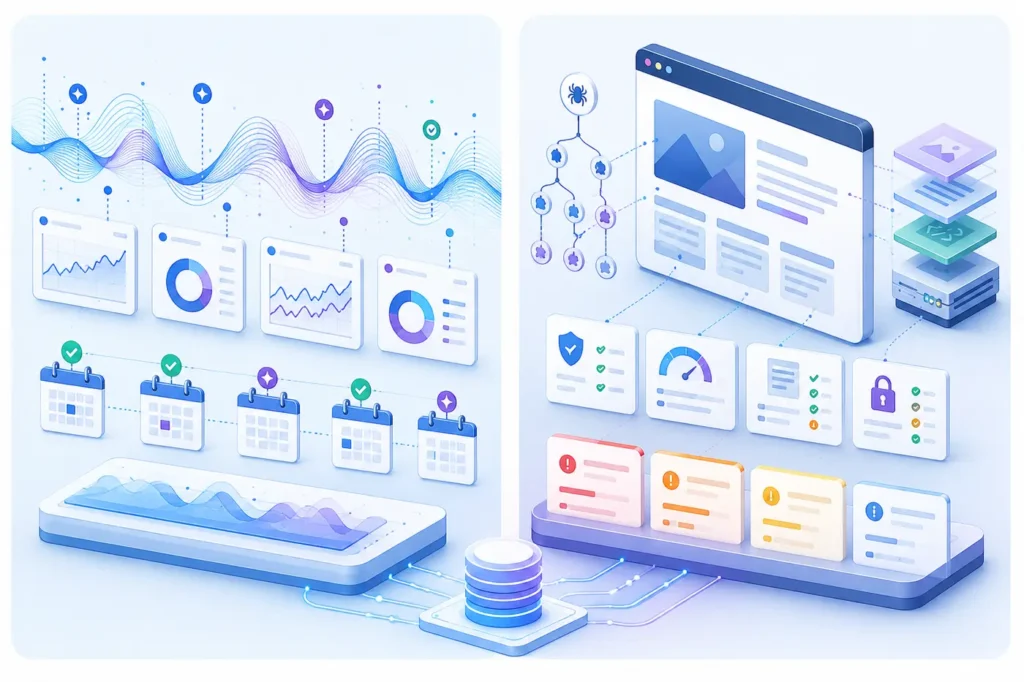
AI visibility monitoring is an ongoing measurement activity. A platform or internal process runs a documented set of prompts on a schedule and records brand mentions, citations, cited URLs, competitor appearances, answer context, and referral traffic where it can be attributed.
An AI readiness audit is a point-in-time diagnosis. It reviews crawler access, HTTP responses, robots directives, rendering, indexability, site structure, entity clarity, answer quality, supporting evidence, and whether the team can reproduce its measurements. Its output should be a prioritized remediation plan, not another trend line.
The boundary matters. Monitoring can reveal that citation coverage fell, but it cannot prove the cause. An audit can identify plausible causes, but its recommendations remain hypotheses until the same measurement is repeated. Treating either output as certainty creates expensive false confidence.
Definitions and boundaries
What monitoring should include
- A fixed, versioned prompt panel covering branded, non-branded, comparison, problem, and purchase-intent questions.
- Repeated collection across the AI products that matter to the audience, with dates, locations, login state, and model details recorded when available.
- Separate measures for mentions, citations, cited pages, competitor share, sentiment or accuracy, and attributable AI referral visits.
- A change log so movements can be compared with content releases, technical fixes, migrations, or major model updates.
What a readiness audit should include
- Access tests for robots.txt, relevant AI and search crawlers, CDN or WAF rules, status codes, canonicals, noindex directives, and rendered HTML.
- A review of whether important pages answer real customer questions clearly and support claims with first-party evidence.
- Internal linking, entity consistency, structured data where appropriate, citation-worthy assets, and gaps against pages already referenced by AI systems.
- A measurement design that states prompts, platforms, denominators, scoring rules, limitations, owners, and a retest date.
Side-by-side comparison
| Area | AI visibility monitoring | AI readiness audit |
|---|---|---|
| Purpose | Detect and track observed outcomes | Diagnose barriers and prioritize fixes |
| Timing | Recurring: weekly, monthly, or quarterly | Point-in-time or milestone-based |
| Main inputs | Prompt runs, citations, mentions, referrals, competitor results | Crawl evidence, server responses, rendered content, site architecture, measurement method |
| Main outputs | Trends, alerts, cited URLs, share comparisons | Verified issues, hypotheses, owners, effort, impact, and retest plan |
| Control | Low: observes external systems | Medium: improves controllable site signals |
| Cost pattern | Ongoing subscription and analyst review | Periodic project cost plus implementation |
| Limitation | Movement does not prove causation | Recommendations do not prove impact until retested |
Discovery and access implications
Both approaches must separate access from visibility. A successful fetch proves only that a page was delivered. It does not prove processing, indexing, retrieval, mention, or citation. If monitoring collapses these stages into one proprietary score, the team cannot locate the failure.
Google’s official guidance for generative AI features says foundational SEO still applies: pages should be crawlable, indexed, eligible to appear with a snippet, and useful to people. It also says special AI files such as llms.txt are not required for Google Search. That makes a readiness audit more valuable when it tests real access and content conditions instead of selling unsupported shortcuts.
OpenAI’s publisher guidance explains that allowing OAI-SearchBot supports discoverability and citation in ChatGPT search, and that ChatGPT referral links include a trackable UTM source. Monitoring should therefore combine prompt observations with server logs and analytics rather than relying only on screenshots.
Measurement, evidence quality, and repeatability
A useful monitoring program preserves raw evidence. For every prompt run, record the exact prompt, product, date, result, mention outcome, linked sources, cited URL, competitors, and any visible context. Publish the denominator beside every percentage. Twenty citations across 100 eligible results is meaningful; “20 citations” without a denominator is not.
Official reporting is also becoming more specific. Bing Webmaster Tools’ AI Performance reporting separates total citations, average cited pages, grounding queries, page-level activity, and trends. Microsoft explicitly notes that citation counts do not indicate ranking, authority, or placement. Apply the same caution to every vendor dashboard.
Evidence rule: A single run is an observation, not a trend. A score without its prompt set, denominator, matching logic, and raw examples cannot support a high-confidence business decision.
Best choice by scenario
New site or uncertain technical foundation
Choose an AI readiness audit first. Verify that priority pages are accessible, render meaningful HTML, use coherent internal links, and contain useful evidence. A young site with few eligible pages gains little from a large monitoring subscription that repeatedly records zero visibility without explaining the foundation.
Known visibility baseline and active content program
Choose recurring monitoring. Use a stable prompt panel to detect whether new pages earn citations, whether competitor share changes, and whether the same URLs remain visible. Schedule a focused audit only when the pattern persists beyond normal variation.
Sudden drop after a migration, redesign, or CDN change
Run a focused readiness audit immediately, then repeat the pre-change monitoring panel. Check robots rules, redirects, canonicals, response codes, rendering, and firewall behavior before rewriting content. The guide to testing HTML visible to AI crawlers provides a practical starting point.
Agency reporting and client retention
Use both. Monitoring creates recurring evidence and alerts; the audit converts meaningful gaps into an owned action plan. Keep the two deliverables separate so a client can see what was observed, what was inferred, what changed, and whether the retest improved the original measure.
A combined workflow that makes both useful
- Define the decision. Select the market, audience, priority pages, and questions the program must inform.
- Audit the foundation. Test access, rendering, indexability, content fit, entity clarity, evidence, and analytics.
- Freeze a baseline. Version prompts, platforms, dates, locations, eligibility rules, and scoring definitions.
- Monitor consistently. Record raw answers, mentions, citations, cited URLs, competitors, and referrals on a fixed cadence.
- Diagnose material changes. Ignore isolated noise; investigate persistent movement or business-critical failures.
- Improve in controlled batches. Tie every fix to a measurable hypothesis and avoid changing everything at once.
- Retest like for like. Use the same prompt panel and evidence rules, preserving positive, negative, and null results.

Test monitoring and audits before buying
Ask each provider to run the same small site and prompt set. Compare raw findings before comparing scores. Can you inspect the exact prompts and citations? Does the audit show request and response evidence for technical failures? Can another analyst reproduce the calculation? Are false positives documented? Is implementation included, and what will ongoing monitoring cost after the first year?
The strongest option is not necessarily the dashboard with the most charts. It is the workflow that exposes its coverage, repeatability, scoring logic, evidence quality, and limitations. Use the broader guide to choosing an AI visibility audit solution to evaluate tools and services against those criteria.
Evidence and screenshots to request
- Complete prompt set or a representative sample with version history.
- Raw generated answers showing both successful and absent mentions or citations.
- Exact cited URLs and the prompts that produced them.
- Request, status, robots, canonical, and rendered-HTML evidence for technical findings.
- Score formula, denominator, weighting, matching rules, and known exclusions.
- Before-and-after comparison using the same measurement conditions.
- Workflow ownership, implementation scope, alert rules, and total annual cost.
The most common interpretation mistake
Do not choose by dashboard polish or one proprietary score.
Different tools use different prompts, engines, locations, schedules, matching rules, and weights. Two scores can disagree while both follow their own definitions. The practical question is whether the method is transparent, repeatable, connected to raw evidence, and useful for deciding what to do next.
Frequently asked questions
Can AI visibility monitoring replace an audit?
No. Monitoring can show movement and recurring patterns, but it rarely proves the technical or editorial cause. Use an audit to investigate material gaps and define controlled fixes.
How often should a readiness audit be repeated?
Repeat it after major migrations, platform changes, persistent visibility declines, or a substantial content expansion. A quarterly light review and an annual deep audit suit many active sites, but cadence should match change frequency and risk.
How often should AI visibility be monitored?
Monthly monitoring is practical for many businesses. Weekly runs suit active experiments or volatile categories; quarterly measurement may be enough for a stable program. Consistent methods matter more than excessive frequency.
What should a small business buy first?
Start with a focused readiness audit if technical access, content quality, or analytics are uncertain. If those foundations are sound and the business already has meaningful web coverage, begin with a compact recurring prompt panel.
Does either option guarantee citations?
No. External systems decide what to crawl, retrieve, mention, and cite. These services improve evidence and decision quality; they cannot guarantee inclusion.
Next step: audit the foundation, then monitor the outcome
The practical answer to AI visibility monitoring vs AI readiness audit is sequence. Audit uncertain foundations, establish a documented baseline, monitor the signals that matter, investigate persistent changes, and retest after controlled improvements. That turns AI visibility from a decorative score into an accountable operating process.
Get the AI Search Readiness checklist:
Review crawler access, machine-readable content, citation readiness, and measurement setup before choosing a monitoring platform or audit service.
Check your website with Visible Pilot and start with the issues you can verify.