

Learning how to make website content easy for AI to quote starts with a simple objective: publish passages that are clear enough to retrieve, specific enough to support an answer, and trustworthy enough to cite. That means improving the page for people first—then testing whether search and AI systems can access, interpret and reuse its evidence.
This is not a promise that shorter paragraphs, schema or “AI-friendly” wording will win citations. Google’s current guidance says there is no required AI writing style, no need to split every idea into tiny chunks, and no special schema for generative search. OpenAI likewise documents how OAI-SearchBot controls search inclusion, not a formula that guarantees selection. The reliable approach is a controlled content experiment.
Short answer: Make each important section answer one defined question, name the relevant people, products or organizations, state verifiable facts with dates and scope, show where the evidence came from, and use descriptive headings. Then compare the same URLs with the same prompts over time. Optimize for sourceworthiness—not for a mythical “quote button.”
What “how to make website content easy for AI to quote” means in practical terms
A quote-ready passage is self-contained without becoming robotic. A reader should understand who or what the passage concerns, the claim being made, its boundary conditions and the evidence behind it. If a sentence says “it improved performance,” the subject, metric, period and comparison are missing. A stronger version identifies the product, the measured outcome, the test window and the baseline.
Retrieval-based AI experiences can assemble answers from multiple pages and related queries. Google explains that its generative features use search systems to retrieve fresh, relevant pages and then show links supporting the response. That makes ordinary search fundamentals—crawlability, indexability, relevance, usefulness and clear structure—the starting point. Formatting can expose meaning; it cannot substitute for it.
Step 1 — Establish a clean baseline and choose representative URLs
Begin with three to five pages that represent different jobs: one commercial page, one tutorial, one comparison or definition page, and one page with original evidence. Avoid rewriting the whole site. A small sample makes it easier to attribute a change and reverse it if the result is worse.
- Record the canonical URL, HTTP status, meta robots directive and whether the primary copy appears in the initial HTML.
- Save the visible title, main heading, author or organization name, publication date and last meaningful update.
- Choose eight to twelve prompts that match real customer questions. Include definitions, comparisons, troubleshooting questions and requests for evidence.
- Run each prompt in the same products, regions and account conditions. Save the full answer, links, quoted wording and date.
- Note whether the page was absent, merely mentioned, linked as a source, or quoted closely enough to identify the supporting passage.
Do not treat a single answer as a stable ranking. AI outputs vary with time, retrieval index, location, model and conversation context. The baseline is useful only when you preserve the inputs and repeat the test.
Step 2 — Rewrite one page section and hold the prompt set constant
Select one high-value section rather than editing every paragraph. Keep the page’s intent and URL unchanged. The goal is to make the evidence easier for a person to evaluate and for a system to retrieve without stripping away nuance.
| Weak pattern | Stronger revision | Why it helps |
|---|---|---|
| “Our solution delivers better visibility.” | Name the solution, the visibility measure, the comparison and the date range. | The claim has an identifiable subject and testable boundary. |
| A long paragraph mixing definition, benefits and exceptions | Lead with a direct definition, then separate benefits, evidence and limitations under descriptive headings. | Readers can find the precise passage without losing context. |
| Statistics with no source or period | Place the figure beside its source, methodology, sample and publication date. | The evidence can be checked and cited responsibly. |
| Brand names introduced as “it” or “they” | Use the full entity name at the first important mention and keep terminology consistent. | References are less ambiguous for readers and machines. |
Build a passage that deserves to be selected
Lead with a precise answer
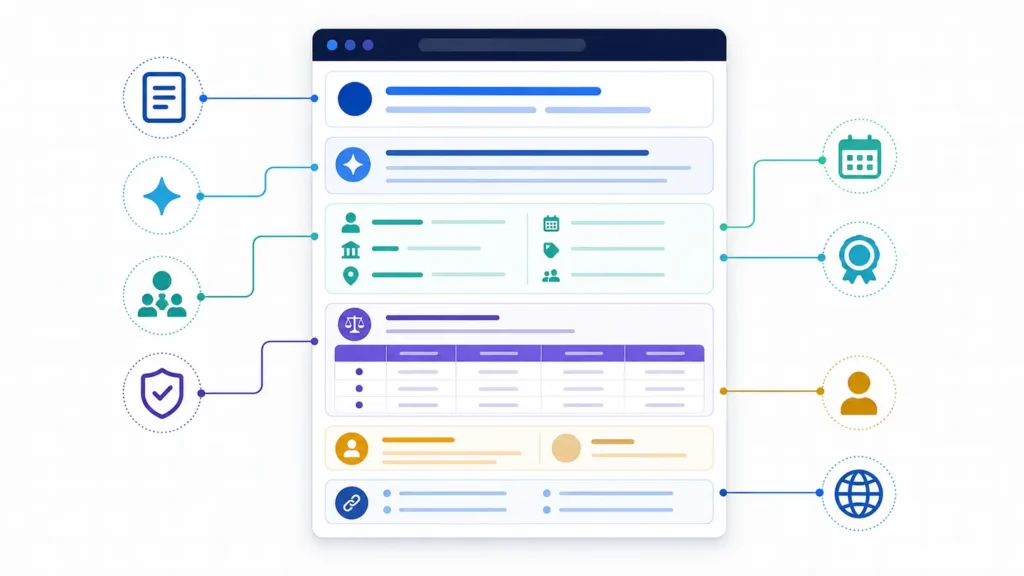
Open the section with one or two sentences that answer the heading directly. A useful definition often follows this pattern: entity + category + distinguishing function + important limitation. Put background and examples after the answer instead of forcing the reader through a long introduction.
Name entities and keep terms consistent
Use the actual company, tool, standard, location or person name where ambiguity matters. Explain acronyms on first use. Link the first meaningful mention to an authoritative internal or external page. This supports the broader entity signals for AI search visibility without repeating a keyword unnaturally.
Make factual support visible
Show authorship, dates, methods, limitations and source links next to the claims they support. Tables are useful when readers need exact comparisons, but prose should still explain the conclusion. Structured data can help search engines understand page elements and enable rich results, yet Google explicitly says it is not required for generative AI search. Add schema only when it accurately matches visible content.
Step 3 — Inspect the evidence and separate access, rendering and content failures
If an AI answer does not use the page, do not assume the copy is the problem. Diagnose the delivery chain first. A brilliant passage cannot be selected if the relevant system cannot fetch or process it.
| Failure layer | What to inspect | Typical evidence |
|---|---|---|
| Access | robots.txt, firewall rules, bot challenges, redirects and response status | 403, 429, challenge page, denied user agent or missing crawler log |
| Rendering | Raw HTML, rendered DOM, JavaScript and API responses | Empty application shell, delayed text or blocked resources |
| Indexing | Canonical, noindex controls, duplicate URLs and search inspection tools | Wrong canonical, excluded URL or stale indexed version |
| Content | Answer completeness, entity clarity, evidence, dates and passage structure | Vague claims, missing source, unclear subject or unsupported statistic |
| Selection | Prompt fit, competitors cited and repeated outcome across runs | Page is accessible but another source provides stronger or fresher support |
Diagnostic rule: Fix the earliest failing layer first. If the server returns a bot challenge, rewriting the conclusion will not solve access. If access and rendering pass but the passage remains vague, then content is the correct layer to change.
Step 4 — Apply the smallest safe fix and document the change
Write a one-line hypothesis before editing: “If we add a direct definition, named evidence and a visible limitation to this section, the page will provide a more complete support passage for prompts about X.” Then change only what the hypothesis requires.
- Replace an ambiguous opening with a direct, scoped answer.
- Add the full entity name and define specialized terminology.
- Attach each important number to a visible source, date and method.
- Separate the main answer from examples, exceptions and promotional copy.
- Add a descriptive internal link to the relevant pillar, such as How to Make Website Content Citable by AI.
- Record the edited URL, block or heading, timestamp, editor and exact before-and-after copy.
Preserve a revision so the test remains reversible. Avoid simultaneous title changes, redesigns, schema additions and large link campaigns; too many variables make the result impossible to interpret.
Step 5 — Retest with the same inputs and define a pass condition
- Verify that the public URL returns a successful response and the revised passage appears in raw HTML and the rendered page.
- Confirm the canonical, indexability controls, author, update date and structured data remain consistent.
- Repeat the original prompt set in the same products and conditions after allowing reasonable discovery time.
- Compare answer completeness, source links, close quotation, competitor mentions and volatility across repeated runs.
- Document both positive and negative results. A non-result is valuable when the test conditions are clear.
Practical pass condition: The page passes the content test when a human can locate one complete, supported answer beneath the matching heading; the technical test when that passage is publicly accessible and indexable; and the outcome test only when repeated prompt runs show a measurable improvement. Passing the first two does not guarantee the third.
Worked example — from vague claim to verifiable passage
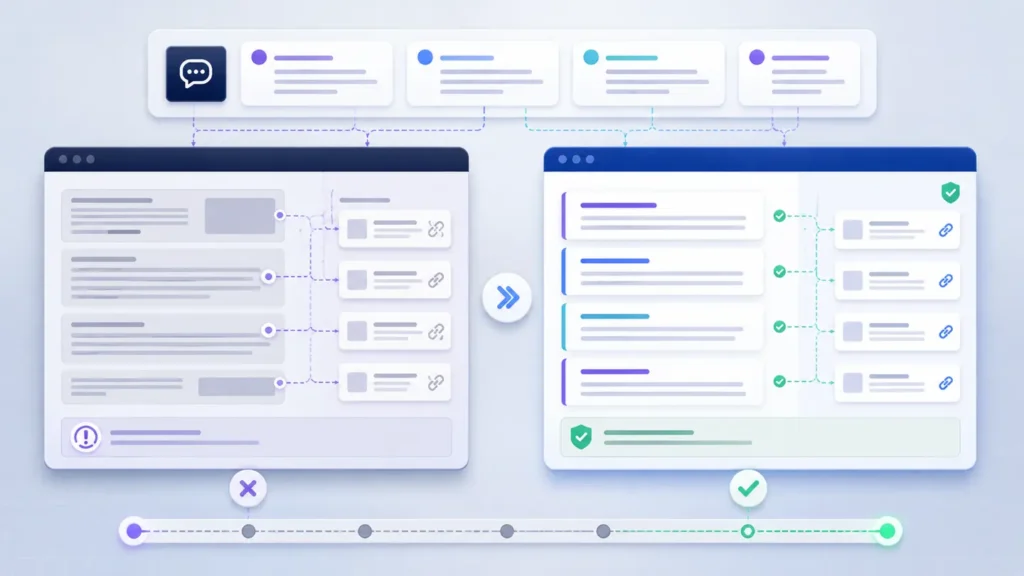
Illustrative example, not a performance claim: imagine a SaaS page answering “What does an AI visibility audit check?” The baseline paragraph says the audit “checks everything and improves results.” It provides no definition, named checks, method or limitation. Search systems can fetch the page, but a reviewer cannot identify one defensible answer.
| Stage | Record |
|---|---|
| Inputs | One unchanged URL, ten fixed prompts, two AI-search products, the same region and a four-run comparison window. |
| Baseline observation | The page loads and is indexable, but the answer mixes marketing claims with undefined technical checks and no supporting method. |
| Small fix | Add a direct definition, list crawl access, rendering, indexability, entity clarity and evidence checks, then state that the audit diagnoses eligibility and does not guarantee citations. |
| Verified page result | The revised answer is present in raw HTML, matches the visible page, names the audit scope and links to supporting methodology. |
| Outcome decision | Count only repeated source inclusion or close quotation against the preserved baseline. If results do not change, keep the clearer page for users and test the next hypothesis. |
The verified page result is within your control; an external citation is not. This distinction prevents teams from reporting an attractive rewrite as an AI-visibility win before evidence exists.
Evidence and screenshots to include
- The original and revised passage with the changed sentence highlighted.
- Raw HTML and rendered-page captures showing the same answer and heading.
- HTTP status, canonical, robots controls and last-modified evidence.
- The fixed prompt list and the date, product, model or mode, region and account conditions used.
- Full answer screenshots, cited URLs, quoted wording and competitor sources for each run.
- A comparison sheet with “not mentioned,” “mentioned,” “linked,” and “closely quoted” as separate outcomes.
- Method notes explaining discovery delay, retries, personalization and any failed runs.
The common interpretation mistake
The most common mistake is adding schema, short answers or a table of contents and then crediting those changes for a citation. Those features may improve clarity or eligibility, but they do not repair weak evidence. A concise claim that is wrong, anonymous or unsupported is simply easier to read—not more sourceworthy.
The opposite mistake is writing dense academic prose to appear authoritative. Sourceworthiness comes from useful original information, transparent methods, precise entities and honest limitations. Google’s guidance favors unique, non-commodity, people-first content and warns against rewriting purely for AI systems. The best AI-ready passage is usually the passage a careful customer would trust.
Frequently asked questions
Does shorter content get quoted by AI more often?
There is no universal ideal length. Use the shortest passage that answers the question completely, then provide evidence, context and exceptions. Do not remove necessary nuance simply to create small “chunks.”
Do I need special schema to make content easy for AI to quote?
No special generative-AI schema is required. Use supported structured data when it accurately describes visible page content and serves normal search features. Schema cannot rescue an unsupported claim.
Should every heading be written as a question?
No. Descriptive headings can work just as well. The heading should reveal the section’s purpose, while the opening sentences should deliver the answer readers expect.
How long should I wait before retesting?
Wait long enough for the platform to rediscover the revised page, then repeat tests on a documented schedule. Timing varies by crawler, index and site. Keep technical verification separate from external answer testing.
Can allowing OAI-SearchBot guarantee a ChatGPT citation?
No. OpenAI recommends allowing OAI-SearchBot for eligibility in ChatGPT search results, but access does not guarantee selection, ranking, quotation or citation. GPTBot is a separate control for model-training crawling.
Next step
Run one clean experiment: Start with the How to Make Website Content Citable by AI guide, pair it with the HTML visibility test, and use the AI Search Readiness checklist to record the baseline, single change and retest. One reproducible result is more valuable than dozens of unverified “AI optimization” edits.
Sources
- Google Search Central: Optimizing your website for generative AI features (accessed August 6, 2026).
- Google Search Central: Creating helpful, reliable, people-first content (accessed August 6, 2026).
- Google Search Central: Introduction to structured data (accessed August 6, 2026).
- OpenAI: Overview of OpenAI crawlers (accessed August 6, 2026).