

A free AI citation readiness grader should answer a useful question before it displays a score: can an AI search system reach this page, understand what it says, connect it to the right entity, and find evidence worth citing? This guide explains the grading method Visible Pilot is developing and gives you the same checks to run manually today. No score can guarantee a mention or citation, but a transparent audit can reveal the obstacles you control.
Pre-launch note: Visible Pilot’s automated grader is still being prepared. The scoring framework below is usable now, and readers can request an early manual check without being told that an unfinished scanner is already live.
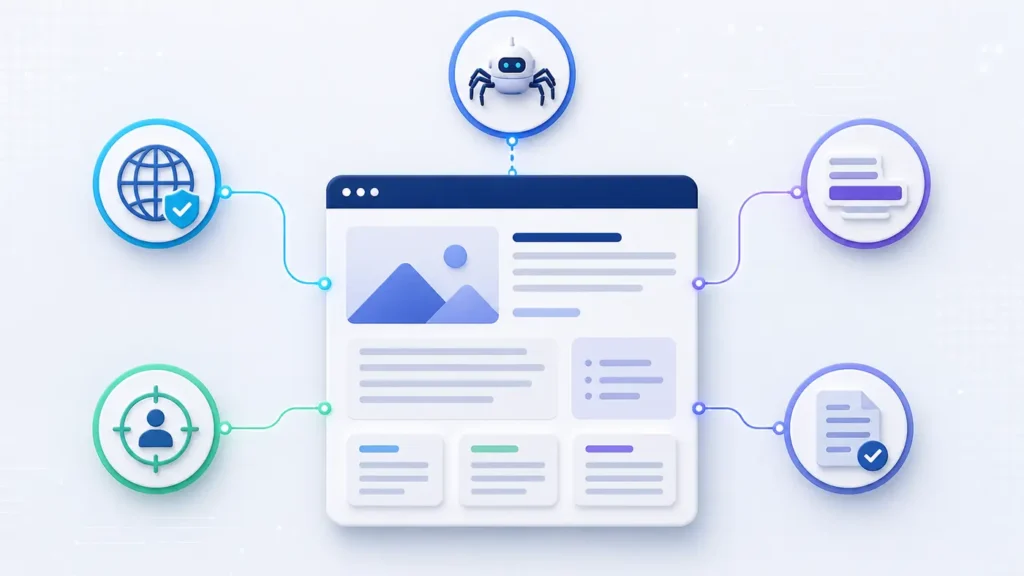
What the free AI citation readiness grader checks
Citation readiness is broader than “good SEO.” A page may rank in conventional search yet be difficult for an AI system to fetch, parse, attribute, or support with reliable evidence. Conversely, a technically clean page may remain uncited because it gives vague claims with no clear source, author, date, or entity context. The grader separates these failure types instead of hiding them inside one unexplained number.
- Crawler access: whether representative public URLs return useful content instead of a 403, challenge page, redirect loop, login wall, or empty shell.
- Index and snippet controls: whether robots rules, page-level directives, canonicals, and conflicting headers permit the intended discovery and presentation.
- Answerability: whether the page gives direct, specific answers with descriptive headings, definitions, steps, tables, and concise supporting context.
- Entity clarity: whether the organization, author, product, location, and topic are consistently named and connected across visible content and structured data.
- Evidence quality: whether important claims are backed by first-party data, credible sources, dates, methodology, examples, and links readers can verify.
Each category is necessary, but none is sufficient alone. OpenAI’s current publisher guidance says sites seeking inclusion in ChatGPT search should allow OAI-SearchBot and notes that cited links depend on discoverability. Its crawler documentation also distinguishes OAI-SearchBot for search from GPTBot for potential model training. That distinction matters because a site can choose different policies for search visibility and training rather than treating every AI user agent as the same.
How the grader works: tests, scoring rules, and limits
The proposed workflow starts with one canonical URL and follows a fixed request path. It validates the URL, fetches robots.txt, requests the page, records status and redirects, inspects response headers, parses the initial HTML, and compares key visible signals with relevant metadata. When possible, a rendered check is added to detect content that appears only after JavaScript execution. The result preserves the evidence behind every pass, warning, or failure.
The score uses five categories worth 20 points each. A hard access failure caps the total because content that cannot be fetched cannot be evaluated reliably. Warnings reduce the score only when they indicate an observable risk; optional enhancements do not masquerade as critical errors. This prevents the common audit pattern in which dozens of cosmetic suggestions bury the one issue actually blocking discovery.
| Dimension | Maximum | What earns points | Typical failure |
|---|---|---|---|
| Crawler access | 20 | Public page returns stable 200 HTML to the intended crawler class | 403, 429, challenge, timeout, redirect loop |
| Index controls | 20 | Intended URL is crawlable, canonical, and not excluded by page or header rules | Blocked resources, noindex, conflicting canonical |
| Answerability | 20 | Direct answers, descriptive structure, useful context, extractable facts | Vague copy, hidden primary content, weak headings |
| Entity clarity | 20 | Consistent names, authorship, ownership, and relevant structured data | Ambiguous brand or author, mismatched markup |
| Evidence | 20 | Dated sources, methodology, examples, and verifiable claims | Unsupported claims, stale facts, no source trail |
Results explained: pass, warning, fail, and evidence
A useful grader never gives only a colored badge. Every finding should name the tested URL, the observation, why it matters, and the smallest reasonable next step. It should also distinguish what was verified from what remained inconclusive.
- Pass: the tested evidence meets the stated rule. For example, the canonical page returns 200 and contains the expected primary content.
- Warning: the page is usable, but a condition may reduce clarity or reliability. For example, the author is visible while the biography and organization relationship remain incomplete.
- Fail: an observable condition prevents the test from succeeding, such as a crawler receiving 403 or the canonical page carrying noindex.
- Inconclusive: the grader could not safely determine the result because of a timeout, bot challenge, location-dependent response, or rendering limitation.
Do not treat the number as a ranking factor. A readiness score is a diagnostic summary, not evidence that an AI platform has indexed, retrieved, selected, or cited the page. Those are separate outcomes and must be measured separately.
Google’s structured-data guidelines reinforce the same evidence-first principle: markup should represent the page’s main visible content, remain accessible, use specific applicable types, and avoid misleading or hidden claims. Valid schema can help a system understand a page, but Google explicitly does not guarantee a search feature merely because structured data is present. The grader therefore rewards alignment and completeness, not schema quantity.
Example result for a healthy page and a blocked page
Consider two product-guidance pages covering the same question. The healthy page returns useful server-delivered HTML, names the company and author consistently, gives a direct answer, and cites dated first-party specifications. The problem page is blocked by a firewall for automated requests, delivers only a JavaScript shell, and contains promotional claims without sources. The table shows how the framework exposes the difference without claiming that the higher-scoring page will definitely be cited.
| Check | Healthy page | Blocked/problem page |
|---|---|---|
| Access | 20 — stable 200 response | 0 — 403 challenge at the edge |
| Index controls | 18 — canonical and eligible | 8 — conflicting canonical and directives |
| Answerability | 17 — direct answer and structured sections | 7 — generic copy in client-rendered tabs |
| Entity clarity | 16 — organization and author aligned | 6 — brand and publisher relationship unclear |
| Evidence | 18 — dated sources and methodology | 4 — claims lack supporting references |
| Overall | 89/100 — ready for platform testing | 25/100 — fix access before deeper analysis |

Privacy and data handling
A public-page grader should request only the URL and the public resources required to evaluate it. It should not ask for passwords, private dashboards, customer records, unpublished copy, or payment information. A responsible implementation records the minimum diagnostic data needed to reproduce a result, limits retention, and makes its policy visible before a scan begins. Sensitive paths such as account, checkout, admin, preview, and API endpoints should be excluded by default.
During the pre-launch manual-check stage, submit only a public URL you are authorized to assess. Visible Pilot should disclose what is reviewed, how long the request is retained, and whether anonymized findings may contribute to aggregate research. Private or authenticated analysis requires a separate consent and security process; it should never be implied by a simple public URL form.
Troubleshooting invalid URLs, protection, timeouts, and inconclusive tests
- Invalid URL: include the full HTTPS address and test the canonical public page, not an editor preview or local development host.
- Bot protection: inspect CDN or WAF events before adding an exception. Verify crawler identity and limit any rule to intended public paths; never trust a copied user-agent string alone.
- Timeout: retest the page from more than one request context, then review server response time, redirects, DNS, cache behavior, and origin health.
- Empty HTML: compare raw source with the rendered page. If the main answer appears only after interaction or client-side JavaScript, provide meaningful server-delivered content.
- Inconclusive result: preserve the timestamp, response headers, request path, and screenshot. A transparent “unknown” is more useful than a confident but fabricated pass.
Related manual checks you can run today
- Open the page in a private browser and confirm its final URL, status, canonical, title, and visible main answer.
- Review robots.txt for the crawler policy you actually intend. For ChatGPT search, consult OpenAI’s current crawler documentation rather than copying an outdated bot list.
- Check page-level robots meta tags and X-Robots-Tag headers. Google notes that a crawler must be able to access a page to see its noindex instruction.
- View raw HTML and verify that the central answer, organization name, author, dates, citations, and essential links are present without requiring a click.
- Validate applicable structured data and compare every marked-up fact with visible content. Remove irrelevant or unsupported properties.
- Run a fixed set of platform prompts over time and record mentions, links, citations, and exact source URLs separately from the technical score.
Strengthen the page beyond the score
Once access and controls pass, improve the page itself. Lead with a direct answer, define the subject precisely, use descriptive headings, and support consequential claims with original evidence or authoritative references. Keep dates and methodology near time-sensitive facts. Build internal links that explain how the page fits the broader topic rather than linking only for keyword repetition.
For the wider framework, read How to Make Website Content Citable by AI. If your competitors appear in answers while your brand does not, use the diagnostic approach in why AI answers mention competitors but not my brand to separate access, authority, entity, content-fit, and evidence gaps.
Priority order: fix hard access and exclusion failures first; then make the answer and entity explicit; finally strengthen evidence and measure real platform outcomes. Rewriting copy cannot compensate for a 403, and a 200 response cannot compensate for unsupported claims.
Frequently asked questions
How accurate is a free AI citation readiness grader?
It can be accurate about observable technical and content conditions when it shows the underlying evidence. It cannot predict a citation with certainty because AI platforms use changing retrieval systems, indexes, models, query context, and third-party sources. Treat the score as a prioritized audit, not a forecast.
Which websites can use the grader?
The framework applies to publicly accessible business, ecommerce, SaaS, publisher, service, and knowledge pages. Authenticated applications, intranets, personalized pages, and highly location-dependent content need a controlled audit with permission and a documented test environment.
How often should citation readiness be checked?
Retest after a CMS migration, redesign, CDN or firewall change, robots update, schema deployment, major content rewrite, or domain move. For stable sites, a monthly technical sample and quarterly content review is a practical starting cadence. Always record dates because crawler rules and platform behavior change.
Does a high score mean ChatGPT, Gemini, Claude, or Perplexity will cite my page?
No. A high score means the tested page has fewer obvious barriers and stronger citation inputs. Platform inclusion and selection remain outside the site owner’s direct control. Measure each platform with a repeatable prompt set and preserve the cited URLs rather than assuming one platform represents all of them.
Do I need structured data to be cited by AI?
Structured data can provide explicit clues about entities and page meaning, but it is not a universal citation requirement and does not replace visible, accurate content. Use the most applicable types, keep markup aligned with what readers see, and avoid adding properties merely to inflate a score.
Next step: run the free Visible Pilot check
Visible Pilot’s automated free AI citation readiness grader is being finalized. If you want the framework applied before launch, request a free manual citation-readiness check for one public URL. You will receive the highest-priority access, clarity, entity, and evidence findings without a fabricated guarantee of ranking or citation.
Sources reviewed 6 August 2026: OpenAI Publishers and Developers FAQ, OpenAI crawler documentation, Google structured-data guidelines, and Google noindex guidance.