

When AI answers mention competitors but not your brand, the problem is rarely a single missing tag. Your site may be technically blocked, poorly represented in search indexes, unclear about the entity it describes, weakly matched to the question, or simply not selected as a source in that response. Those are different failures, so they need different tests.
The practical goal is not to “force” a model to recommend you. It is to remove technical barriers, make your expertise easy to verify, and measure whether the same prompts produce better quotation, citation, and brand-mention outcomes after a controlled change.
Quick answer: Competitors are often mentioned because they are easier to retrieve, understand, verify, or support with independent evidence. Start by proving access and rendering, then compare your page’s factual coverage, entity clarity, and source support against the pages that appear.
Quick diagnosis: why AI answers mention competitors but not my brand
Begin with the answer that actually disappointed you. Save the prompt, platform, date, location or account conditions, full response, cited URLs, and competitor names. Then ask which of these explanations best fits the evidence:
- Your content was not available. A crawler encountered robots rules, a firewall challenge, a non-200 response, a login, or an empty client-rendered shell.
- Your page was available but not retrieved. It may be weakly indexed, buried in the site, poorly linked, stale, or a poor semantic match for the prompt.
- Your brand entity is ambiguous. The site uses inconsistent names, descriptions, categories, authors, locations, or product terminology.
- Your answer is not source-ready. Claims lack dates, methods, examples, first-party data, named authors, or links to primary evidence.
- A competitor was the safer selection. Its relevant page may be clearer, more specific, better corroborated, or closer to the question’s intent.
Symptom map: access failure versus discovery and citation gaps
Do not treat every missing mention as an “AI visibility” problem. A 403 response is an access failure. Important copy that appears only after a fragile script runs is a rendering failure. A healthy, indexed page that is not chosen for a particular answer is a retrieval or citation-selection gap. Use the first failing layer as your starting point.
| Observed symptom | Most likely layer | First proof to collect |
|---|---|---|
| Your page cannot be opened or fetched | Access | Status, robots rules, firewall and crawler logs |
| The page opens but key claims are missing | Rendering or delivery | Raw HTML versus rendered DOM |
| Your brand is absent only for certain questions | Relevance and coverage | Prompt-to-passage mapping |
| Your facts appear but a competitor gets named | Entity or source selection | Brand consistency, support and citations |
| Results change across repeated runs | Platform variance | Dated multi-run test log |
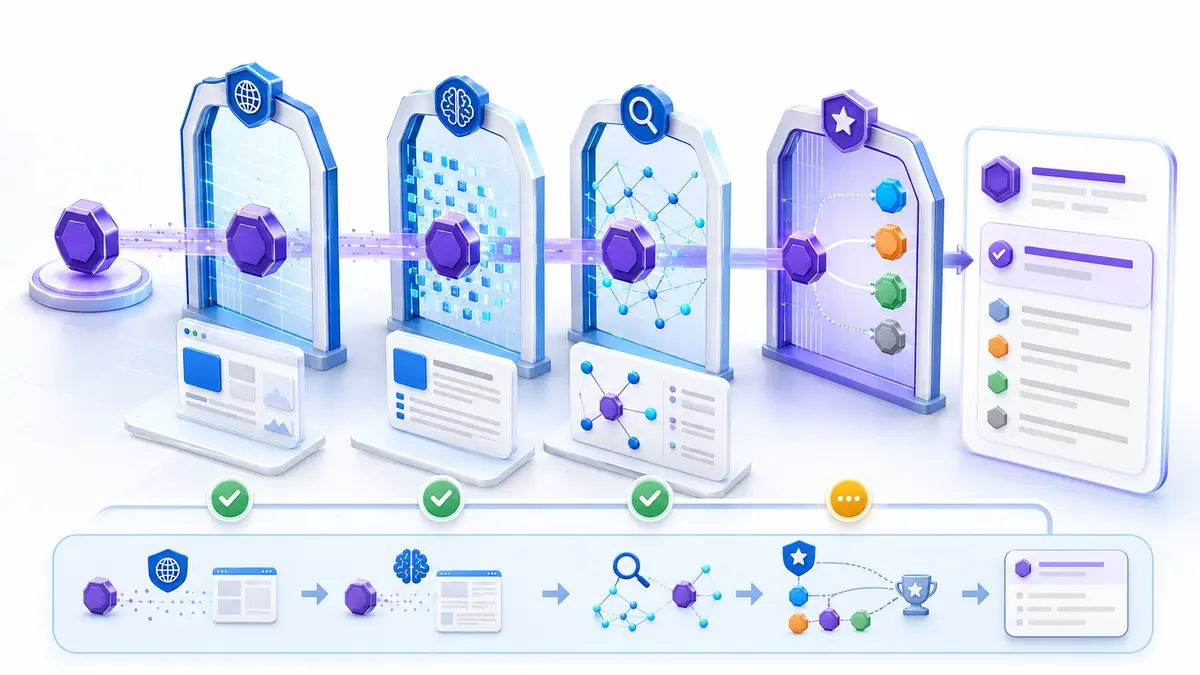
Test 1: reproduce the issue on representative URLs
Choose three to five pages that should support the missing mention: a homepage or about page, the most relevant service or product page, a detailed evidence page, and one strong comparison or case study. Test them without cookies and through direct URLs.
- Record the final status code, redirects, canonical URL, indexability directives, and robots rules.
- Compare raw HTML with the rendered page. The brand name, primary topic, essential claims, supporting links, and authorship should not depend on a late interaction.
- Check whether the page is linked from navigation, a hub page, the XML sitemap, and relevant articles.
- Search the page for the exact facts needed to answer the prompt. A broad marketing page may mention the topic without providing a usable answer.
- Repeat the prompt several times and preserve all results, including runs where no source is cited.
If raw HTML and the rendered page differ substantially, use the diagnostic process in JavaScript rendering issues for AI crawlers. If ChatGPT cannot open the page at all, start with why ChatGPT can’t read your website.
Test 2: rewrite one page section and hold the prompt set constant
Pick one page and one narrow question. Rewrite only the section that should answer it. Add a direct answer, define the relevant entity, support the claim with a method or primary source, include a date where freshness matters, and link to deeper proof. Do not simultaneously change robots rules, schema, internal linking, ten other pages, and the prompt set.
Run the same prompts before the change, after the page is recrawled, and again on a scheduled follow-up. Track four separate outcomes: whether the brand is mentioned, whether its wording is accurately quoted, whether the page is cited, and whether the answer sends a user to your site. A mention without a supporting link is not the same result as a citation.

Controlled-test rule: Keep the prompt wording, platform, account or location conditions, target URL set, and scoring method constant. Change one meaningful page section, document the crawl or index timing, and report variance across multiple runs.
Root-cause checks: directives, delivery and entity signals
1. Crawler access and content delivery
For ChatGPT search, OpenAI’s current publisher and developer guidance says sites should not block OAI-SearchBot if they want content included in summaries and snippets. That is an eligibility step, not a promise that any page will be cited. Confirm robots access, stable 200 responses, firewall behavior, server logs, and meaningful initial HTML.
2. Topic match and answer completeness
Map each target prompt to a specific passage. The passage should answer the question without requiring a reader to combine vague claims from multiple pages. Include the conditions, scope, limitations, and next decision. A competitor with a tightly matched comparison, benchmark, or tutorial can outrank a famous brand’s generic service page for that prompt.
3. Brand and entity consistency
Use one primary brand name and a stable description of what the company does. Keep organization details, product names, authors, locations, contact information, and social profiles consistent across important pages. Link the brand to real people, products, research, and evidence. Structured data can reinforce visible information, but it should describe what users can already verify on the page.
4. Sourceworthiness and factual support
Replace unsupported superlatives with verifiable details: sample size, methodology, date, comparison criteria, limitations, original screenshots, change logs, or first-party results. Google’s current guidance for generative AI features emphasizes foundational SEO and valuable, non-commodity content; it also warns that special AI markup and overfocused structured data are not shortcuts to visibility.
5. Independent corroboration
Strengthen genuine references beyond your own domain: relevant industry coverage, partner pages, customer evidence, expert contributions, conference profiles, directories with editorial standards, and useful community participation. Do not manufacture mentions. A consistent, supported reputation is more useful than a burst of low-quality citations that repeat the same marketing copy.
Fixes ordered by impact, effort and risk
- Highest impact: repair blocked crawling, non-200 responses, empty rendered content, incorrect canonicals, and inaccessible key assets.
- High impact: create one definitive page for each commercial topic and connect it to supporting tutorials, comparisons, evidence, and case studies.
- High impact: publish original proof—benchmarks, tests, datasets, screenshots, methods, and clearly dated findings that another answer can responsibly cite.
- Medium impact: clarify organization, product, author, and service entities in visible copy and consistent structured data.
- Medium impact: improve internal links with descriptive anchors from relevant pages, not only from a footer or sitemap.
- Lower-risk refinement: tighten headings, summaries, tables, definitions, and FAQs after the evidence and page purpose are strong.
Priority principle: Fix the earliest failing layer first. Better prose cannot solve a firewall block, and more schema cannot compensate for weak evidence or an irrelevant page.
Verification: evidence that proves progress
A successful fix should improve repeatable evidence rather than one favorable screenshot. Build a small measurement sheet or dashboard with the prompt, platform, run date, answer, competitor mentions, your brand mention, quotation accuracy, citation URL, and referral traffic where available.
- Representative URLs return stable 200 responses and meaningful HTML to anonymous fetches.
- Target pages are indexed or otherwise discoverable in the platform’s relevant search layer.
- The brand name, product, category, author, and key facts are presented consistently.
- The rewritten passage answers the target prompt and links to primary evidence.
- Repeated runs show a higher and more stable mention or citation rate, with exact URLs recorded.
- Analytics or server logs show visits from cited links. OpenAI notes that ChatGPT referral URLs can include
utm_source=chatgpt.com.
When the website is healthy but the platform still does not cite it
A technically healthy site can still be absent. Answer generation is selective and can vary with prompt phrasing, freshness, location, account context, and the sources retrieved on that run. Your page may also be relevant but redundant: if several sources support the same claim, a system may cite only a subset.
At that point, improve the value of the source, not just its formatting. Add evidence no competitor offers, answer a narrower decision, explain a method, publish a transparent comparison, or update stale information. Google’s people-first content guidance similarly recommends useful, reliable material created for readers rather than pages produced mainly to manipulate rankings.
Evidence and screenshots worth keeping
- The full prompt and unedited answer for every test run.
- Every cited URL, the passage it supports, and the competitor mentioned beside it.
- Raw HTML, rendered screenshots, final status, canonical, and indexability settings for target pages.
- Crawler, CDN, and firewall events from the exact testing window.
- Before-and-after copies of the changed section and the publication date.
- A simple score separating mention, accurate quotation, citation, and referral—four different outcomes.
Common interpretation mistake
Do not assume “add schema and shorter answers” is the cure. Schema can clarify visible entities and content types, while concise passages can improve usability. Neither creates independent proof, relevance, trust, or guaranteed selection. Improve factual support, clarity, and sourceworthiness first; then use markup to describe that stronger page accurately.
Frequently asked questions
Can I guarantee that an AI answer will mention my brand?
No. You can improve eligibility, relevance, clarity, evidence, and measurement, but a platform controls retrieval and answer selection. Treat any guaranteed-mention promise with skepticism.
Does organization schema make AI systems recognize my brand?
It can help describe the organization consistently, especially when it matches visible information, but it is not proof of authority and does not guarantee a mention. Validate the page content, entity consistency, and supporting evidence together.
How long should I wait after improving a page?
There is no universal recrawl or refresh period across AI platforms. Record when the page changed, verify when relevant crawlers revisit it, and run the same test set on a schedule rather than drawing a conclusion after one day.
Should I create separate pages for every prompt variation?
Usually not. Build a strong page around one clear user need and cover its genuine follow-up questions. Google’s current guidance warns against producing many query variations primarily to manipulate generative responses.
Why is a competitor mentioned even when my product is better?
Answer systems cannot judge unseen product quality. They work from accessible evidence and retrieved sources. A weaker product with clearer documentation, better corroboration, and a page that directly matches the question may be easier to mention responsibly.
Next step: build a citation-ready evidence trail
If AI answers mention competitors but not your brand, begin with one prompt, one page, and one controlled improvement. Verify access, make the answer passage independently useful, support it with primary evidence, and track mentions and citations separately. Then expand the method across your most valuable product and service topics.