

An AI visibility audit for small business websites should answer a practical question: when customers use ChatGPT, Google’s AI features, Perplexity, or another answer engine, can those systems access, understand, retrieve, mention, and cite your business accurately? A useful audit does not stop at a branded prompt or one attractive score. It produces evidence that helps you decide what to fix first.
Small businesses need a focused version of this work. You probably do not need thousands of prompts, an enterprise dashboard, or a report filled with speculative “AI ranking factors.” You need a representative sample of customer questions, tests on the pages that support revenue, and a prioritized roadmap that fits your website, team, and budget.
Quick answer: A good small-business AI visibility audit checks five layers separately: technical access, search discovery, brand and entity clarity, answer-ready evidence, and repeatable visibility outcomes. If a provider combines all five into one unexplained score, ask to see the underlying tests and denominator.
What an AI visibility audit for small business should reveal
The audit should identify the earliest failing layer between your website and an AI-generated answer. That distinction matters because the remedies are different. Better copy cannot solve a firewall block, while changing robots.txt cannot make an unsupported claim more citable.
- Access: whether important URLs return stable 200 responses, respect intended crawler rules, avoid login or firewall challenges, and deliver meaningful HTML.
- Discovery: whether revenue pages are indexable, canonicalized correctly, linked internally, included in the sitemap, and discoverable through normal search systems.
- Entity clarity: whether the business name, services, locations, people, products, and proof are described consistently.
- Answer coverage: whether a specific passage answers each target question with useful scope, conditions, examples, dates, and supporting sources.
- Mentions and citations: how often the brand appears, which URL is cited, how competitors compare, and how results vary across repeated runs.
- Commercial impact: which findings affect high-value pages and customer decisions, rather than merely changing a vanity score.
Scope: pages, platforms, technical layers and evidence
Start small enough to finish. Select roughly 10–20 prompts across brand, service, problem, comparison, local, and purchase-intent questions. Map each prompt to the page that should support the answer. Include the homepage, primary service or product pages, location pages where relevant, the about page, and your strongest proof such as reviews, case studies, original research, pricing, policies, or detailed guides.
Test platforms that your customers actually use. Keep platform results separate because access controls, source retrieval, answer formats, and citations can differ. For ChatGPT search eligibility, OpenAI’s current crawler documentation says OAI-SearchBot is used to surface websites in ChatGPT search and recommends allowing it when a site wants to appear. That is an eligibility step, not a guarantee of inclusion or citation.
| Audit layer | Representative test | Useful evidence |
|---|---|---|
| Crawler access | Request key URLs and review directives, status and delivery | robots.txt snapshot, headers, logs, raw HTML |
| Search discovery | Check indexability, canonical, sitemap and internal links | inspection screenshots and indexed URL |
| Brand clarity | Compare names, descriptions, locations and organization facts | page excerpts and structured-data validation |
| Source quality | Map each prompt to an answer passage and supporting proof | dated passage, author, method and source links |
| Visibility | Repeat the same prompt set under recorded conditions | mentions, citations, URLs, competitors and run date |
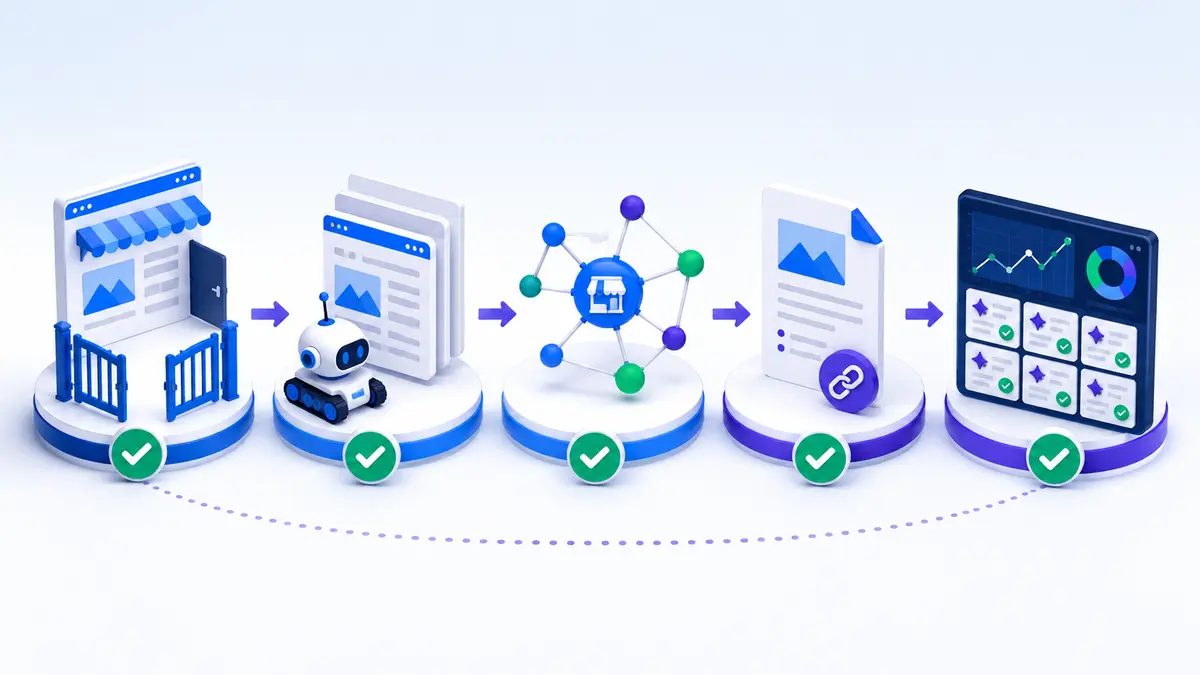
Audit process: baseline, tests, findings, prioritization and retest
1. Define the baseline before changing the site
Write down the audit date, platforms, account or location conditions, prompt wording, run count, target URLs, and scoring rules. Save every response, including runs with no citation. A baseline created after a rewrite cannot prove whether the rewrite helped.
2. Test the website before testing prompts
Confirm that the target pages are accessible, indexable, internally linked, and useful in initial HTML. Compare raw HTML with the rendered page if the site relies on JavaScript. The diagnostic steps in JavaScript rendering issues for AI crawlers can help separate a polished browser experience from content that an automated fetcher may not receive.
3. Run representative prompts more than once
Use identical prompts across a small number of repeated runs and record results separately. Track brand mention, citation presence, exact cited URL, factual accuracy, position in the answer, sentiment, and competitors. Do not silently replace an unsuccessful prompt or count only favorable outputs.
4. Convert findings into prioritized fixes
Rate every issue by business impact, confidence, effort, and dependency. A blocked service page with proven demand normally outranks a cosmetic schema warning. A missing case study may outrank ten minor title edits if comparison prompts consistently cite competitors with stronger evidence.
5. Retest after one controlled change
Hold the prompt set and measurement rules constant. Change one meaningful layer, wait for the relevant page to be recrawled or reprocessed, then repeat the test. Compare rates with the same denominator and keep the raw evidence. Improvement across several runs is more persuasive than one impressive screenshot.
Deliverables a small business can actually use
The final report should be short enough to act on but detailed enough to verify. A 100-page export is not automatically more valuable than a ten-page report linked to reproducible evidence.
| Deliverable | What it should contain | Decision it supports |
|---|---|---|
| Executive summary | Top failures, evidence and likely business effect | What needs attention now? |
| Issue inventory | Affected URLs, proof, confidence and owner | Who fixes each problem? |
| Prompt benchmark | Prompt set, model, date, runs and outcomes | Where is the brand absent or misrepresented? |
| Competitor comparison | Shared prompts, cited domains and content differences | What evidence or coverage is missing? |
| Fix guidance | Specific technical or content change with acceptance test | What does “done” mean? |
| Roadmap | Impact, effort, dependency and retest date | What comes first and when? |
Acceptance-test rule: Every recommendation should include a way to verify completion—for example, “target URL returns 200 with meaningful HTML to an anonymous fetch” or “five repeated runs use the same prompt and record the cited URL.”
Evidence and screenshots worth keeping
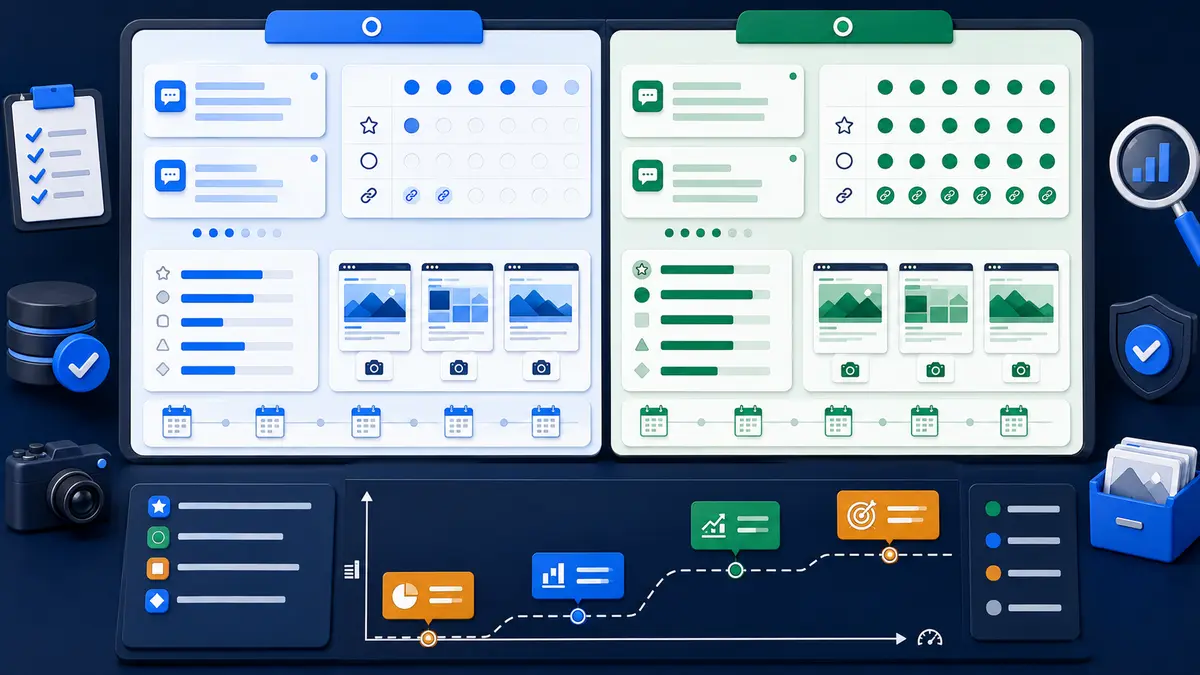
Evidence makes an audit defensible. It also lets another employee, developer, or consultant reproduce the finding later. Store it in a shared folder or sheet using consistent filenames and dates.
- The full prompt, model or product name, test date, account or geography conditions, and unedited response.
- The number of runs and the transparent denominator used for mention and citation rates.
- Your brand mention, competitor mentions, answer position, sentiment, and factual accuracy for every run.
- The exact cited URLs—not only cited domains—and whether each URL actually supports the claim.
- robots.txt, response headers, final status, canonical, noindex and raw-versus-rendered content evidence.
- Screenshots of key findings plus exported text or structured records, because screenshots alone are difficult to compare.
- The page version, change date, recrawl evidence, and retest date for every controlled experiment.
If competitors appear but your brand does not, use the diagnostic sequence in why AI answers mention competitors but not your brand to distinguish access, retrieval, entity, evidence and citation-selection problems.
What changes by site size, technology and business model
| Business situation | Adjust the audit | Common priority |
|---|---|---|
| Local service business | Add location, service-area, review and business-profile prompts | Consistent NAP, service proof and local landing pages |
| Small ecommerce store | Test products, categories, policies, availability and merchant data | Product facts, feeds, crawlable detail and trust |
| SaaS or online service | Add comparison, use-case, pricing, integration and security questions | Clear product entity, evidence and answer-ready pages |
| JavaScript-heavy site | Compare raw HTML, rendered DOM and anonymous fetch behavior | Server-rendered critical content and stable delivery |
| Multi-location or multilingual site | Segment prompts, URLs and results by market and language | Canonical, hreflang, entity and location consistency |
Google’s current guidance for generative AI features keeps foundational SEO central: crawlable and indexable pages, useful non-commodity content, and clear technical structure. It also warns against treating special markup, artificial mentions, excessive chunking, or third-party “internal” scores as shortcuts.
When a checklist is enough—and when expert help is justified
A checklist is usually enough when the site is small, the content management system is standard, key pages are indexable, there is no complex firewall or rendering layer, and someone can collect results consistently. Begin with ten prompts and five important URLs. Fix obvious access, page clarity, internal linking, and evidence gaps before buying continuous monitoring.
Expert help becomes reasonable when pages return inconsistent statuses, a CDN or WAF behaves differently by user agent or region, critical content depends on client rendering, several sites or markets must be compared, structured data conflicts with visible content, or the business needs a defensible benchmark for investment decisions. The expert should still explain the tests rather than asking you to trust a proprietary score.
Budget principle: Pay first for diagnosis that changes a decision. Continuous monitoring is valuable only after the prompt set, target pages, scoring rules, and ownership of fixes are defined.
How to compare AI visibility audit providers
- Ask for the exact platforms, prompt categories, run count, locations, pages, and technical checks included.
- Require raw results and screenshots in addition to a summary score.
- Check whether mention rate, citation rate, factual accuracy, sentiment, and competitor share are reported separately.
- Ask how prompt variance and repeated runs are handled.
- Confirm that every issue identifies affected URLs, evidence, impact, fix guidance, and an acceptance test.
- Look for a prioritized roadmap based on your business model—not a generic export of every possible warning.
- Reject guaranteed mentions, citations, rankings, or traffic. Eligibility and improvement do not guarantee selection in a particular answer.
- Confirm who owns the data, whether you can export it, and how a retest is priced.
The most common interpretation mistake
The biggest mistake is combining incomparable prompts, platforms, locations, dates, and vendor scores into one percentage without a transparent denominator. A brand may score 40% because it appeared in four of ten repeated purchase prompts, while another tool reports 70% from seven entirely different informational prompts. Those values do not form a valid trend.
Keep each metric tied to its prompt set and conditions. Report counts beside percentages: “6 citations in 30 recorded runs across 10 prompts” is clearer than “20% AI visibility.” Segment branded and non-branded questions, transactional and informational intent, and each platform. When the method changes, start a new baseline.
A practical 30-day small-business audit plan
- Days 1–3: choose 10–20 customer questions, map target pages, define metrics, and save the baseline.
- Days 4–7: test status, directives, canonicalization, raw HTML, rendering, sitemap inclusion, and internal links.
- Week 2: compare your answer passages, entity facts, evidence, and cited competitor pages.
- Week 3: fix the highest-confidence access issue and improve one commercially important page.
- Week 4: confirm recrawl or reprocessing, repeat the same prompt runs, document variance, and set the next priority.
Frequently asked questions
What is an AI visibility audit for a small business?
It is a structured review of whether AI-enabled search and answer systems can access, understand, retrieve, mention, and cite a business website. It combines technical checks, content and entity review, prompt testing, competitor evidence, and a prioritized remediation plan.
How many prompts should a small business audit?
Start with 10–20 representative prompts covering brand, services, problems, comparisons, local intent, and buying decisions. Repeating a smaller, stable set is usually more useful than running hundreds of undocumented prompts once.
Can an audit guarantee that ChatGPT or Google will cite my site?
No. An audit can identify barriers, improve eligibility and source quality, and measure outcomes. It cannot guarantee selection in a generated answer, because retrieval and answer generation vary by platform, prompt, freshness, context, and available sources.
Is AI visibility the same as Google ranking?
No. Search rankings, AI mentions, citations, answer position, sentiment, and referral visits are related but different outcomes. Track them separately. For Google’s AI features, normal search eligibility and foundational SEO remain important.
How often should the audit be repeated?
Retest after meaningful technical or content changes and after enough time for recrawling or reprocessing. For many small businesses, a quarterly benchmark plus targeted post-fix retests is more useful than daily monitoring.
Next step: build a transparent baseline
Begin with the pages and questions closest to revenue. Save the evidence, fix the earliest failing layer, and retest using the same method. Visible Pilot is being built to help small businesses and agencies turn these checks into a transparent, prioritized website roadmap.