
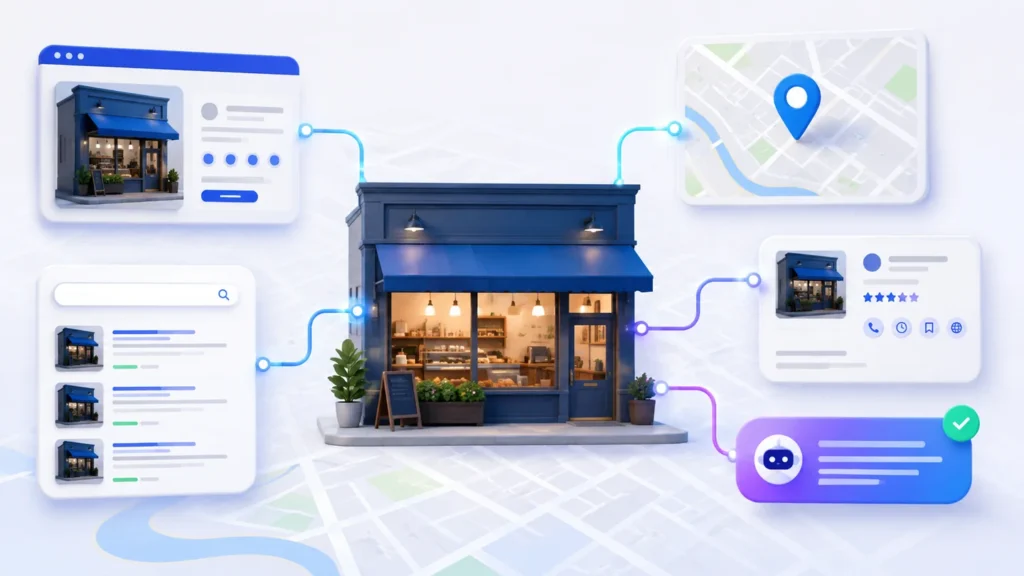
An AI visibility checklist for local businesses should answer a practical question: when a nearby customer asks an AI-powered search tool for a provider, can the system access your pages, identify the correct business, understand what you offer, and support its answer with reliable evidence? This checklist helps restaurants, clinics, contractors, shops, professional services, and multi-location teams test those layers separately.
Local visibility is not created by adding one schema field or repeating a city name. It depends on a chain: public pages must work, search systems must be allowed to discover them, business facts must agree across important sources, service and location pages must answer real questions, and results must be measured with a repeatable method. A failure near the start of that chain can make later content improvements ineffective.
Quick answer: Complete the critical checks first: public access, stable 200 responses, correct index controls, accurate business details, a verified business profile, useful service-and-location pages, and a documented prompt baseline. Then improve supporting evidence, structured data, reviews, images, and ongoing measurement.
Before you start: gather pages, access and baseline evidence
To use this AI visibility checklist for local businesses, do not begin by changing the website. First create an inventory of the pages and sources that should represent the business. Include the homepage, contact page, every active location page, priority service pages, about or team pages, booking or quote pages, review or case-study pages, and policies that influence a customer decision. For a service-area business, record the real service area without inventing offices or doorway pages.
Gather access to Google Search Console, Google Business Profile, the content management system, analytics, the sitemap, and—when available—CDN, firewall, and server logs. Save a copy of robots.txt, the page source or raw HTML for the most important URLs, and screenshots of current search and AI results. This is your pre-change evidence.
- Website inventory: homepage, services, locations, contact, about, proof, FAQs, booking or quote journey.
- Business facts: legal and public name, address or service area, phone, hours, category, services, staff, credentials, and canonical website URL.
- Discovery evidence: sitemap, internal links, Search Console inspection, indexed URLs, response status, canonical, and robots directives.
- Off-site sources: Google Business Profile, major industry associations, trusted local directories, press, review platforms, and social profiles that customers actually use.
- Prompt baseline: 10–20 fixed questions covering the brand, service, city, problem, comparison, price, trust, and purchase intent.
Check 1: crawler access in the AI visibility checklist for local businesses
Run the access checks on every revenue-critical page, not only the homepage. A page should load without a login, cookie-wall failure, CAPTCHA, geoblock, or browser challenge. Confirm the final response is normally 200, the URL does not enter a redirect loop, and meaningful business content is present in the returned HTML. Review CDN and WAF events for blocked or rate-limited requests.
For ChatGPT search eligibility, review OpenAI’s official crawler documentation. It identifies OAI-SearchBot as the crawler used to surface websites in ChatGPT search and recommends allowing it when a site wants to appear. OAI-SearchBot and GPTBot have independent controls: allowing search crawling does not require allowing model-training crawling. Access is an eligibility condition, not a promise that a page will be selected.
- Open
/robots.txtand check Googlebot and relevant AI-search crawler rules for accidental disallows. - Test the exact service and location URLs anonymously and confirm a stable final
200response. - Check that important CSS, JavaScript, images, and APIs are not blocked when they are needed to understand the page.
- Inspect firewall, bot-management, rate-limit, and CDN events for
403,429, challenge, timeout, or connection-refused patterns. - Confirm important pages are linked from crawlable navigation or relevant content and included in the XML sitemap.
- Verify there is one preferred URL for each page and redirects resolve to that URL consistently.
If you find an access failure, use the diagnostic sequence in Cloudflare blocks ChatGPT from reading a website. Fix the earliest failing layer before rewriting copy.
Check 2: technical delivery, rendering and index controls
This technical part of the AI visibility checklist for local businesses goes beyond public reachability. Check the canonical URL, robots meta tag, X-Robots-Tag, rendered title, main heading, visible copy, internal links, and structured data. Compare raw HTML with the rendered page if core business details arrive only after client-side JavaScript runs.
| Technical check | Pass condition | Evidence to save |
|---|---|---|
| Index control | No unintended noindex or restrictive snippet control on a target page | Rendered head and response headers |
| Canonical | Self-referencing preferred URL or a deliberate canonical to the correct page | Canonical tag plus final URL |
| Rendering | Business name, service, location and proof appear in usable page content | Raw HTML and rendered screenshot |
| Mobile delivery | Main content and conversion path work on a narrow viewport | Mobile screenshot and interaction test |
| Location architecture | Each genuine location has unique, useful details and a working contact path | Page inventory and internal links |
| Structured data | Valid LocalBusiness subtype and facts match visible content | Rich Results Test output |
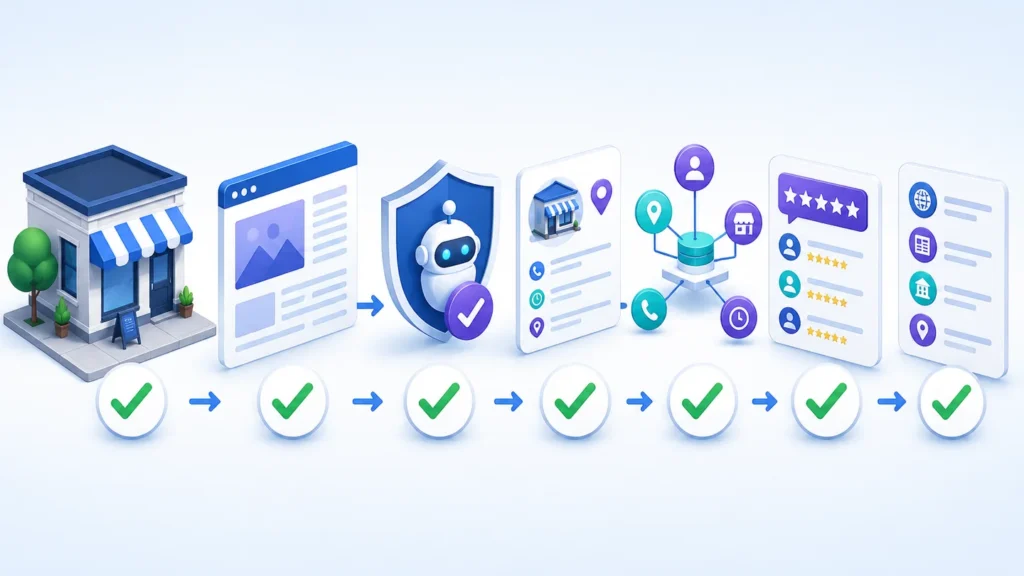
Google’s LocalBusiness structured-data documentation explains how business hours, location, telephone, URL, and other facts can be described. Use the most specific appropriate subtype and validate the markup. Do not add facts that are absent or contradicted on the page.
Structured-data limit: LocalBusiness markup can improve machine-readable clarity and eligibility for certain search features, but it does not guarantee a rich result, local ranking, AI mention, or citation. Google’s current AI guidance says there is no special schema required for generative AI search.
Check 3: content clarity, local entities and citation signals
The content stage of the AI visibility checklist for local businesses asks the site to state plainly who the business is, what it does, where it operates, who it serves, and how a customer can act. Put the core answer on the page that owns the topic. A plumber’s emergency-service page should explain availability, coverage, exclusions, response process, pricing approach, licensing, and what happens after the call—not merely repeat “emergency plumber” beside stock photos.
Compare the business name, address or service area, phone, hours, website URL, categories, and services across the website and profiles. Small formatting differences are not automatically harmful; factual conflicts are. Correct old numbers, moved addresses, duplicate profiles, expired hours, and mismatched categories. For local search, Google advises maintaining complete and accurate Business Profile information, responding to reviews, and adding useful photos. Google’s July 2026 generative AI optimization guide also says Business Profiles can help local business details appear in AI responses and other search results.
- Give every priority service a dedicated, useful page with scope, process, proof, limitations, and a clear next step.
- Describe real locations or service areas with staff, hours, access details, local examples, and relevant contact information.
- Publish first-hand evidence: original photos, completed-work examples, case studies, measurements, before-and-after records, or documented processes.
- Identify responsible people, authors, technicians, clinicians, or advisers where credentials and accountability matter.
- Keep prices, availability, menus, service details, policies, dates, and opening hours current.
- Earn authentic reviews and relevant mentions; never fabricate citations, offices, awards, reviews, or directory listings.
- Link claims to primary sources where appropriate and make the supporting passage easy for a reader to verify.
For passage-level improvements, see how to make website content easy for AI to quote. Clearer evidence can improve usefulness and testability, but no writing format guarantees quotation.
Check 4: platform testing and a pass/fail recording method
The measurement stage of this AI visibility checklist for local businesses treats visibility as sampled behavior rather than a permanent rank. Build a prompt panel that reflects customer decisions, then keep it stable. Example prompt groups include “best [service] near [city],” “[service] for [specific problem],” “compare [category] providers,” “is [business] reputable,” and branded questions about hours, location, expertise, pricing, or booking.
Run the same prompt set on the platforms your customers use. Record the product or model, date, account state, stated location, device, and number of runs. Save both successful and unsuccessful outputs. Track brand mention, citation presence, exact cited URL, factual accuracy, competitor mentions, answer position, and sentiment separately. Do not replace a failed prompt after seeing the result.
| Field | Record | Pass rule example |
|---|---|---|
| Prompt | Exact wording and intent group | Unchanged across baseline and retest |
| Conditions | Platform, product/model, date, location, account and device | All material conditions documented |
| Mention | Yes/no and answer position | Count every run, including no mention |
| Citation | Exact source URL and supporting claim | URL loads and supports the answer |
| Accuracy | Correct, partly correct, incorrect or unverifiable | No critical business fact is wrong |
| Evidence | Screenshot plus copied response or export | Another reviewer can reproduce the record |
Use transparent denominators. “The brand appeared in 7 of 30 recorded runs across 10 prompts” is auditable; “AI visibility score: 82” is not unless the method is disclosed. The framework in how to measure brand visibility in ChatGPT can be adapted for local prompt panels.
Controlled-retest rule: Change one meaningful layer, wait for recrawling or reprocessing where relevant, then repeat the same prompt panel and scoring rules. A single favorable screenshot is not evidence of a durable improvement.
Prioritize critical, important and improvement items
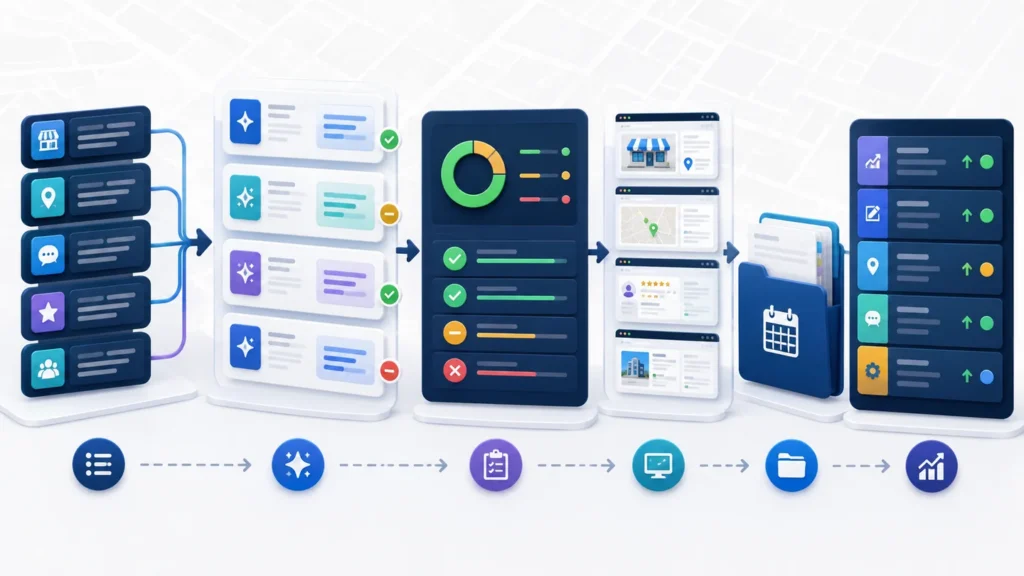
Fix problems by dependency and commercial impact. A blocked booking page is more urgent than a non-critical schema warning. A wrong phone number is more urgent than adding another blog post. Use the following priority model to turn this AI visibility checklist for local businesses into an action plan.
| Priority | Examples | Action |
|---|---|---|
| Critical | Key page blocked, noindex, persistent error, wrong address or phone, broken booking path, unsafe or false claim | Fix immediately and verify with a direct acceptance test |
| Important | Thin service page, conflicting profile data, missing location proof, weak internal links, incomplete Business Profile, unsupported claims | Schedule in the next focused improvement cycle |
| Improvement | Better original photos, richer FAQs, secondary schema properties, additional case studies, wider prompt coverage | Add after critical dependencies pass |
Evidence and screenshots to include
Store the evidence from your AI visibility checklist for local businesses in a dated folder or worksheet so a developer, marketer, owner, or agency can reproduce each finding. Screenshots are useful, but pair them with copied text, URLs, status data, and test conditions. That prevents a visually impressive report from becoming impossible to audit.
- Page inventory showing the business model, real locations, service areas, priority services, and conversion journeys.
- robots.txt snapshot, response status, headers, canonical, index controls, raw HTML, and rendered content for critical URLs.
- Google Business Profile screens for name, category, address or service area, hours, phone, website, services, photos, and review activity.
- Structured-data validation with the visible page facts beside the machine-readable properties.
- Examples of original experience and authority: staff credentials, real projects, local case studies, methods, policies, prices, and dates.
- Full prompt, platform, conditions, unedited response, exact cited URLs, competitor appearances, and the transparent denominator.
- Change log with page version, owner, implementation date, recrawl evidence, and retest date.
The common mistake: copying a generic AI SEO checklist
A generic checklist often treats every website as a publisher. Local businesses have different page inventories and risks. A restaurant needs accurate hours, menu, reservation, accessibility, and location information. A home-service company needs genuine service areas, emergency availability, licensing, job evidence, and a working call or quote journey. A clinic needs practitioner credentials, services, policies, and careful health claims. Multi-location brands need clean location ownership and consistent canonical architecture.
Adapt every check to the transaction. Ask which page should answer the customer, which facts must be correct, which proof reduces risk, and which conversion step must work. Remove checks that do not change a decision. Add industry-specific evidence and legal or safety review where the topic requires it.
Frequently asked questions
What does AI visibility mean for a local business?
It means the business can be accurately discovered, understood, mentioned, and sometimes cited in AI-assisted search experiences relevant to local customers. It includes technical eligibility, business-entity clarity, useful local content, source quality, and measured outcomes. It is not the same as one permanent ranking.
How often should I run this AI visibility checklist for local businesses?
Run a complete baseline before major work, retest after meaningful fixes and enough time for recrawling, and repeat a stable benchmark quarterly. Time-sensitive businesses should also verify hours, services, staff, location, menus, and availability whenever they change.
Do local businesses need schema markup for AI search?
No special AI schema is required. Accurate LocalBusiness structured data can help machines interpret facts and can support eligibility for Google search features, but the markup must match visible content. It does not replace crawlable pages, a complete Business Profile, useful evidence, or correct business information.
Do reviews improve AI visibility?
Authentic reviews can strengthen customer trust and provide external evidence about a business, while review quantity and quality also matter in Google’s local ranking guidance. However, a review is not a guaranteed AI citation. Never buy, fabricate, gate, or manipulate reviews.
Can this checklist guarantee a ChatGPT or Google AI mention?
No. It can identify barriers, improve eligibility and clarity, strengthen evidence, and create a repeatable measurement method. Selection in a particular answer can still vary by platform, query, freshness, location, user context, and available sources.
Next step: turn the checklist into a measured baseline
Start with five revenue-critical pages and ten customer questions. Save the baseline, fix the earliest failing layer, and retest with the same method. For the wider framework, use the AI Search Readiness by Website Type guide. Visible Pilot is being built to help local businesses and agencies convert these checks into a transparent, prioritized website roadmap.