

Choosing the best AI visibility tool for small business is less about finding the dashboard with the biggest score and more about finding the tool that answers your next business question. Do you need to know whether AI platforms mention your brand, why important pages are inaccessible, which sources are cited, or what to fix first? Each problem requires a different type of evidence.
This comparison explains the main tool categories, their boundaries, current cost patterns, and the tests a small business can run before subscribing. It avoids declaring one product universally best because a local service company with five target prompts has different needs from an online store tracking hundreds of products.
Short answer:
For most small businesses, the best starting setup is a focused prompt-monitoring tool plus a technical diagnostic process. Monitoring shows where the brand appears; diagnostics explain access, rendering, content, and citation-readiness problems. Start manually or with a low-cost specialist, then add a broader suite only when its extra research and reporting will be used every month.
The meaningful difference behind “best AI visibility tool for small business”
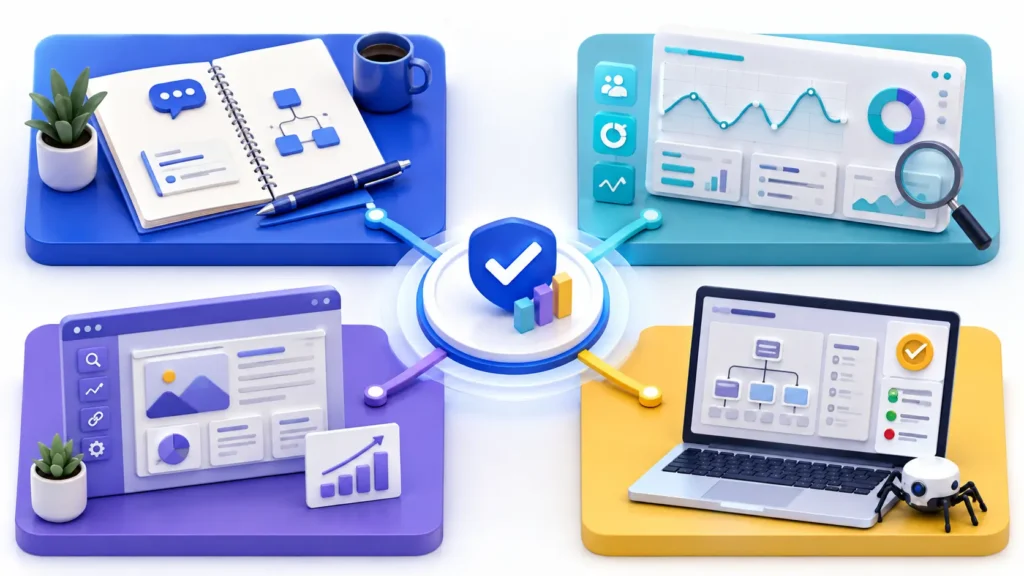
An AI visibility monitor repeatedly asks selected prompts and records mentions, citations, competitors, and answer changes. A technical diagnostic checks whether crawlers can access a page, whether useful information appears in delivered HTML, and whether canonical, robots, sitemap, or rendering problems weaken discovery. An all-in-one SEO suite connects AI visibility with keywords, backlinks, site audits, and competitor research.
These products overlap, but they are not interchangeable. A monitor can report that your company is absent without proving why. A crawler audit can reveal a blocked or thin page without showing whether an AI answer cites it. The best choice is therefore the smallest combination that closes the gap between observation and action.
Definitions and boundaries: what each option does
- Manual prompt tracker: a spreadsheet containing fixed questions, answer dates, mentions, linked citations, and cited URLs. It offers maximum control and almost no software cost, but collection is slow and results vary by model, account, location, and date.
- Specialist AI monitoring tool: automates prompt runs and trend reporting. For example, Otterly.AI describes tracking across major AI search engines, citations, markets, and competitors. The trade-off is prompt limits and another recurring subscription.
- All-in-one SEO suite: combines AI visibility with established search data. Semrush’s AI Visibility Toolkit focuses on brand presence and competitors, while Ahrefs Brand Radar emphasizes large-scale prompt and citation research.
- Technical diagnostic platform: tests crawler access, HTTP responses, delivered content, internal structure, and evidence quality. This is most useful when the question is “what is broken?” rather than only “how often are we mentioned?” Visible Pilot is being built around this diagnostic layer.
Side-by-side comparison
| Option | Primary purpose | Inputs and outputs | Control | Cost and limitation |
|---|---|---|---|---|
| Manual tracker | Baseline a small prompt set | Your prompts; saved answers and citations | High | Low cash cost; high time cost |
| Specialist monitor | Track mentions and citations | Prompt set; trends, share of voice, sources | Medium to high | Entry plans can be affordable; prompt limits apply |
| SEO suite | Join AI visibility with SEO research | Domain and prompts; broad search intelligence | Medium | Higher total cost and learning curve |
| Diagnostic platform | Find technical and content failure states | URLs and site data; evidence-backed issues | High | May need monitoring alongside it |
At the time of writing, Otterly.AI publishes an entry plan starting at $29 per month, while Semrush publishes an AI Visibility base plan at $99 per month per domain when billed annually. Pricing and allowances change, so verify the current plan and calculate cost per domain, prompt, engine, market, user, and report—not only the headline fee.
Discovery and access implications
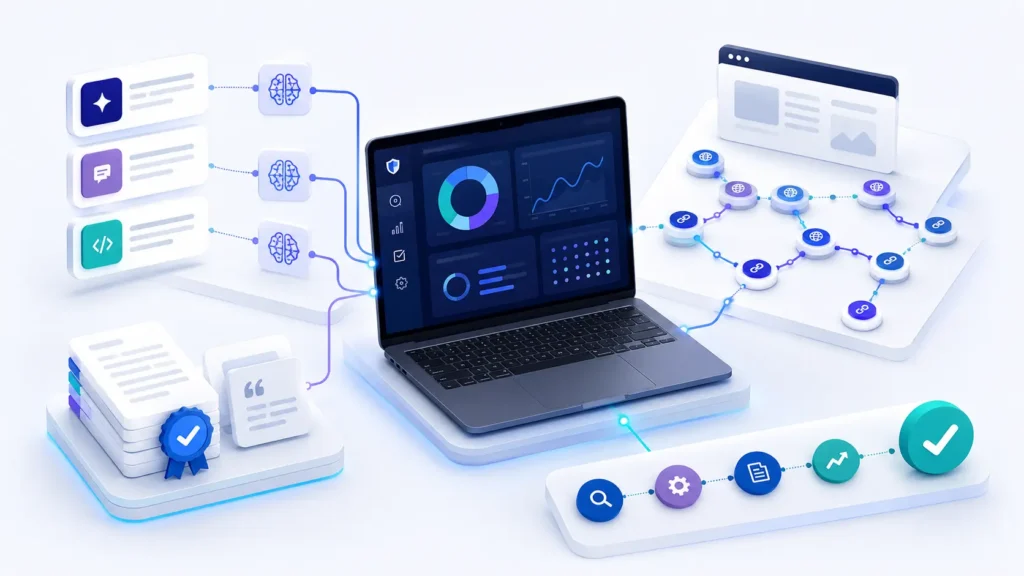
A visibility score cannot tell you whether an intended crawler was blocked by robots.txt, challenged by a firewall, redirected incorrectly, or served an empty client-rendered shell. Before paying for a larger prompt panel, test representative commercial and informational URLs. Confirm a normal response, consistent canonical URL, intended crawler access, sitemap inclusion, useful server-delivered HTML, and descriptive internal links. The guide to testing HTML visible to AI crawlers provides a practical starting method.
Measurement, evidence quality, and repeatability
Useful software preserves raw evidence behind every summary. You should be able to see the exact prompt, platform, date, answer, brand mention, linked citation, cited URL, competitor, and calculation method. Ask whether prompts are supplied by the vendor, written by you, derived from search data, or mixed. These samples answer different questions and should not be blended into one unexplained score.
Evaluation rule:
If a score changes, the tool should help you explain which prompts, answers, mentions, or citations produced the change. If it cannot, treat the score as a navigation hint—not evidence of business improvement.
Best choice by small-business scenario
- New site with no baseline: begin with 10–20 high-intent prompts, a manual tracker, and a technical readiness check. Do not buy enterprise-scale coverage before confirming the website can be discovered and understood.
- Suspected technical failure: prioritize diagnostics that expose response codes, blocking rules, delivered HTML, canonicals, redirects, sitemaps, and internal links.
- Content or citation gap: choose a monitor that records cited domains and URLs, then compare the passages, evidence, and page types that competitors earn citations from.
- Ongoing marketing program: use automated monitoring with stable prompts, scheduled reporting, competitor benchmarks, exports, and a clear workflow for assigning fixes.
A combined workflow works better than one score
- Define buying questions and select a stable prompt panel.
- Capture baseline answers, mentions, linked citations, cited URLs, and competitors.
- Run a technical and content diagnostic on the pages that should answer those questions.
- Fix the earliest verifiable failure, such as access before content or content before promotion.
- Repeat the same tests and compare raw findings before comparing headline scores.
This workflow separates the measurement baseline from the optimization backlog. The comparison of an AI visibility audit versus a GEO audit explains why those outputs should remain distinct.
Test the tools yourself before subscribing
Run the same domain and prompt set through every shortlisted option. Use at least one brand prompt, one category prompt, one comparison prompt, one problem-solving prompt, and one local or industry-specific prompt. Check whether each platform exposes the raw answer and cited URL, identifies unlinked mentions, distinguishes engines, supports your country or language, and lets you export the evidence.
Then create three known test cases: an accessible strong page, an intentionally blocked test URL, and a thin page with weak evidence. A trustworthy tool should report what it can actually observe and avoid pretending that one proprietary score proves causation. Record false positives, missing citations, duplicated prompts, and the time required to turn a finding into a fix.
Evidence and screenshots to include in your trial
- Prompt coverage by engine, market, language, and date.
- Raw answer, mention, citation, and cited-URL evidence.
- Scoring definition, weighting, and a worked example.
- Repeat runs showing normal answer variation.
- False positives, missed issues, export quality, and total monthly cost.
The common interpretation mistake
Do not choose by dashboard polish or one proprietary score.
A beautiful trend line can hide weak prompt sampling, missing citation URLs, or a calculation you cannot reproduce. Choose the tool that provides verifiable diagnostic output and fits the decisions your team can act on.
Frequently asked questions
What is the best free AI visibility tool for a small business?
Start with a manual fixed-prompt tracker and any reputable free snapshot checker. Free tools are useful for a baseline, but usually provide fewer prompts, less history, or limited exports. Preserve the raw answers and cited URLs so you can compare results later.
How many prompts should a small business track?
Begin with 10–20 prompts tied to actual buying questions, services, comparisons, problems, and locations. A small stable panel produces more useful learning than hundreds of generic prompts that nobody reviews or acts on.
Can an AI visibility tool guarantee citations?
No. A tool can observe answers, diagnose conditions, and recommend improvements, but generated results vary and platforms control retrieval and presentation. Treat every citation as a measured sample rather than a permanent ranking.
Do I still need traditional SEO software?
Usually yes. Search eligibility, crawlability, content quality, links, and brand authority still support discovery. Add specialist AI monitoring when it answers a distinct question; do not replace proven SEO workflows merely because a new score is available.
Next step: build an evidence-first shortlist
The best AI visibility tool for small business is the one that supports a repeatable decision at a sustainable cost. Define your prompt panel, prove that important pages are accessible, compare raw evidence, and select the smallest workflow that connects findings to fixes.
Join Visible Pilot early access:
Visible Pilot is being developed to uncover technical, content, SEO, and AI-search issues that prevent websites from being discovered, understood, and recommended. Join the early-access list and start with problems you can verify.