

Brand facts page for AI search is a practical way to give customers, search engines and AI systems one stable, first-party reference for your company. Instead of scattering your official name, offer, location, leadership and policies across unrelated pages, you publish the facts in visible language, connect them to supporting sources and test whether systems can retrieve them consistently. This guide shows how to build the page, run a controlled before-and-after test and avoid mistaking schema validation for proof of AI visibility.
Quick answer: Create a crawlable, canonical page that states your verified brand identity, products or services, audience, locations, ownership, contact routes, policies and supporting evidence in plain language. Add accurate Organization schema only for facts visible on the page. Then test a fixed set of prompts before and after one controlled change. A clean page can improve clarity, but it cannot guarantee indexing, rankings, mentions or citations.
What a brand facts page for AI search means in practical terms
A brand facts page is not a special file format or a confirmed ranking factor. It is an editorial reference page designed to reduce ambiguity. Think of it as the public source you would send to a journalist, partner or customer who needs to verify what the business is, what it offers and where a claim came from.
The page should have one self-referencing canonical URL, be linked from normal site navigation or an About area, return a stable HTTP 200 response and expose its important facts in rendered HTML. Google says the same foundational SEO practices apply to its AI features: pages need to be indexable, useful, internally linked and available in textual form. OpenAI separately documents OAI-SearchBot controls for ChatGPT search. These access rules are prerequisites, not promises that a page will be selected.
Step 1 — establish a clean baseline and choose representative URLs
Before editing anything, choose the facts you want to verify and the URLs that currently support them. Use the homepage, About page, one key product or service page, a contact or location page and any primary research page. Record the page title, canonical URL, response status, index directive, last updated date and whether the important claim appears in the HTML without a click, login or script-only interaction.
Create a small prompt set that reflects real buyer questions. Run the same prompts in the same tools, region and account state. Save the full answer, cited links, date and any uncertainty language. Useful prompts include:
- What is the official name of [brand], and what does it do?
- Who is [brand] for, and which products or services does it provide?
- Where is [brand] based, and which markets does it serve?
- What primary source supports [brand’s specific claim]?
- How does [brand] differ from a named competitor on one verifiable feature?
| Baseline field | What to record | Pass condition |
|---|---|---|
| Access | HTTP status, robots rule, WAF action and rendered HTML | A clean 200 response with the facts visible |
| Identity | Name, URL, logo, legal or trading name and same-as profiles | The same identity is used across first-party pages |
| Answer | Completeness, wording, uncertainty and named entities | The answer states the tested fact without invention |
| Source | Citation URL and passage supporting the answer | A relevant first-party passage directly supports the claim |
Measurement rule: Save the baseline before rewriting. If prompts, tools, URLs and timing all change together, you cannot tell whether the brand facts page caused the result.
Step 2 — rewrite one page section, hold the prompt set constant, and compare quotation and citation behavior over time
Start with one high-value fact cluster, not a complete site rewrite. For example, replace a vague paragraph such as “we deliver innovative solutions worldwide” with a short statement that names the company, category, customer, product and geographic scope. Follow it with a proof link, a definition or an effective date where that context matters.
A useful section answers one question at a time. Use descriptive headings, direct sentences and enough context for a passage to stand on its own when quoted. Avoid stuffing synonyms or repeating the brand name in every sentence. The aim is factual support and retrieval clarity, not keyword density.
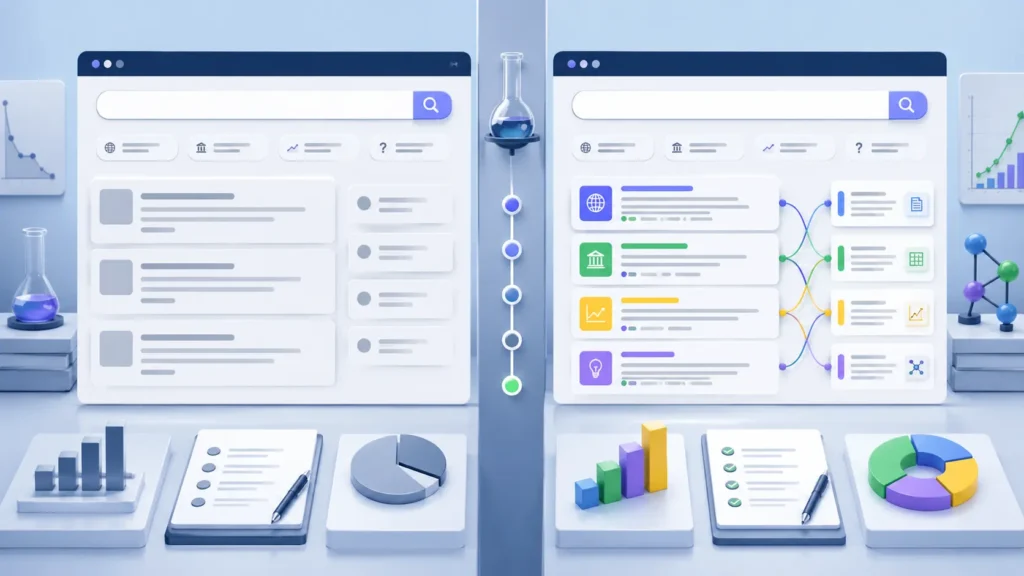
A compact page structure that works for people first
- Identity: official and alternate names, primary URL and a one-sentence description.
- Offer: products or services, intended users, supported platforms and service boundaries.
- Operations: headquarters, service regions, contact channels and relevant availability.
- Proof: first-party research, methodology, certifications, case studies and dated evidence.
- Policies: pricing model, returns, privacy, support or editorial policies where applicable.
- Ownership and people: parent organization, founders or accountable leadership when publicly verifiable.
Structured data can reinforce this visible content. Google’s Organization markup guidance recommends adding relevant properties, while its general guidelines require markup to represent visible, accurate page content. The broader vocabulary is defined by Schema.org Organization. Do not invent awards, locations, reviews or affiliations to fill optional fields.
{
  "@context": "https://schema.org",
  "@type": "Organization",
  "@id": "https://example.com/#organization",
  "name": "Example Brand",
  "url": "https://example.com/",
  "description": "The same concise description shown on the page.",
  "sameAs": ["https://www.linkedin.com/company/example-brand"]
}
Step 3 — inspect the evidence and separate access, rendering, and content failures
A weak answer does not automatically mean the writing failed. Diagnose the pipeline in order. First confirm that the crawler can fetch the canonical URL. Then inspect the delivered and rendered HTML. Next check whether the passage contains the exact entity, relationship and supporting detail. Only after those layers pass should you compare mentions, quotations and citations.

| Observed failure | Likely layer | Next test |
|---|---|---|
| Page never appears as a source | Access or discovery | Check robots, CDN/WAF logs, status, canonical and internal links |
| Crawler receives an empty shell | Rendering | Compare raw HTML with the rendered page and disable hidden interactions |
| Brand is confused with another entity | Content and identity | Make names, relationships, URL and same-as references consistent |
| Answer mentions the brand but cites another site | Sourceworthiness | Add direct evidence, dates, methodology and a precise supporting passage |
| Results vary between runs | Platform variance | Repeat the fixed prompt set and report the distribution, not one screenshot |
For delivery problems, use the CDN settings checklist for AI crawler access. For evidence formats, see original research formats most cited by AI. These checks keep access, content and citation analysis from collapsing into one vague “AI visibility” score.
Step 4 — apply the smallest safe fix and document the change
Choose the smallest edit that could resolve the diagnosed failure. That may be an allow rule for a verified crawler, a server-rendered summary, a clearer relationship between the parent company and product, a dated methodology note or one internal link from a high-authority page. Record the old passage, new passage, deployment time and reason for the change.
Avoid a risky shortcut: Do not publish unsupported “best,” “largest,” “official” or market-share claims simply because they are easy for a model to repeat. A concise unsupported statement is still unsupported. Link to the underlying evidence and state its scope, date and method.
Step 5 — retest with the same inputs and define a pass condition
After the updated page is accessible and eligible for recrawling, repeat the original prompt set. Compare answer completeness, correct entity naming, supporting passages, citations and competitor mentions. Do not treat one favorable response as proof. Run several observations over a defined window because search indexes, retrieval systems and generated answers can change.
Write the pass condition before viewing the new results. A defensible example is: “Across three scheduled runs, the answer names the correct company and product in at least two runs, contains no unsupported claims, and any first-party citation lands on a passage that directly supports the statement.” Your threshold may differ, but it should be specific enough for another person to reproduce.
Worked example — inputs, observations, fix, and verified result
Scenario: A fictional SaaS company called Northstar Audit has a product page describing “complete visibility,” while its About page uses a different product name and never states who the tool serves. The baseline prompt asks what Northstar Audit does and which websites it supports. Answers alternate between a security auditor and an SEO platform, and the cited pages do not support the platform list.
Fix: The company adds one visible facts section stating its official company and product names, target customer, supported website platforms and the date that platform support was verified. It links each platform claim to the relevant product documentation and updates Organization schema to match the visible name and URL.
Retest: The same prompts are run on the same schedule. The correct category and platform list appear more consistently, while the unsupported “complete visibility” phrase disappears. That is a useful result, but the company records it as an observed association—not proof that the page caused every response change.
Interpret the example correctly: A controlled content test can show whether answers changed after a documented edit. It cannot isolate every external variable in a live search or AI system, and it does not create a permanent citation entitlement.
Evidence and screenshots to include
A credible case study should let readers audit the result. Capture the complete prompt, full answer, date, tool or surface, region if relevant, cited URLs and the exact passage that supports each statement. Add request and firewall logs where access is part of the diagnosis. Include the raw HTML or rendered text when JavaScript may hide content.
- Answer completeness and any uncertainty or qualification language
- Correctly recognized brand, product, people, locations and relationships
- Source support for every material factual claim
- Passage structure before and after the edit
- Citation outcomes across repeated observations
- Competitor mentions using the same neutral comparison prompt
Common interpretation mistake — adding schema or short answers without improving support
The most common mistake is optimizing only the wrapper. Valid Organization schema does not repair a vague page, and a short answer does not become trustworthy through brevity. Google explicitly says structured data must match visible content and does not guarantee a search feature. Its current guidance for AI features likewise says no special markup is required. Improve the underlying facts, provenance, page clarity and evidence first; use markup to describe that reality.
Frequently asked questions
Is a brand facts page the same as an About page?
It can be part of an About page, but the purpose is narrower: provide structured, verifiable answers to common identity and offer questions. A long company story may remain useful while a clearly headed facts section handles retrieval and verification.
Does a brand facts page guarantee ChatGPT or Google AI citations?
No. It can make first-party information easier to retrieve and verify, but selection depends on crawling, indexing, the query, the platform and other sources. Neither access nor valid schema guarantees a citation.
Should every fact appear in Organization schema?
No. Use properties that accurately describe the organization and are supported by visible content. Product, person, local business or dataset information may belong in other appropriate types or pages.
How often should the page be updated?
Review it whenever the brand name, ownership, offer, service area, policies or supporting evidence changes. Show an accurate updated date when it helps readers judge freshness; do not change dates without a meaningful revision.
Can one page fix conflicting third-party information?
It gives the business a stable first-party reference, but conflicting external sources may persist. Correct important listings and profiles, keep names and URLs consistent, and document which source is authoritative.
Next step — turn the page into a repeatable diagnostic
Build the first version around ten to fifteen facts that buyers regularly ask about. Link each material claim to evidence, validate the canonical and rendered page, and save a baseline prompt set before publishing the change. Then repeat the test and report both passes and failures. For a broader review, use the Visible Pilot AI Search Readiness checklist to connect brand clarity with crawler access, rendering, content quality and measurement.