Category: Uncategorized

  • AI Search Readiness Benchmark Report

    AI Search Readiness Benchmark Report

    AI search readiness benchmark report findings should help website owners make better decisions—not decorate a page with an unexplained score. This July 2026 pilot establishes a reproducible baseline by reviewing the public crawler policies of ten prominent SaaS and business websites.

    The narrow conclusion is useful: every sampled site published a reachable robots.txt file, but explicit AI-agent rules were uncommon and inconsistent. That does not mean most sites blocked AI search. When a named crawler is absent, the wildcard group may govern it. It also does not prove that an allowed crawler can render, understand, index or cite a page.

    Research date: 28 July 2026. Sample: 10 public business/SaaS domains. Measured layer: robots.txt availability and explicit treatment of selected AI user agents. This pilot is a crawler-policy benchmark, not a claim about universal AI citations or platform rankings.

    Key findings from the pilot benchmark

    FindingResultDenominatorWhat it means
    Public robots.txt file reachable1010 sitesThe basic policy file could be inspected for every sampled domain.
    GPTBot explicitly named310 sitesMost files did not create a named GPTBot group; wildcard rules may still apply.
    OAI-SearchBot explicitly named110 sitesOnly Zapier explicitly named OpenAI’s search crawler in this snapshot.
    ClaudeBot explicitly named310 sitesNamed Claude access rules appeared on Squarespace, Canva and Zapier.
    PerplexityBot explicitly named210 sitesCanva and Zapier explicitly addressed PerplexityBot.
    Different explicit AI-policy patterns33 sites with named AI rulesThe observed patterns were general-path rules, selective-path access and broad explicit access.

    The strongest signal is not that one policy is universally “best.” It is that crawler intent, inherited rules and path scope must be read together. OpenAI documents OAI-SearchBot for search visibility and GPTBot for potential training use as independent controls. Counting either name without interpreting the associated rules would produce a misleading readiness score.

    Methodology

    We selected ten recognisable SaaS and business websites with public, crawlable marketing properties: Shopify, Wix, Squarespace, HubSpot, Salesforce, Stripe, Notion, Canva, Zapier and Webflow. The sample is purposive rather than random, so results describe these domains only.

    Ten website samples flowing through an AI crawler policy benchmark methodology
    The pilot compares ten public robots.txt files using the same dated fields and interpretation rules.
    • Collection period: one observation window on 28 July 2026.
    • Source: each domain’s public /robots.txt file.
    • Availability test: whether the policy file could be retrieved and read.
    • Agent checks: literal presence of GPTBot, OAI-SearchBot, ChatGPT-User, ClaudeBot and PerplexityBot.
    • Policy interpretation: named group, wildcard inheritance, and whether the rule broadly allowed, broadly disallowed or selectively scoped paths.
    • Exclusions: no WAF/IP verification, rendered-page test, index-state measurement, prompt testing or citation-rate claim.

    The observations were manually checked against current official crawler guidance. A named-agent count measures configuration explicitness, not effective access by itself. If an agent is absent, robots exclusion rules normally fall back to the applicable wildcard group; server, CDN and security controls can still produce a different real-world outcome.

    Overall results for the AI search readiness benchmark report

    Ten out of ten sampled sites exposed a readable robots.txt file. That is a useful minimum control, but it is only the first layer of readiness.

    Three out of ten explicitly named GPTBot: Squarespace, Canva and Zapier. Three out of ten explicitly named ClaudeBot: the same three domains. Only one out of ten explicitly named OAI-SearchBot, and only two out of ten explicitly named PerplexityBot.

    The explicit policies were not equivalent. Zapier grouped several AI agents and allowed the root path. Canva broadly disallowed several training-oriented agents while allowing selected public directories and separately allowing Perplexity agents. Squarespace grouped many named agents with the wildcard rules that restricted sensitive, search, account, API and parameter paths while leaving other public paths available.

    Interpretation guardrail: “not explicitly named” is not the same as “blocked.” Likewise, “allowed in robots.txt” is not proof of successful fetching, rendering, indexing or citation. Treat each as a separate testable stage.

    Site-level robots.txt snapshot

    DomainGPTBot namedOAI-SearchBot namedClaudeBot namedPerplexityBot namedObserved policy pattern
    ShopifyNoNoNoNoWildcard rules; public areas and selected paths governed generally
    WixNoNoNoNoWildcard rules with many product and utility exclusions
    SquarespaceYesNoYesNoNamed AI agents grouped with general path restrictions
    HubSpotNoNoNoNoLarge wildcard policy; no selected named agents found
    SalesforceNoNoNoNoNo selected named agents found in this snapshot
    StripeNoNoNoNoNo selected named agents found in this snapshot
    NotionNoNoNoNoNo selected named agents found in this snapshot
    CanvaYesNoYesYesTraining-oriented agents broadly restricted; selected paths allowed; Perplexity allowed
    ZapierYesYesYesYesSelected AI search, user and training agents explicitly allowed
    WebflowNoNoNoNoCompact wildcard policy; no selected named agents found

    This table is a configuration snapshot, not a ranking. A domain with no named rule may be accessible through User-agent: *. A domain with a named allow can still fail at the transport layer. The next full edition should therefore pair policy parsing with verified requests and rendered-content evidence.

    Explicit AI crawler rules compared with inherited wildcard robots.txt rules
    A named crawler rule and a wildcard rule can produce different path-level outcomes; both require evidence beyond the policy file.

    Breakdown by policy approach

    1. Wildcard-led configuration: 7 of 10 sites

    Seven domains did not explicitly name the selected AI agents. Their public crawler treatment therefore depends on the applicable general rules plus any controls outside robots.txt. This approach is simpler, but it makes the site owner’s intent less explicit to reviewers and can hide accidental inheritance.

    2. Named agents with shared path rules: 1 of 10 sites

    Squarespace listed multiple AI and conventional agents before a shared rule set. The pattern restricts sensitive and low-value paths rather than applying a blanket block to the public site.

    3. Named agents with deliberate allow/disallow choices: 2 of 10 sites

    Canva and Zapier showed more explicit agent-level choices. Canva separated certain agents and path exceptions; Zapier grouped search, user and training agents under a broad allow. These examples show why a binary “has AI rules” field is too crude for a useful benchmark.

    Failure-pattern analysis: what clusters together

    Even in a robots-only pilot, three recurring interpretation failures emerged.

    • Name-counting without rule parsing: finding GPTBot in a file says nothing until the matching allow/disallow paths are evaluated.
    • Training and search controls collapsed into one score: OAI-SearchBot and GPTBot serve different documented purposes; one cannot substitute for the other.
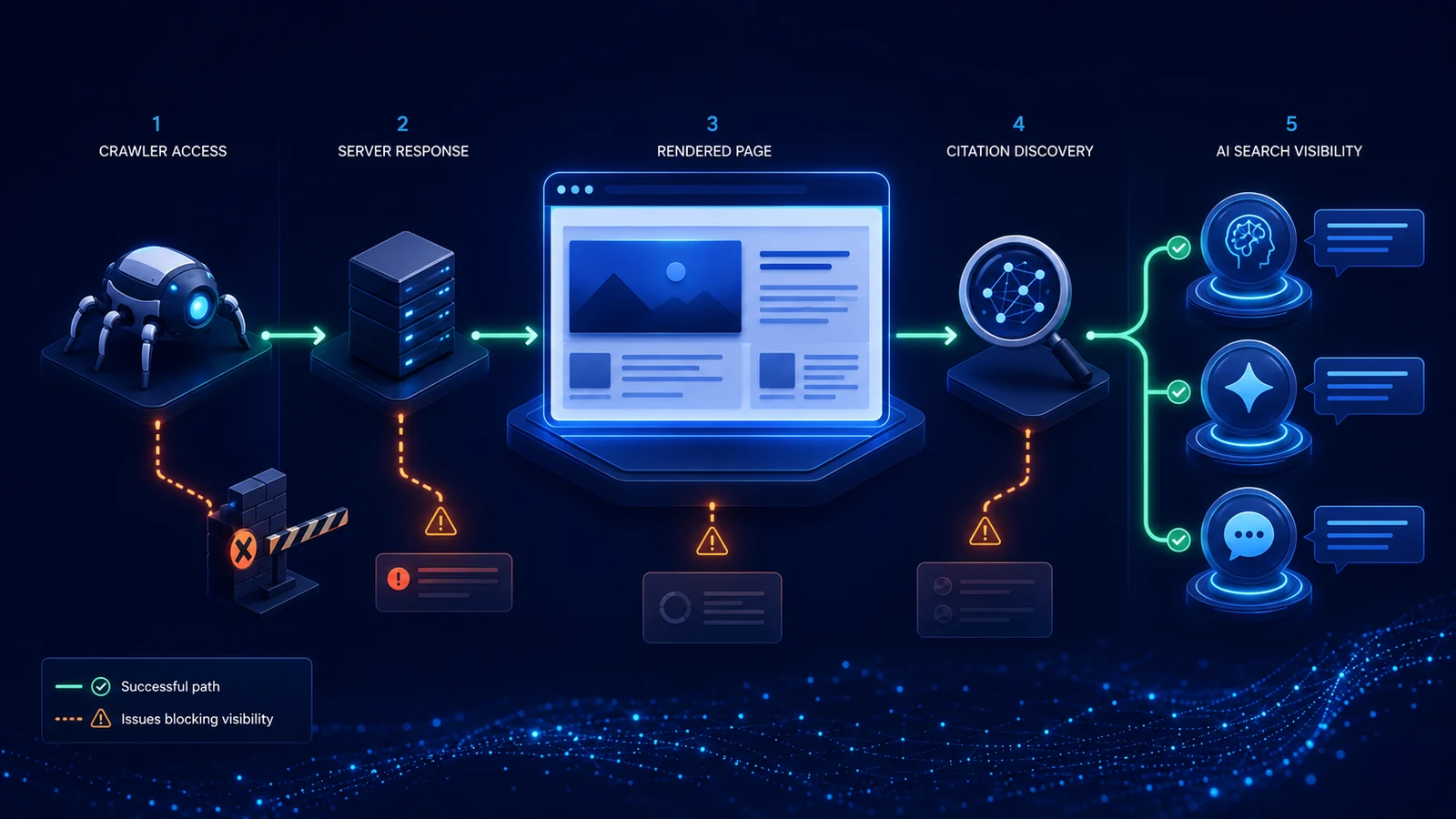
    • Policy availability treated as end-to-end readiness: robots.txt cannot prove a 200 response, rendered content, correct canonical, clear entities or platform citation.

    These failures cluster because simple audit tools prefer a single boolean. A defensible readiness model should preserve separate fields for policy, transport, rendering, index controls, entity clarity and observed platform behaviour.

    What the findings mean for website owners

    ActionWhy it mattersEvidence to keep
    Map product goal to crawlerSearch visibility, user-triggered retrieval and training are different controlsOfficial agent documentation and dated policy decision
    Test representative pathsRules can vary by directory and templateHomepage, commercial page and article results
    Verify beyond robots.txtCDN/WAF responses may contradict policy intentStatus, headers and security event
    Inspect delivered contentA 200 response may still contain an empty shellInitial HTML and rendered DOM
    Separate readiness from citationEligibility does not guarantee source selectionFixed prompt, date, locale and cited URL

    For a practical end-to-end process, use the AI search readiness checklist and the guide on how to test if a website is ready for AI search.

    How to reproduce this benchmark

    A future researcher should be able to reach the same classification from the stored inputs. Record one row per domain with the following raw fields.

    • Domain, requested robots.txt URL, final URL, retrieval timestamp and HTTP status.
    • Raw policy text or cryptographic hash, plus any redirect details.
    • Literal presence of each tested user agent.
    • Matched group for the root path and for at least one representative knowledge-page path.
    • Effective allow/disallow conclusion with the exact rule that produced it.
    • Reviewer, parser version and a manual-review note for ambiguous syntax.

    Percentages should always retain their numerator and denominator. For example, report “3 of 10 sites explicitly named GPTBot,” not “30% are GPTBot-ready.” The first statement is observable; the second adds an unsupported causal label.

    Limitations of this pilot

    This is not a market-wide readiness score. The ten domains were purposively selected, observations were made once, and robots.txt is only one layer. The study did not verify crawler IPs, CDN/WAF behaviour, page rendering, index eligibility, answer-engine retrieval or citations. Results should not be generalized to all business websites.

    Robots files can change at any time, and platform documentation can change independently. Some policy syntax is also difficult to interpret without the crawler’s exact precedence behaviour. The public files and timestamp are therefore part of the result, not footnotes.

    Update policy

    Visible Pilot will keep future editions comparable by preserving the original ten-domain panel, publishing the observation date, retaining the same core fields and labeling every methodology change. A larger edition should add a stratified sample by CMS, company size and site type while reporting the original panel separately.

    • Monthly: recheck crawler documentation and agent names.
    • Quarterly: rerun the ten-domain robots snapshot and publish changes.
    • Major edition: add verified HTTP, WAF, rendering and representative-page tests.
    • Versioning: never overwrite prior denominators; publish a dated comparison table.

    Frequently asked questions

    What is an AI search readiness benchmark?

    It is a defined comparison of observable conditions that affect whether AI search systems can discover and use website content. A useful benchmark publishes its sample, fields, denominators, date and limitations rather than relying only on a proprietary score.

    Does missing OAI-SearchBot from robots.txt mean ChatGPT search is blocked?

    Not automatically. If no specific group exists, the applicable wildcard rules may govern the crawler. Effective access also depends on the tested path and controls such as CDN or WAF rules.

    Is GPTBot the crawler for ChatGPT search?

    OpenAI documents OAI-SearchBot for ChatGPT search visibility and GPTBot for potential training use. Their controls are independent, so a benchmark should not collapse them.

    Can robots.txt prove that a page will be cited?

    No. It can express crawl permissions for compliant agents. Citation also depends on successful delivery, rendering, discovery, relevance, source selection and platform behaviour.

    Why use a ten-site pilot?

    A small transparent sample is more useful than invented large-sample statistics. It tests the measurement fields, exposes classification problems and creates a baseline that can be expanded without rewriting history.

    Downloadable charts and dataset

    The pilot’s site-level table, field definitions and calculation notes are included above so the result can be checked immediately. A future downloadable dataset should preserve the raw policy snapshot, dated classifications and change log rather than publishing only a chart.

    Next step: Use the evidence fields in this report to audit your own site, then get the AI Search Readiness checklist for the transport, rendering, index-control and content layers.

    Official sources and observed policy files

    Reviewed 28 July 2026. This report documents a point-in-time public-policy snapshot. Recheck current files before changing production controls.


  • 30-Day AI Search Readiness Case Study

    30-Day AI Search Readiness Case Study

    A 30-day AI search readiness case study should answer a practical question: can a website become easier for AI systems to discover, retrieve and use after a controlled set of technical and content improvements? The honest answer requires fixed tests, dated evidence and restraint. Thirty days is enough to repair many access and clarity problems and observe early changes, but it is not enough to guarantee citations, traffic or revenue.

    Transparency note: This is an evidence-led case-study protocol with an explicitly illustrative example—not a claim about an unnamed client. Use it to run and document a real 30-day test without manufacturing results.

    What this 30-day AI search readiness case study measures

    AI search readiness is the condition of being technically accessible, understandable and usable as a source. It is different from being mentioned or cited by a particular answer engine. A useful study therefore separates controllable website conditions from platform-dependent outcomes.

    • Access: whether relevant crawlers and user-triggered retrieval can reach representative URLs.
    • Delivery: whether pages return stable HTTP responses and meaningful HTML without a browser-only dependency.
    • Index controls: whether robots directives, canonical tags and noindex rules match the intended visibility.
    • Content clarity: whether each page answers a defined question, identifies its subject and supports claims with evidence.
    • Observed visibility: whether fixed prompts return the domain, page or citation during the same test conditions.

    Readiness is a prerequisite, not a promise. A technically healthy page may still be absent because of authority, relevance, freshness, platform coverage or model behavior.

    Baseline: capture evidence before changing the site

    Days 1–3 should establish a frozen baseline. Select a small, representative set: the homepage, one commercial page and one knowledge article. Record the exact URLs, timestamps, environment and test method. Saving only a score is insufficient; preserve the underlying evidence so another person can reproduce the finding.

    Baseline fieldEvidence to saveWhy it matters
    Crawler accessrobots.txt rules, response codes, redirect chain and relevant WAF/CDN eventsSeparates policy from infrastructure blocking
    Rendered contentraw HTML, rendered view, title, canonical and index directivesShows what a retrieval system can actually receive
    Content signalspage purpose, entity names, claims, sources and update dateTests whether the page is understandable and citable
    Platform checksfixed prompts, account/region, date and complete outputsMakes later comparisons less subjective
    Conventional searchindexed URL check and relevant query baselineProvides context without treating rankings as AI visibility

    Take screenshots or exports of the important states, but also retain text logs. Screenshots are persuasive evidence; logs are easier to compare. If server logs are available, note whether a request actually reached the origin rather than assuming a simulated user-agent proves crawler access.

    Four-stage AI search readiness case study workflow: baseline, diagnosis, fixes and retest
    A reproducible case study separates baseline capture, diagnosis, controlled intervention and retesting.

    Diagnosis: test the initial hypothesis

    Days 4–7 are for diagnosis. Start with a hypothesis such as “AI systems cannot use the article because the site blocks AI crawlers.” Then try to disprove it. A robots.txt allowance does not rule out a 403 from a firewall, an empty client-rendered response or an accidental noindex tag.

    1. Request each representative URL as a normal browser and with a controlled crawler identity.
    2. Follow every redirect and record the final status, headers and canonical destination.
    3. Compare raw HTML with the rendered page; confirm the main answer exists in the delivered source.
    4. Inspect robots meta tags, X-Robots-Tag headers and canonical tags.
    5. Review CDN or WAF events for blocked, challenged or rate-limited requests.
    6. Check whether the page states who it is for, what it answers and where factual claims come from.

    A strong diagnosis identifies the failing stage—access, delivery, index control, understanding or citation—instead of collapsing every symptom into one “AI visibility” score.

    Intervention plan: prioritize controlled, reversible changes

    During days 8–21, fix the smallest set of high-confidence issues. Prioritize defects that prevent access or remove the main content before polishing secondary signals. Document what you deliberately avoid changing; otherwise a before/after improvement cannot be connected to a plausible cause.

    PriorityExample interventionHold constant
    CriticalCorrect an unintended block, 403, redirect loop or noindex rulePage topic and test URLs
    HighDeliver the primary answer and supporting evidence in stable HTMLPrompt set and measurement method
    MediumClarify headings, entities, authorship, dates and source linksCore claim and user intent
    ImprovementStrengthen internal links and descriptive anchor textPublishing cadence where possible

    Change-control rule: record the date, owner, affected URLs, expected effect and rollback path for every intervention. Bundling unrelated redesign, migration and content changes makes causation harder to interpret.

    Implementation timeline: what happens across 30 days

    WindowWorkExit condition
    Days 1–3Freeze URLs, prompts and baseline evidenceEvery representative URL has a complete evidence pack
    Days 4–7Reproduce failures and isolate the failing layerEach issue has proof and a testable hypothesis
    Days 8–14Repair critical access, delivery and control issuesRetest shows the technical defect is gone
    Days 15–21Improve answer structure, entity clarity and source supportPages remain accurate and useful to humans
    Days 22–27Repeat tests with the same inputsComparable observations are captured
    Days 28–30Analyze, qualify and publish resultsClaims match the evidence and limits are disclosed

    Measurement method: fixed prompts, URLs and controls

    Use a prompt set that reflects real customer questions, but freeze it before the intervention. A compact study might include 10–20 prompts split between branded, category and problem queries. Run them at the same interval and preserve complete outputs. If the platform exposes no deterministic mode, repeat each prompt and report variability rather than selecting the most favorable response.

    • Keep prompt wording, order and evaluation criteria fixed.
    • Record the platform, model or product surface, account state, region and date.
    • Count eligible observations, not only successful mentions.
    • Distinguish a brand mention, linked source, unlinked citation and direct page retrieval.
    • Use a comparison page or unchanged URL where practical.
    • Report inconclusive and failed tests instead of discarding them.

    Illustrative example: how to report results without fabricating them

    The following numbers are hypothetical and demonstrate the reporting format only. Suppose a 20-prompt baseline produced two brand mentions, one linked citation and six retrieval failures across three URLs. After documented fixes, the retest produced four mentions, three linked citations and zero retrieval failures. The defensible finding is that access reliability improved and citations were observed more often in this sample. It is not proof that the changes caused a durable platform-wide ranking gain.

    MetricBaseline (illustrative)Day 30 (illustrative)Interpretation
    Successful URL retrievals12 of 1818 of 18Access defect appears resolved in the tested paths
    Brand mentions2 of 204 of 20Observed increase; small sample
    Linked citations1 of 203 of 20Observed increase; platform variability remains
    Organic sessionsNot used as primary outcomeNot used as primary outcomeThirty days and mixed causes limit attribution

    What likely caused improvement—and what cannot be proven

    When the same URL changes from blocked to a stable 200 response with complete HTML, the repair is a strong explanation for improved retrievability. When citations rise after several simultaneous changes, the causal claim is weaker. External indexing cycles, competing sources, model updates and prompt variability can all affect the outcome.

    Safe conclusion: “The intervention removed verified access and content-delivery barriers, and the fixed test set showed more successful retrievals.” Unsafe conclusion: “These fixes guarantee AI citations.”

    Lessons you can transfer to another website

    • Start with representative URLs, not a sitewide score.
    • Prove the failing layer before editing content.
    • Fix access and delivery before adding speculative machine-readable files.
    • Keep evidence for both successful and unsuccessful tests.
    • Separate readiness metrics from mentions, citations, traffic and revenue.
    • Publish denominators and limitations so readers can judge the result.
    • Continue monitoring beyond day 30; discovery and citation behavior can lag.

    Evidence checklist for a publishable case study

    • Dated robots.txt and robots-meta evidence
    • HTTP status, headers and redirect chain
    • Raw HTML and rendered-page comparison
    • Relevant WAF/CDN or server log events
    • Fixed prompt list and complete platform outputs
    • Change log with owners and timestamps
    • Before/after table using absolute counts and denominators
    • Disclosure of sample size, uncertainty and confounding changes

    Common interpretation mistake

    The most common mistake is confusing conventional rankings with evidence that an AI system can discover and use the site. Search rankings can provide useful context, but they do not prove retrieval, mention or citation in another product. Report each stage separately.

    Frequently asked questions

    Is 30 days enough to improve AI search readiness?

    It can be enough to identify and repair technical access, delivery and content-clarity issues. It is not enough to guarantee platform discovery, citations or business impact.

    What is the best primary metric?

    For a technical intervention, use successful, reproducible retrieval of representative URLs. Treat mentions and citations as downstream observations with platform-dependent variability.

    Should a case study use an AI visibility score?

    A score can summarize checks, but publish the subscores and evidence behind it. A single number can hide whether the real problem is blocking, rendering, index control or content fit.

    How many prompts should be tested?

    Use enough prompts to cover branded, category and problem intent while remaining repeatable. A small, fixed set with full evidence is more useful than a large set that changes between tests.

    Can improved citations be attributed to one fix?

    Only cautiously. Attribution is strongest when one controlled change removes a directly observed failure. Multiple simultaneous changes and external model updates weaken causal confidence.

    Run your own 30-day readiness study

    Use this framework to establish the baseline, repair verified barriers and publish an honest before/after account. If you want an evidence-led review of crawler access, rendered content, index controls and citation readiness, request a Visible Pilot audit. You can also explore the broader AI Search Readiness guide and compare your next step with the free AI search readiness checker.

  • Technical Issues Affecting AI Search Visibility

    Technical Issues Affecting AI Search Visibility

    Technical issues affecting AI search visibility are usually not one mysterious “AI SEO” problem. They are failures somewhere along a delivery chain: a system cannot discover the URL, cannot fetch it reliably, cannot see the useful content after rendering, cannot determine what the page is about, or does not select it as a source for a particular answer.

    The practical response is to test that chain in order. Start with access and server behaviour, then inspect the HTML an automated system receives, then check index controls and page meaning, and only after those pass evaluate mentions or citations. This guide gives you a repeatable method that works without relying on a proprietary visibility score.

    Quick diagnosis of technical issues affecting AI search visibility

    Observed symptomMost likely layerFirst evidence to collect
    Crawler receives 401, 403, 429 or 5xxAccess, security or capacityRaw HTTP response, response headers and matching CDN/WAF event
    Browser looks fine but fetched HTML is thin or emptyRendering or content deliveryInitial HTML, rendered DOM, resource failures and consent state
    Canonical points elsewhere or page carries noindexIndex controlFinal canonical, robots meta and X-Robots-Tag after redirects
    Only some templates disappearTemplate or routing ruleComparison across homepage, commercial page and article
    Pages are healthy but answers do not cite themDiscovery, relevance or source selectionInternal links, sitemap, entity evidence and fixed-prompt observations

    Do not begin by changing every robots.txt rule or installing another schema plugin. A broad change can remove useful controls while leaving the actual failure untouched. Reproduce the symptom on a small, representative sample and preserve the evidence before making a change.

    A three-layer symptom map

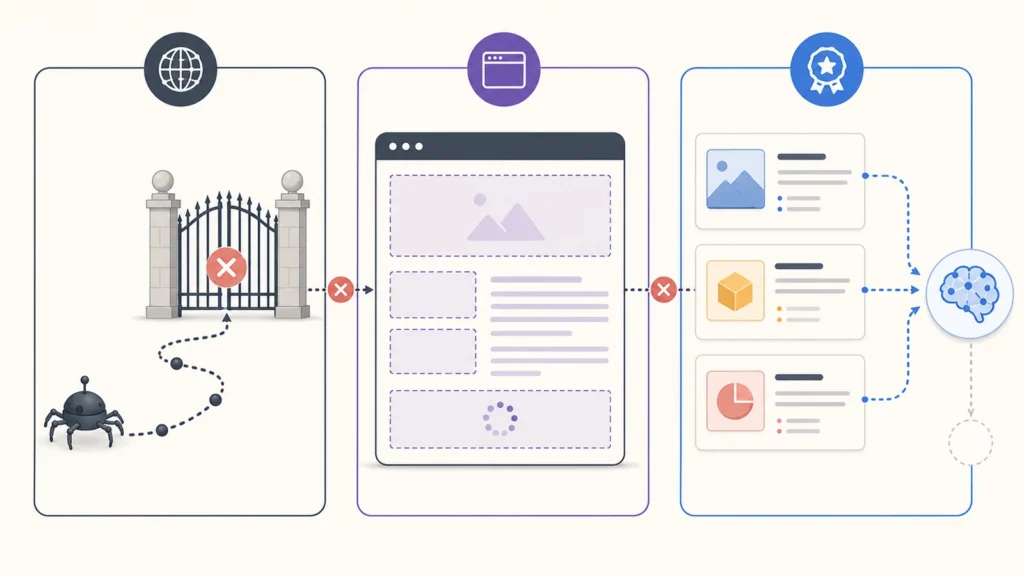
    Three layers of technical issues affecting AI search visibility
    Access, rendering and citation-readiness failures require different evidence and fixes.

    Layer 1: access and transport

    At this layer, the requested URL is never delivered normally. Common causes include an accidental robots.txt disallow, password protection, IP or country restrictions, a WAF bot rule, a JavaScript challenge, rate limiting, TLS errors, redirect loops, DNS instability or a server timeout. The result may differ by user agent, IP range, protocol, subdomain or time of day.

    Robots.txt is only one control. A crawler can be allowed there and still be blocked downstream by a CDN or security product. Conversely, an ordinary browser request can succeed while a controlled crawler request receives a challenge or a different response.

    Layer 2: rendering and index controls

    A 200 response is not proof that the main content was delivered. Client-side applications may return a nearly empty shell and load the decisive copy later. Cookie gates, hydration errors, blocked JavaScript, failed APIs and lazy-loaded sections can leave automated systems with a title but little substance.

    Index controls add a separate risk. A robots meta directive or X-Robots-Tag can mark a page noindex, a canonical can consolidate it into another URL, and redirects can carry a crawler away from the intended page. Check the final response after every redirect rather than inspecting only the CMS setting.

    Layer 3: discovery, meaning and citation eligibility

    A technically available page can still be difficult to retrieve or cite. Weak internal linking, orphaned pages, stale sitemaps, ambiguous titles, missing authorship or organisation context, unsupported claims, unclear dates, and content that never answers a narrow question all reduce usable evidence.

    Structured data can reinforce meaning when it accurately describes visible content, but it cannot compensate for inaccessible or unhelpful pages. Treat schema as corroboration, not a substitute for clear copy, crawlable links and verifiable sources.

    Test 1: reproduce the issue on representative URLs

    Choose three URLs that exercise different templates and business purposes:

    • Homepage: confirms brand identity, global navigation and the default delivery path.
    • Commercial page: tests product or service copy, conversion components and structured business information.
    • Knowledge article: tests long-form rendering, author and date signals, citations and related-content links.

    For each URL, record the test time, requested URL, final URL, HTTP status, redirect chain, content type, canonical, robots directives, visible title, main heading and whether the central answer appears in both the initial HTML and rendered page. Keep the same URLs throughout the repair so the before-and-after evidence is comparable.

    A single successful homepage request cannot clear the whole site. Template rules, edge caching and application routes often fail differently.

    Test 2: run the same readiness checks across all three pages

    CheckPass conditionFailure clue
    DiscoveryURL appears in navigation, contextual links or a current sitemapOrphaned URL or sitemap points to redirected/canonicalised version
    Crawler policyRelevant search crawler is not disallowed for the tested pathBroad wildcard or crawler-specific rule blocks the directory
    TransportStable 200 response for the canonical page without an interstitial403, 429, 5xx, timeout, challenge or inconsistent redirect
    Rendered contentTitle, H1 and decisive copy are present and readableEmpty app shell, consent overlay, failed API or hidden main copy
    Index controlsIntended canonical plus compatible robots meta/headernoindex, conflicting directives or canonical to an unrelated URL
    MeaningPage identifies subject, organisation, author/date where relevant and evidenceGeneric claims, unclear entity relationships or unsupported statements
    Citation readinessClaims have direct support and sources are accessibleCircular claims, missing dates, inaccessible references or promotional-only copy

    Use a normal browser request as a control, then use the documented identity for the crawler you are evaluating. Do not assume a user-agent string proves the request is genuine; when a platform publishes IP ranges or verification guidance, compare the source network with that official data. Preserve request and response details without exposing private tokens or visitor information.

    Root-cause checks: directives, status, security, delivery and entities

    1. Separate search crawlers from training crawlers

    Crawler names do not all represent the same purpose. OpenAI documents OAI-SearchBot for surfacing websites in ChatGPT search and GPTBot for content that may be used to improve generative models; the controls are independent. Anthropic and Perplexity also publish bot guidance. Audit the crawler relevant to the visibility goal rather than treating every AI-labelled agent as interchangeable.

    2. Read the final HTTP exchange

    Capture the status and headers at each redirect hop. Look for authentication, bot-management cookies, cache variations, geo routing, Retry-After values, incorrect content types and X-Robots-Tag. A cached 200 shown to an administrator does not disprove a 403 served at the edge to another request profile.

    3. Compare source HTML with rendered output

    Search the initial response for the title, main heading, primary explanation, links and structured data. Then compare it with a rendered view. If the information appears only after scripts run, test whether required resources are accessible and whether the application completes without interaction. Server rendering or static generation can reduce dependencies, but the right fix is the smallest stable change that makes essential content available consistently.

    4. Audit canonical and index directives together

    Inspect the canonical, robots meta and X-Robots-Tag on the final URL. Conflicts often arise when staging rules, faceted-navigation settings or SEO plugin defaults leak into production. Remember that a crawler must access a page to observe a noindex directive; robots.txt and noindex solve different problems.

    5. Trace internal discovery

    Verify that important pages receive ordinary HTML links from relevant hubs and are represented by their preferred canonical URLs in the sitemap. Avoid relying exclusively on form submissions, JavaScript click handlers or an XML sitemap with no internal context.

    6. Strengthen entity and source clarity

    State what the organisation does, who is responsible for the content, when factual material was updated and what evidence supports important claims. Use descriptive headings and concise definitions that can stand alone. Link to original sources where possible and keep citations adjacent to the claims they support.

    Fixes ordered by impact, effort and risk

    PriorityTypical fixImpactEffortRisk and guardrail
    CriticalRemove unintended authentication, 403/429 rules, redirect loops or 5xx failures on public canonical pagesVery highVariesLimit the rule change to verified public paths; retain security controls elsewhere
    CriticalRemove accidental noindex or wrong canonical from pages intended for discoveryVery highLow–mediumConfirm duplicates and staging URLs remain controlled
    HighMake decisive page content available in stable HTML or reliable renderingHighMedium–highMaintain parity between user and crawler-visible content
    HighRepair internal links and sitemap URLs to preferred destinationsHighLow–mediumAvoid creating crawl traps or linking to parameters
    ImportantClarify page purpose, entities, authorship, dates and sourcesMedium–highMediumDo not add markup unsupported by visible content
    ImprovementTune caching, resource delivery and monitoring thresholdsMediumMediumMeasure before changing global cache or bot rules

    Verification: the evidence that proves a technical fix

    Before and after verification of an AI search visibility technical fix
    Retest the same request conditions and preserve before-and-after evidence to verify a repair.

    A fix is verified when the original failure can no longer be reproduced under the same controlled conditions and the intended page state is observable. Record both a technical pass and its scope.

    1. Repeat the identical URL, request identity, location or network condition and rendering method used for the baseline.
    2. Capture the redirect chain, final status, headers and response body again.
    3. Confirm the title, H1 and decisive content are present in the initial or reliably rendered output.
    4. Recheck canonical and index directives after caches and deployments settle.
    5. Confirm the WAF or CDN no longer records the request as blocked while unrelated protections remain active.
    6. Store the timestamp, tool version, screenshots or logs, and a short explanation of the pass condition.

    Visibility in an answer engine should be measured separately with a fixed set of prompts, dates, locations where relevant and exact cited URLs. A clean crawl test proves that a barrier was removed; a citation observation shows what happened in a particular retrieval context. Neither alone proves universal visibility.

    When the website is healthy but the platform still does not cite it

    Source selection is platform-dependent. A system may prefer a page that answers the question more directly, has stronger corroboration, is fresher for the topic, is better connected to known entities or is already present in the platform’s retrieval index. The query may also not require an external citation at all.

    When access, rendering and index controls pass, shift from technical repair to content and evidence questions: Does this page provide the best direct answer? Are factual claims specific and supported? Is the organisation clearly connected to the subject? Can the page be discovered from authoritative and relevant pages? Is the information current? Test improvements over a defined window without presenting correlation as proof of causation.

    Evidence and screenshots to include in an audit

    • A timestamped robots.txt extract for the relevant crawler and path.
    • The complete redirect chain with status codes and final content type.
    • Response headers showing cache, robots and security behaviour.
    • A redacted CDN/WAF event tied to the controlled request.
    • Initial HTML and rendered output showing whether decisive content is present.
    • Canonical, robots meta and structured data from the final page.
    • Internal-link and sitemap evidence for the preferred URL.
    • A fixed-prompt observation log that separates mentions, links and citations.

    Redact IP addresses, session cookies, authentication tokens, personal data and sensitive security configuration. The evidence should make the finding reproducible without turning the audit into a blueprint for attacking the site.

    A common interpretation mistake

    The most common mistake is treating conventional rankings—or a single answer-engine mention—as proof that every AI system can discover and use the website. Search products have different crawlers, retrieval systems and controls. A page may rank in Google while a separate search crawler is blocked at the CDN, or it may be fully accessible yet not selected for a specific prompt.

    Use a staged conclusion: accessible, delivered, index-control compatible, understandable, and observed in a defined platform test. This prevents a healthy technical result from being oversold as guaranteed citation visibility.

    Frequently asked questions

    Can robots.txt alone cause AI search visibility problems?

    Yes, a relevant disallow rule can prevent a compliant crawler from fetching a path. But robots.txt is not the only access layer. A CDN, WAF, login requirement, rate limit or server failure can still block a crawler that robots.txt allows.

    Does allowing GPTBot make a site appear in ChatGPT search?

    OpenAI documents separate controls: OAI-SearchBot is used for ChatGPT search visibility, while GPTBot relates to potential model-training use. Audit and configure the agent that matches your goal.

    Is a 200 status enough to prove the page is usable?

    No. A 200 response can contain an empty application shell, a soft error, a consent wall, the wrong canonical or a noindex directive. Inspect the body, rendered result and page controls as well as the status.

    Should I whitelist every AI user agent?

    No. Decide which product behaviours you want, use official documentation, scope rules carefully and verify published network information where available. Broad exceptions can create avoidable security and capacity risks.

    How long should I wait after fixing a technical issue?

    Transport and rendering repairs can be retested immediately after deployment and cache expiry. Recrawling, indexing and visible source selection may take longer and vary by platform. Keep the technical retest separate from the later visibility observation.

    Continue your AI search readiness work

    Technical diagnosis is strongest when it follows a consistent checklist. Review the AI search readiness checklist for business websites, compare the wider causes in why a website is invisible in AI search, or use the repeatable AI readiness testing method before changing site-wide rules.

    Official references

    Reviewed 27 July 2026. Crawler policies and product behaviour can change; verify current official documentation before modifying production controls.

  • AI Search Readiness Score Explained

    AI Search Readiness Score Explained

    An AI search readiness score is a diagnostic summary of how easily AI crawlers and answer engines can access, process, understand, and potentially use a website. It is not a prediction of whether ChatGPT, Gemini, Claude, or Perplexity will mention your brand. A useful score turns technical and content evidence into priorities; a weak score merely compresses uncertain signals into an impressive-looking number.

    AI search readiness score explained: the short answer

    A readiness score should answer one practical question: what could prevent this website from being discovered, understood, or selected as a source by AI systems? It combines evidence for crawler access, technical delivery, content clarity, authority, and freshness. Treat it as website-health triage—not a promise that an AI platform will cite the site.

    What an AI search readiness score can measure reliably

    The strongest inputs are reproducible. Two people running the same test against the same URL at roughly the same time should reach the same conclusion. These checks create an evidence-based baseline:

    • Crawler accessibility: robots.txt rules, page-level robots directives, authentication barriers, and relevant bot permissions.
    • HTTP delivery: status codes, redirect chains, timeouts, rate limiting, CDN challenges, and WAF blocks.
    • Rendered content: whether essential copy and links exist in the delivered HTML or become available after dependable rendering.
    • Machine-readable structure: canonical signals, titles, headings, schema markup, semantic relationships, and internal links.
    • Content clarity: identifiable authorship, dates, entities, sources, concise answers, and claims supported by evidence.
    • Freshness and consistency: current information, stable facts across pages, and visible update practices.

    For a broader preparation workflow, use the complete AI search readiness guide. These checks complement—not replace—the crawlability, indexing, content, and authority work in a conventional SEO program.

    What remains platform-dependent

    No external audit can see every system behind an AI answer. Model training data, retrieval indexes, query rewriting, source selection, personalization, geography, licensing arrangements, and live-web access can all change the response. A platform may also retrieve a healthy page but choose another source because it better matches the question or carries stronger evidence.

    Important limitation: Readiness is not visibility, and visibility is not attribution. A technically healthy site can remain uncited for a competitive topic. A cited site can also have weaknesses because a platform encountered it through another source, an older crawl, or a licensed dataset.

    A practical five-part scoring model

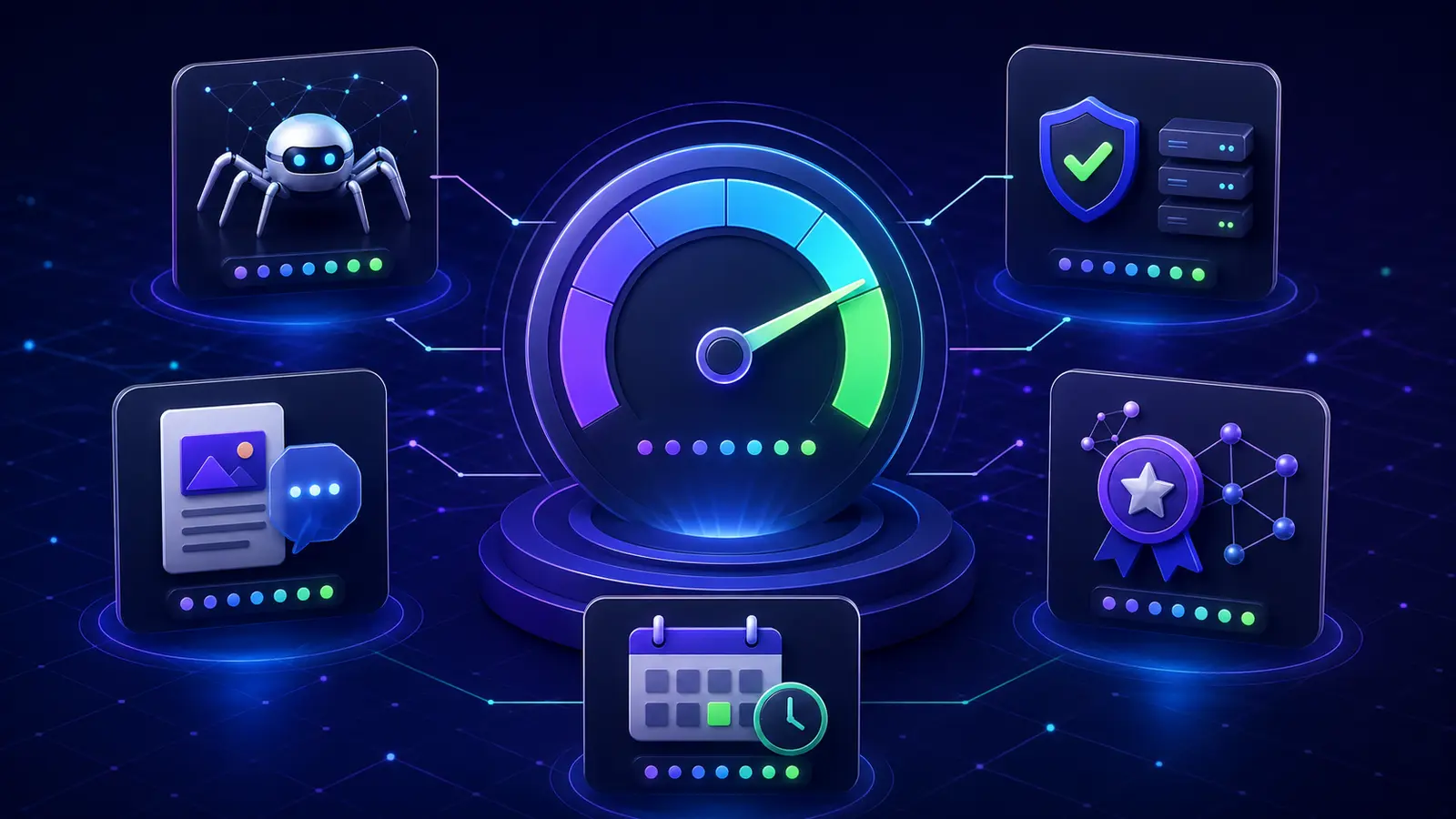
    Five factors feeding an AI search readiness score: access, delivery, content, authority and freshness
    A useful readiness score separates measurable website conditions from platform-dependent outcomes.

    A transparent score should show its components rather than hide them behind one proprietary number. The following model is a sensible way to organize evidence. Weighting can change by site type, but critical access failures should cap the overall result because excellent content cannot compensate for an unreadable page.

    Score areaExample weightWhat a low subscore usually means
    Crawler access25%Robots rules, authentication, bot protection, or server controls restrict retrieval.
    Technical delivery20%Errors, redirects, slow responses, or rendering dependencies hide essential content.
    Content clarity25%The page lacks a direct answer, clear entities, useful structure, or supporting evidence.
    Authority and citations20%Claims are weakly sourced or the site has limited corroboration and recognition.
    Freshness and consistency10%Information is stale, conflicting, undated, or poorly maintained.

    The exact weights are less important than the rules behind them. A score is credible when every deduction links to a URL, observation, severity, and recommended retest. It should also distinguish a failed test from an inconclusive one.

    Practical examples with contrasting site conditions

    Example 1: strong content, blocked access

    A research article has named authors, original data, citations, descriptive headings, and relevant schema. However, a CDN challenge returns a 403 response to automated clients. Its content quality may be excellent, but readiness should remain low because retrieval fails before the content can be evaluated.

    Example 2: accessible page, weak information value

    A product page returns 200, loads quickly, and contains clean HTML. Yet it uses vague marketing language, does not explain who the product is for, offers no verifiable specifications, and has few internal or external references. Access is healthy; usefulness and citability are not.

    Example 3: healthy site, inconsistent platform visibility

    A knowledge hub passes access, rendering, structure, and clarity checks. It appears for some research prompts but not others. This does not automatically expose an audit error. Query intent, competition, platform coverage, source diversity, and model behavior can explain the variation.

    A simple diagnostic you can run today

    Choose three representative URLs: your homepage, one commercial page, and one knowledge article. Use the same pages throughout the test so the before-and-after comparison remains meaningful.

    1. Check access. Review robots.txt, meta robots, canonical tags, HTTP status, redirects, and any bot protection affecting automated requests.
    2. Inspect delivery. Compare the initial HTML with the rendered page. Confirm that the primary answer, entity names, headings, and internal links are available.
    3. Evaluate clarity. Ask whether a reader can identify the page topic, publisher, author, date, main claim, evidence, and next step without guessing.
    4. Test representative prompts. Record the platform, date, prompt, response, cited sources, and whether your page appeared. Keep prompts fixed for later comparisons.
    5. Fix and retest. Prioritize access failures first, then delivery, clarity, evidence, and authority gaps. Repeat the identical checks and save proof.

    If you need a more structured starting point, follow the AI search readiness checklist for business websites.

    How to interpret the result without overclaiming causation

    Read the overall number only after reviewing the failed checks. A move from 58 to 82 can show that observable barriers were removed; it cannot by itself prove that the change caused more AI citations. To investigate causation, preserve a baseline, record implementation dates, control your test prompts, compare similar periods, and note other changes such as new backlinks, updated content, or platform releases.

    Use score bands as communication aids, not scientific laws. For example, 0–39 may indicate critical blockers, 40–69 substantial gaps, 70–84 a solid foundation with improvements available, and 85–100 few detected readiness problems. The evidence matters more than the label.

    Best interpretation rule: Use the score to decide what to inspect next—not to declare that an AI platform will rank or cite the site. A good audit leaves you with testable fixes and a repeatable verification method.

    Common mistakes when reading readiness scores

    • Treating one aggregate score as more important than a critical failed check.
    • Confusing conventional Google rankings with evidence that an AI system can retrieve and use the page.
    • Assuming every AI crawler, training crawler, retrieval bot, and user-triggered fetch behaves the same way.
    • Changing prompts between tests and calling the results a trend.
    • Ignoring test dates, geographic differences, authentication state, and platform updates.
    • Optimizing for the score while weakening user experience or publishing unsupported claims.

    Frequently asked questions

    What is a good AI search readiness score?

    A good score indicates that no major access, delivery, or content-understanding barriers were detected. The threshold depends on the methodology, so compare subscores and evidence instead of assuming that 80 from one tool equals 80 from another.

    Does a high score guarantee ChatGPT citations?

    No. It improves the conditions under which a page can be discovered and understood, but source selection depends on the prompt, platform, retrieval coverage, relevance, authority, freshness, and competing sources.

    How often should I check my score?

    Retest after significant releases, migrations, CDN or firewall changes, template updates, and important content revisions. For active sites, a monthly baseline plus post-change checks is usually more useful than daily score watching.

    Can I calculate a readiness score manually?

    Yes. Define the checks, weights, pass conditions, caps for critical failures, and rules for inconclusive results. Record every observation. Manual scoring takes longer but forces transparency and can expose weaknesses hidden by a single automated number.

    Is AI search readiness different from SEO?

    It overlaps heavily with technical SEO and content quality, then adds platform-specific access, retrieval, citability, entity clarity, and fixed-prompt measurement. The best approach combines both rather than replacing established SEO fundamentals.

    Check your website’s AI discoverability.

    Visible Pilot is being built to identify technical, content, SEO, and AI-search issues that can prevent websites from being discovered, understood, and recommended. Explore the AI search readiness guide, document your baseline, and prioritize evidence-backed fixes.

  • Why My Website Is Invisible in AI Search

    Why My Website Is Invisible in AI Search

    Why my website is invisible in AI search is usually not answered by one ranking report or one chatbot test. “Invisible” can mean a crawler cannot reach the site, the page delivers too little usable content, the business is poorly understood, the answer engine did not retrieve the page for a particular prompt, or the platform retrieved it but selected another source. Each symptom needs different evidence and a different fix.

    This guide gives you a practical diagnostic path. You will test three representative URLs, separate access failures from rendering and citation gaps, rank fixes by impact and risk, and define what proof is strong enough to call an issue resolved. The goal is readiness and evidence—not a promise that any AI system will mention, cite, or recommend your website.

    Quick diagnosis: the most likely causes

    • Access failure: robots rules, authentication, WAF policies, rate limits, CAPTCHAs, or server errors prevent a relevant crawler from fetching the page.
    • Delivery or rendering failure: the URL returns 200, but important copy, links, product data, or organisation details are missing from usable output.
    • Search eligibility failure: noindex directives, canonical mistakes, redirects, duplicates, or weak discovery keep a page out of an index that powers an AI feature.
    • Understanding gap: the page does not make its subject, publisher, offer, expertise, or evidence sufficiently clear.
    • Retrieval or citation gap: the page is accessible and useful, but another source better satisfies the query—or the platform does not select it in the observed run.
    • Measurement gap: the site may appear for some prompts, modes, places, or dates, but the test is too narrow to observe it reliably.

    Symptom map: access failure vs rendering failure vs discovery or citation gap

    Treat AI visibility as a chain of stages rather than one score. A page must first be discoverable, fetchable, and usable. It must then be eligible for the relevant retrieval system, understandable in context, useful for a query, and competitive with alternative sources. A failure at one stage can resemble another when you only inspect the final answer.

    Why a website is invisible in AI search across access rendering and citation layers
    AI search invisibility can originate in access, rendering, understanding, or citation selection—not one universal failure.
    Observed symptomLikely layerEvidence to collect
    401, 403, 429, CAPTCHA, or repeated 5xxAccess or infrastructureRequest identity, timestamp, status, headers, response, redirect chain and server/WAF log
    200 response but main content is absentDelivery or renderingInitial HTML, rendered DOM, loaded resources and template comparison
    Page is not indexed where eligibility is requiredDiscovery or index controlRobots, meta/X-Robots-Tag, canonical, sitemap, internal links and inspection data
    Business facts conflict across pagesEntity clarityVisible copy, about/contact details, authorship, structured data and corroboration
    Healthy page is not cited for one promptRetrieval or selectionExact prompt, platform/mode, date, location, repeats, full answers and citations
    No reliable baseline existsMeasurementStable prompt set, representative URLs, dated records and repeat rules

    Test 1: reproduce the issue on representative URLs

    Do not begin with the entire website. Choose the homepage, one commercial page that should generate revenue, and one substantial knowledge article. Add another URL only when the symptom belongs to a distinct template such as a product, location, documentation, or category page.

    • Write the intended result first. Record the page purpose, audience, canonical URL, intended index state, primary entity, and one question it should answer.
    • Save the test conditions. Include date, deployment version, request identity, rendering method, platform mode, location, account state, and exact prompt where relevant.
    • Reproduce before changing anything. Preserve the failing response, empty render, incorrect directive, contradiction, or missing citation as baseline evidence.
    • Compare templates. If all three pages fail identically, investigate shared infrastructure or templates before editing individual copy.

    Diagnostic rule: describe what you observed, not what you assume. “OAI-SearchBot received 403 at 10:15 UTC” is evidence. “ChatGPT hates our website” is not.

    Test 2: run the same readiness checks across three page types

    Apply the identical checklist to the homepage, commercial page, and knowledge article. Consistency matters because changing the test between pages makes results difficult to compare.

    CheckHomepageCommercial pageKnowledge article
    HTTP and redirectExpected final URL and 200Expected final URL and 200Expected final URL and 200
    Usable contentIdentity and offer presentOffer, evidence and next action presentAnswer, author, sources and update context present
    Index controlsIntended robots and canonicalIntended robots and canonicalIntended robots and canonical
    Entity clarityName, category, location and contacts agreeService and provider relationship is explicitAuthor, publisher, topic and claims are explicit
    Citation readinessPrimary facts are attributableCommercial claims have supportOriginal insight, sources and dates are visible

    A single passing page is not proof that the site is healthy. A single failing page is not proof that the domain is blocked. The pattern across the sample tells you where to expand the audit.

    Root-cause checks: directives, status, security, delivery and entity signals

    1. Confirm the right crawler and purpose

    Crawler controls are platform-specific. OpenAI documents OAI-SearchBot for surfacing websites in ChatGPT search, GPTBot for potential model-training use, and ChatGPT-User for certain user-triggered actions. These controls are independent. Blocking GPTBot does not automatically opt a site out of ChatGPT search; OAI-SearchBot is the relevant documented control for that search surface.

    Anthropic currently distinguishes ClaudeBot for model development, Claude-SearchBot for search quality, and Claude-User for user-directed retrieval. Perplexity distinguishes PerplexityBot for search indexing from Perplexity-User for user actions. Test the crawler that matches the symptom and consult current official documentation because names, policies, and IP ranges can change.

    2. Check robots.txt and page-level controls

    Read the final robots.txt served from every relevant host and subdomain. Confirm the specific user agent reaches the intended rule group and a broad wildcard rule does not create a conflict. Then inspect meta robots and X-Robots-Tag headers. Robots permission only governs crawling; it does not guarantee indexing, retrieval, or citation.

    3. Inspect HTTP behaviour beyond a browser visit

    Record the full redirect chain and final status. Investigate intermittent 403, 429, 5xx, soft errors, geo-dependent responses, cookie walls, login requirements, and security challenges. A normal browser request may pass while a crawler identity or published IP range receives a block. Avoid allowing traffic based only on a spoofable user-agent string; use current provider verification guidance and logs.

    4. Compare source delivery with rendered meaning

    A successful response can still be unusable. Check whether the title, H1, main explanation, ordinary links, product facts, author information, and important media or transcripts exist in the initial response or reliably rendered output. Look for blocked JavaScript, API failures, delayed hydration, client-only navigation, placeholder shells, and content that appears only after interaction.

    5. Validate conventional search eligibility

    Google’s current guidance says eligibility for supporting links in AI Overviews and AI Mode depends on being indexed and eligible to appear in Google Search with a snippet; Google does not require special AI-only markup. Verify Googlebot access, a successful response, indexable content, appropriate controls, useful internal discovery, and the relevant Search inspection evidence.

    6. Clarify entities, claims and provenance

    Make it easy to identify who published the page, what the organisation does, which entity the page describes, who authored or reviewed it, what is original, which sources support time-sensitive claims, and when it was updated. Structured data can reinforce visible meaning, but hidden markup cannot rescue vague or contradictory copy.

    Fixes ordered by impact, effort and risk

    Prioritise the earliest confirmed barrier with the widest affected coverage. Do not rewrite dozens of articles while a shared firewall rule blocks the crawler, and do not loosen security for an unverified bot because one prompt lacked a citation.

    PriorityExample fixImpactRisk and safeguard
    CriticalRemove unintended authentication, 403/429, CAPTCHA, 5xx, noindex, or wrong canonicalRestores a required access or eligibility conditionLimit scope, verify identity and preserve rollback
    HighRestore meaningful delivered/rendered content and crawlable links on a broken templateImproves discovery and understanding across many URLsTest representative templates before rollout
    HighCorrect conflicting business, product, author and publisher factsImproves trust and entity clarityCreate a single factual source and owner
    ImportantAdd first-party evidence, dates, methods, sources and author contextImproves usefulness and citation readinessDo not manufacture expertise or claims
    ImportantImprove topic hubs, descriptive internal links, sitemaps and orphan discoveryImproves discoveryAvoid indiscriminate sitewide links
    MonitorExpand stable prompt coverage and repeat observationsImproves measurementDo not treat prompt counts as business outcomes

    A safe remediation sequence

    • Capture a revision and baseline. Save configuration, evidence, affected URLs, and rollback instructions.
    • Make the smallest scoped change. Address the observed cause without widening access unnecessarily.
    • Verify the technical condition immediately. Repeat the same request and rendering checks.
    • Check adjacent pages and users. Confirm security, analytics, usability and unrelated crawler rules still work.
    • Allow for reprocessing. Crawling, indexing, retrieval and citation changes may lag behind a server-side fix.
    • Repeat platform observations later. Preserve prompts and document dates, modes, answers and citations.

    Verification: exact evidence that proves the issue is resolved

    Website AI search visibility test fix and verification loop
    Use the same representative pages and inputs before and after a change so the result is comparable.

    A fix is verified when the failing condition changes under the same test and the new state persists across the relevant sample. Access is proven by an expected response to the verified crawler request. Rendering is proven when important text, links, facts, and media are present in usable output. Index controls are proven when intended directives and canonicals are served consistently, with later processing evidence where available.

    Entity clarity is proven when key business and author facts agree across visible pages and matching structured data. Citation readiness is proven when important claims have context, provenance, dates and sources—but that remains a content-quality pass, not a citation guarantee. A platform mention or citation should be reported with its prompt, conditions, frequency, and selected URL.

    When the website is healthy but the platform still does not cite it

    If access, rendering, index eligibility, entity clarity, and content quality all pass, the remaining explanation may be competitive selection rather than a technical defect. Another source may be more authoritative, specific, current, original, or directly relevant. Results may also vary across prompts, modes, accounts, locations, and dates.

    Stop making speculative technical changes. Improve the underlying asset with original data or experience, complete answers, primary sources, disclosed methods, current facts, genuine references, and coherent internal relationships. Then measure a stable set of customer-relevant prompts over time.

    A healthy site proves that tested site-side barriers were absent or corrected under recorded conditions. It does not prove that every platform indexed the page, a prompt will retrieve it, it will outrank competing evidence, or future answers will cite it.

    Evidence and screenshots to include

    Preserve the affected URL, date and timezone, request identity, status and redirect chain, relevant headers, robots rule, source or rendered output, and the expected-versus-observed difference. For platform tests, save the full prompt and answer, cited URLs, platform and mode, account state where relevant, location, repeat count, and whether the result was a mention, citation, or neither.

    Crop screenshots only for presentation and keep the complete raw record. Redact credentials and personal data. Never fabricate logs, Search Console screens, or citations. If evidence is unavailable, label the result “unknown” and specify the next test.

    The common interpretation mistake

    The most common mistake is confusing conventional rankings with proof that every AI system can discover and use the website. Strong Google performance is useful evidence of search eligibility, relevance, and authority, but it does not prove access by every other crawler or retrieval for every AI prompt.

    The reverse is equally misleading: a 200 response or allowed robots rule does not mean a page should be cited. Access is only the first gate. Report discovery, access, delivery, index eligibility, understanding, retrieval, mention, citation, and business results separately.

    Frequently asked questions

    Why is my website not showing in ChatGPT search?

    Verify OAI-SearchBot access using OpenAI’s current documentation, then check server/WAF responses, delivered content, internal discovery, and page relevance. Absence from one answer does not prove a block; record stable prompts and cited URLs before drawing a conclusion.

    Does allowing AI crawlers guarantee citations?

    No. Allowing a relevant crawler removes one possible access barrier. Indexing, retrieval, ranking, mention, recommendation, and citation remain separate platform decisions.

    Can robots.txt make my site invisible in Google AI Overviews?

    Blocking Googlebot can prevent the crawling needed for Search eligibility. Google states that supporting links in AI Overviews and AI Mode must be indexed and eligible to appear with a snippet. Check the full Search eligibility chain, not a separate AI-only rule.

    Should I allow every AI bot?

    Not automatically. Decide which product uses align with your publishing, privacy, security, licensing, and commercial goals. Search, training, and user-triggered agents can use different controls. Apply deliberate rules and verify identities with current official guidance.

    How long after a fix should AI visibility improve?

    The technical condition can often be retested immediately, but crawling, indexing, retrieval, and answer selection update on different schedules. OpenAI and Perplexity currently note that certain robots changes may take about 24 hours to be reflected; broader visibility can take longer and is not guaranteed.

    Is llms.txt required to appear in AI search?

    No universal requirement exists. Google’s July 2026 guidance explicitly says it does not use llms.txt for Google Search or its generative AI features. Treat emerging conventions as controlled experiments, not substitutes for crawlability, index eligibility, clear content, and evidence.

    Next step: diagnose before you optimise

    If you are still asking why my website is invisible in AI search, begin with the earliest stage you can prove. Test a homepage, a commercial page, and a knowledge article. Fix confirmed access and rendering failures first; then improve entity clarity, evidence, usefulness, and measurement.

    Use the AI search readiness checklist, follow the repeatable testing method, compare AI readiness with a traditional SEO audit, or review what an evidence-based readiness audit should deliver.

    Visible Pilot is building a practical way to detect website conditions that interfere with discovery across Google Search and AI-assisted search systems.

    Get the AI Search Readiness checklist and record your baseline before changing the site.

    Official references

  • AI Search Readiness vs Traditional SEO Audit

    AI Search Readiness vs Traditional SEO Audit

    AI search readiness vs traditional SEO audit is not a choice between a modern service and an obsolete one. It is a choice between two diagnostic lenses. A traditional SEO audit asks whether a website can be crawled, indexed, understood, and ranked in conventional search. An AI search readiness audit asks whether relevant AI discovery systems can access and interpret the site, retrieve useful answers from it, and provide observable evidence of mentions or citations.

    Most established websites still need traditional SEO. Some also need an AI-specific layer because crawler controls, rendering behaviour, entity clarity, citation evidence, and platform testing introduce questions that a standard audit may not answer. This comparison will help you decide which scope fits your current problem—and when combining them produces the most reliable result.

    Short answer: choose a traditional SEO audit when the main problem is Google crawling, indexing, organic traffic, rankings, or technical performance. Add an AI search readiness audit when you also need to test AI crawler access, machine-readable meaning, retrieval and citation evidence, or visibility across named AI platforms.

    AI search readiness vs traditional SEO audit: the meaningful difference

    The overlap is substantial. Both reviews should inspect crawlability, HTTP responses, robots rules, canonicalisation, index controls, internal links, content quality, structured data, and website architecture. Those fundamentals do not disappear when an answer is generated by an AI interface.

    The difference is the final question each audit must answer. Traditional SEO connects website conditions to search discovery, indexation, rankings, clicks, and conversions. AI readiness follows the chain further: can the relevant system reach the page, obtain meaningful content, identify the organisation and topic, retrieve an answer for a stable prompt, and—where the product exposes it—mention or cite the source?

    This distinction matters because “AI visibility” is not one universal index. Google states that pages shown as supporting links in AI Overviews or AI Mode must be indexed and eligible for a Search snippet, with no additional technical requirements beyond Search. OpenAI, Anthropic, and Perplexity publish their own crawler or user-agent controls. A test that proves Google eligibility therefore does not automatically prove access or retrieval in every other platform.

    Definitions and boundaries

    What a traditional SEO audit does

    A traditional SEO audit evaluates the conditions that influence organic search performance. Depending on scope, it covers technical crawling and indexing, site architecture, page templates, performance, mobile experience, on-page relevance, content quality, internal linking, backlinks, structured data, localisation, analytics, and Search Console data.

    • Finds technical barriers that stop search engines discovering or indexing intended pages.
    • Identifies duplicate, thin, outdated, or poorly targeted content.
    • Evaluates architecture, internal links, canonicals, redirects, sitemaps, and templates.
    • Connects findings to impressions, rankings, clicks, leads, sales, and other organic-search outcomes.
    • Produces a prioritised plan for developers, content teams, and site owners.

    It does not automatically test every AI crawler, repeat prompts across multiple answer engines, record citation behaviour, or separate AI access from AI retrieval. Some modern SEO audits include these tasks, but the proposal should say so explicitly.

    What an AI search readiness audit does

    An AI search readiness audit examines whether a website has avoidable barriers to discovery and use in AI-assisted search experiences. It should separate access, delivery, index eligibility, understanding, retrieval, mention, and citation rather than compressing them into a single score.

    • Checks relevant AI crawler rules alongside conventional search crawlers.
    • Tests whether important meaning exists in delivered or reliably rendered content.
    • Evaluates entity clarity: who the business is, what it offers, who created the content, and what evidence supports its claims.
    • Runs documented platform observations using stable prompts, dates, locations, accounts, and repeat counts where practical.
    • Reviews whether passages are understandable, attributable, current, and useful enough to support an answer or citation.
    • Defines retest conditions without promising that a platform will select the site.

    It does not guarantee a mention, citation, ranking, or recommendation. Readiness proves only that tested barriers were absent or corrected under recorded conditions.

    Side-by-side comparison

    Traditional SEO audit evidence and AI search readiness evidence combining into one action roadmap
    A combined audit can reuse technical evidence while keeping search and AI conclusions distinct.
    Decision factorTraditional SEO auditAI search readiness audit
    Primary purposeImprove organic search eligibility, rankings, traffic, and conversions.Identify barriers to AI discovery, interpretation, retrieval, mentions, and citations.
    Main inputsCrawl data, Search Console, analytics, rankings, backlinks, page templates, performance data.Relevant crawler rules, HTTP and rendering evidence, entity/content review, platform tests, citation observations.
    Typical outputsTechnical issue register, content gaps, architecture fixes, keyword opportunities, performance roadmap.Readiness issue register, crawler-access matrix, evidence pack, platform baseline, fix-and-retest protocol.
    MeasurementIndex coverage, impressions, positions, clicks, organic conversions, links, crawl and performance metrics.Access results, rendered meaning, prompt observations, mention/citation frequency, cited URLs, evidence quality.
    ControlMany site-side factors are controllable; rankings and traffic are not guaranteed.Access and clarity can be improved; retrieval, recommendation, and citation remain platform-controlled.
    Cost driverURL count, templates, markets, data sources, site complexity, and depth of content/link analysis.Everything in technical scope plus platforms, crawlers, prompt sets, repeat testing, and evidence collection.
    Core limitationMay stop at conventional search data and overlook AI-specific access or observation.Platform results can vary and may lack complete reporting or stable attribution.

    The table is a scope guide, not a reason to create two separate reports for every site. A well-designed combined audit can share the crawl, page sample, technical evidence, and issue register while keeping search and AI conclusions distinct.

    Discovery and access implications

    Both audits begin with discovery. Important URLs need crawlable links, stable responses, accurate sitemaps where appropriate, sensible redirects, and deliberate index controls. A page that returns a firewall challenge, empty application shell, or contradictory canonical cannot become useful merely because its copy is excellent.

    A traditional audit normally tests Googlebot and perhaps Bingbot, then evaluates server logs, robots.txt, Search Console, XML sitemaps, status codes, and rendered output. An AI readiness layer expands the access matrix. The auditor records which crawler identity was tested, what its published purpose is, the observed response, and what the result does—and does not—prove.

    • Separate user agents: training, search, and user-triggered fetching can use different controls.
    • CDN and WAF behaviour: robots.txt permission does not help if the infrastructure returns 403, 429, CAPTCHA, or inconsistent content.
    • Rendered meaning: a 200 response is not a pass when the title, main copy, links, or organisation details are absent from usable output.
    • Index dependence: Google’s generative search features build on Google Search eligibility; other products publish their own access mechanisms.
    • Time lag: a technical fix may be immediately testable while recrawling, reindexing, and platform observations take longer.

    Measurement, evidence quality, and repeatability

    Traditional SEO has mature measurement systems. Search Console and analytics can show impressions, clicks, pages, queries, conversions, and trends, although sampling, privacy, attribution, and reporting limits still apply. Rankings can be checked repeatedly with known device and location settings.

    AI measurement is less uniform. Outputs can change with prompt wording, model version, location, account context, freshness, retrieval source, and repeated runs. Some platforms expose cited URLs; others provide limited site-owner reporting. That makes test design more important, not less.

    Minimum evidence for a defensible AI observation

    • Exact prompt and the reason it represents a real customer need.
    • Platform, mode, date, location, and account state where relevant.
    • Full answer or reproducible record, not a cropped favourable sentence.
    • Named and linked citations, including which page was selected.
    • Repeat count and the number of runs with a mention or citation.
    • A control or comparison prompt when testing a change.
    • Clear separation between access evidence and answer-engine behaviour.

    A screenshot is evidence of one observation. It is not evidence of universal visibility, causation, or future performance.

    Best choice by scenario

    ScenarioStart withWhy
    New website with no stable traffic historyCombined technical baselineValidate crawl, index, rendering, entity, and measurement foundations without treating missing history as failure.
    Pages disappeared from Google resultsTraditional SEO auditIndex controls, canonicalisation, redirects, server errors, quality systems, or manual actions are the immediate investigation.
    Google traffic is healthy but the brand is absent from AI answer toolsAI readiness layerTest platform access, entity clarity, retrievable passages, citation evidence, and representative prompts.
    403, 429, CAPTCHA, or bot challengesCombined technical auditThe same infrastructure may affect search and AI crawlers differently; logs and controlled requests are required.
    Content is indexed but poorly targeted and earns no linksTraditional content and authority auditSearch demand, intent, quality, internal linking, and external authority are the primary gaps.
    Company facts are inconsistent across important pagesCombined entity/content reviewClear, corroborated business information benefits users, search understanding, and AI retrieval.
    Ongoing board-level AI visibility reportingAI measurement programme after readinessDefine prompt sets, platforms, evidence, frequency, ownership, and limits before building a dashboard.

    If the symptom is vague—“our website is invisible”—begin with a compact readiness checklist across representative pages. Escalate only after the test identifies whether the failure sits in access, rendering, index eligibility, content, authority, retrieval, or measurement.

    Combined workflow: when both audits should work together

    The most efficient combined audit reuses evidence rather than running two disconnected crawls. It applies one shared technical baseline, then branches into search-performance analysis and AI-specific observations.

    1. Define the decision. Name the business symptom, affected templates, target markets, search engines, AI platforms, and what a useful answer will change.
    2. Select representative URLs. Include the homepage, a commercial page, a substantial knowledge article, and any template linked to the symptom.
    3. Establish access and delivery. Record robots rules, status codes, redirects, headers, canonicals, source HTML, rendered output, internal links, and infrastructure differences.
    4. Validate conventional search eligibility. Check index controls, sitemap state, Search Console evidence, template quality, performance, architecture, and organic data.
    5. Evaluate meaning and authority. Review entity consistency, authorship, claims, sources, first-party evidence, topical coverage, and internal relationships.
    6. Run documented platform observations. Use stable prompts, preserve outputs and cited URLs, repeat tests where practical, and label uncertainty.
    7. Prioritise once. Combine all issues into a single roadmap using business impact, diagnostic confidence, affected coverage, effort, risk, and dependency.
    8. Fix and retest by stage. Verify the technical condition first, then allow time for reprocessing before evaluating rankings, traffic, mentions, or citations.

    This prevents a familiar waste pattern: an SEO team fixes canonicalisation while an AI consultant separately recommends rewriting content, even though both findings originate from the same broken template.

    Test it yourself on three representative pages

    AI search readiness self-test across a homepage, commercial page and knowledge article
    Test the same access, rendering, meaning and citation conditions across three representative pages.

    Use the same test on your homepage, one commercial page, and one knowledge article. This small sample will not replace a full audit, but it can reveal whether the problem is isolated or template-wide.

    1. Record the intended state

    For each URL, write down its purpose, primary audience, intended canonical, desired index state, main entity, and the question it should answer. Save the date and deployment version.

    2. Test access and delivery

    Confirm the URL returns the expected status, is not blocked unintentionally, and provides meaningful content without authentication or a security challenge. Compare the initial HTML with the rendered page. Check that the H1, main explanation, internal links, canonical, and important business facts survive rendering.

    3. Test search eligibility

    Inspect meta robots and X-Robots-Tag directives, sitemap inclusion, canonical targets, redirects, duplicate variants, and Search Console’s URL-level evidence. Remember that eligibility does not guarantee indexing or ranking.

    4. Test understanding and citation readiness

    Ask whether a reader can quickly identify who published the page, what it claims, what is original, what sources support factual statements, when it was updated, and which company, product, person, or topic it describes. Structured data should agree with visible content rather than introduce hidden claims.

    5. Run a controlled platform observation

    Choose one narrow informational prompt and one commercial prompt relevant to the page. Save the exact wording, platform, date, answer, cited URLs, and repeat count. Record “not observed” rather than “blocked” unless you also have technical evidence of a block.

    6. Classify the result

    • Pass: the tested condition is satisfied with reproducible evidence.
    • Fix: a specific site-side failure was observed and an owner can act on it.
    • Monitor: the foundation passes, but enough platform or performance data has not accumulated.
    • Unknown: the test method or available evidence cannot support a conclusion.

    Apply the smallest safe correction, then repeat the identical technical test. Run later search and AI observations only after the relevant systems have had time to process the change.

    Evidence and screenshots to include

    Good audit evidence allows another competent person to reproduce a finding. For crawler access, include the URL, request identity, timestamp, status, redirect chain, response headers, relevant robots rule, and final response. For rendering, compare the delivered HTML with the rendered output and mark whether primary content and standard links are present.

    For entity clarity, show the visible passages and matching structured fields that identify the organisation, author, service, or product. For citation readiness, show the claim, source, publication or update date, and surrounding explanation. For platform visibility, save the full prompt, answer, citation links, context, and repetition record.

    Do not substitute a branded score for raw evidence. If a score is useful for prioritisation, document its denominator, weighting, coverage, and limitations so that it can be retested after a change.

    The most common interpretation mistake

    The most common mistake is treating conventional rankings as proof that every AI system can discover and use the site. Strong Google performance is valuable evidence of search eligibility, relevance, and authority, but it does not prove access by every published AI crawler, retrieval for a particular prompt, or selection as a citation.

    The reverse is equally misleading. A page that an AI crawler can fetch is not automatically indexed, trusted, useful, authoritative, or likely to be recommended. Access is the first gate, not the outcome.

    Report the stages separately: discovery, access, delivery, index eligibility, understanding, retrieval, mention, citation, and business result. That turns a vague visibility claim into a testable diagnosis.

    Frequently asked questions

    Do I need an AI search readiness audit if my SEO audit is recent?

    Not automatically. Review the existing scope first. If it tested relevant AI crawler controls, rendering, entity clarity, citation evidence, and named-platform observations with reproducible methods, much of the work may already be covered. Add only the missing layer.

    Can AI readiness replace technical SEO?

    No. Crawlable URLs, reliable responses, deliberate index controls, canonicalisation, internal links, useful content, and accessible rendering remain foundational. Google explicitly says its AI features rely on Search eligibility and do not require separate AI-only technical requirements.

    Which audit should a brand-new website buy first?

    Use a combined baseline with a limited, representative sample. A new site often lacks stable ranking, traffic, link, and citation history, so the immediate decision is whether launch foundations are sound and measurement is ready—not whether missing history is a failure.

    How often should AI visibility be retested?

    Retest immediately after a site-side fix to verify the technical condition, then schedule platform observations at a cadence that matches the business and rate of change. Monthly may suit an active SaaS content programme; quarterly may be enough for a stable brochure site. Keep prompts and recording rules consistent.

    Is an llms.txt file part of either audit?

    It can be recorded as an experiment, but it should not replace crawlable pages, accurate robots controls, index eligibility, or clear content. Google’s current guidance says it does not use llms.txt for its generative search features. Treat any claimed benefit on another platform as something to test transparently.

    Can either audit guarantee a green score or AI citations?

    An SEO plugin can mark configured on-page checks as complete, but that badge does not guarantee rankings. Likewise, no responsible AI readiness audit can guarantee mentions or citations. Use scores as prompts for review; use reproducible evidence and business outcomes for decisions.

    Next step: choose the smallest scope that answers the decision

    When comparing AI search readiness vs traditional SEO audit, start with the failure you need to explain. If the issue is indexing, organic traffic, ranking, or technical search performance, begin with traditional SEO. If the search foundation is sound but AI access, interpretation, retrieval, or citation remains unknown, add the readiness layer. If the symptom crosses both, use one combined evidence pack and one prioritised roadmap.

    Use the AI search readiness checklist for business websites for a fast baseline, then follow the repeatable AI readiness testing method. If the findings span templates, infrastructure, content, and measurement, the AI search readiness audit guide explains what a full evidence-based audit should deliver.

    Visible Pilot is building a practical way to find website conditions that interfere with discovery across Google Search and AI-assisted search systems. Record your baseline now so future fixes can be measured rather than guessed.

    Official references

  • AI Search Readiness Audit for a New Website

    AI Search Readiness Audit for a New Website

    An AI search readiness audit for a new website answers a practical question before you invest heavily in content: can search and AI discovery systems reliably access, interpret, and reuse the pages that matter to your business? For a new site, the right audit does not promise citations or rankings. It produces evidence, separates critical blockers from normal early-stage uncertainty, and gives your team an ordered plan.

    This guide explains what a useful audit should cover, what you should receive at the end, when a checklist is enough, and how to compare providers without being distracted by a mysterious score.

    What an AI search readiness audit for a new website should reveal

    A new domain has little history, few links, and often no stable pattern of AI mentions. That does not make an audit premature; it changes its purpose. Instead of pretending to prove visibility that has not had time to develop, the audit should establish whether the foundations for discovery exist and whether future results can be measured.

    A strong audit separates five states that are often collapsed into one “visibility” score:

    • Access: Can relevant crawlers request the URL, or are robots rules, authentication, a firewall, rate limits, or server errors stopping them?
    • Delivery and rendering: Does the response contain meaningful page content, metadata, and links—or only an application shell that depends on fragile client-side execution?
    • Index eligibility: Do canonical tags, noindex directives, redirects, duplicate URLs, and sitemap signals support the intended public version?
    • Understanding: Is it clear who the company is, what it offers, whom it serves, and how claims, authors, products, and evidence relate?
    • Use and observation: Can controlled platform tests find, summarize, mention, or cite the page consistently enough to establish a baseline?

    Readiness is not guaranteed inclusion. An audit shows whether avoidable barriers exist; it cannot force an AI system to select, rank, mention, or cite a page.

    Scope: pages, platforms, technical layers, content signals, and evidence

    Auditing every URL on a very small site can be reasonable, but a representative sample usually produces a faster decision. Include the homepage, primary product or service page, one conversion page, one substantial knowledge article, the About page, and any page that defines the brand’s expertise.

    Page and template scope

    Identify templates as well as URLs. If ten articles use the same layout, one rendering defect can affect all ten. A clean homepage does not prove that a JavaScript-heavy pricing page or a recently launched blog template is equally accessible.

    • Homepage and primary navigation
    • Product, service, pricing, or demo pages
    • One high-quality informational article
    • About, author, contact, and policy pages
    • XML sitemap, robots.txt, and relevant feeds
    • Mobile and desktop delivery where it differs

    Platform and crawler scope

    The auditor should state which systems were tested and what each test can prove. OpenAI documents separate controls for OAI-SearchBot, which supports search visibility, and GPTBot, which relates to model training. Google says supporting links in AI Overviews and AI Mode must be indexed and eligible for a search snippet; it does not require a separate AI-only technical optimization. Anthropic also publishes crawler controls that respect robots.txt. A single user-agent check is therefore not a complete audit.

    Technical scope

    • DNS, TLS, redirects, HTTP status codes, and response consistency
    • robots.txt rules for conventional and relevant AI crawlers
    • meta robots and X-Robots-Tag directives
    • canonical URLs, duplicate variants, and sitemap inclusion
    • server-rendered HTML compared with the rendered DOM
    • crawlable internal links using standard href attributes
    • CDN, WAF, CAPTCHA, rate-limit, and bot-protection behavior
    • structured data validity where it accurately represents visible content

    Content and entity scope

    Technical access is necessary but not sufficient. Important pages need a clear purpose, descriptive title and headings, direct answers, original evidence, named sources, useful definitions, and an obvious relationship to the company. Business facts should remain consistent, while unsupported claims must not be presented as established evidence.

    Evidence scope

    Every finding should be attached to reproducible evidence: a request and response, rendered-content comparison, exact blocking directive, affected URL set, or dated platform observation. A screenshot helps stakeholders understand an issue, but it should not replace the underlying test.

    Audit process: baseline, tests, findings, prioritization, and retest

    Five-stage AI search readiness audit process for a new website from baseline through retesting
    A repeatable audit moves from baseline and access tests through evidence, prioritization, fixes, and retesting.

    A dependable audit is a controlled diagnostic process, not a one-time crawl with a branded score. This sequence makes findings easier to verify and fixes easier to defend.

    1. Establish a clean baseline

    Record the date, deployment version, robots.txt contents, sitemap URLs, analytics setup, Search Console status, and representative URLs. Save the expected canonical and intended index state for each page. On a new site, record “no observation yet” rather than converting missing history into a failure.

    2. Run access and delivery tests

    Request each URL with ordinary and relevant crawler identities where permitted. Record status, redirect chain, response headers, timing, HTML payload, and whether security layers behave differently. Confirm that robots.txt can be fetched and interpreted. A 200 status alone is not a pass if the useful content is missing.

    3. Compare source delivery with rendered meaning

    Inspect both the server response and rendered page. Verify that the primary heading, main copy, canonical, internal links, organization details, and important structured data are present. Google can render JavaScript, but rendering is a separate processing stage; other crawlers may handle JavaScript differently. Essential meaning should not depend on a brittle interaction.

    4. Classify and prioritize findings

    Label each issue as access, delivery, index eligibility, understanding, or observation. Then assign a business priority. A sitewide firewall block on a revenue template is critical. A missing caption on a decorative image is not. Include affected URLs, diagnostic confidence, effort, owner, and fix risk.

    5. Apply the smallest safe fix

    Avoid broad changes when a targeted correction will work. Update the precise robots rule, firewall setting, template output, canonical, heading, or content section responsible for the failure. Keep a change record and rollback path.

    6. Retest with identical inputs

    Use the same URLs, request conditions, and pass criteria. A fix is verified only when the original failure is gone and no adjacent regression appears. Because crawler systems can take time to reprocess changes, distinguish an immediate technical retest from a later visibility observation.

    Deliverables you should receive

    A useful report lets a developer reproduce a problem and a business owner decide what to do next. Ask for deliverables that remain valuable after the presentation ends.

    • Executive decision summary: what is ready, what blocks launch or growth, and what can wait.
    • URL and template inventory: the tested sample, intended state, and coverage limitations.
    • Issue register: finding, affected URLs, stage, evidence, severity, confidence, owner, and recommended action.
    • Evidence pack: request logs, headers, robots excerpts, rendered comparisons, screenshots, and dated observations.
    • Prioritized roadmap: critical fixes first, followed by important improvements and experiments.
    • Implementation guidance: enough detail for the responsible developer, SEO lead, editor, or infrastructure owner.
    • Retest protocol: exact pass conditions and the date or trigger for verification.
    • Measurement baseline: queries, platforms, URLs, and recording method for future checks.

    If the report contains only a percentage and generic best practices, it is a lead-generation snapshot—not a complete audit deliverable.

    What changes by site size, stack, and business model

    Small brochure or local-service website

    Coverage can be nearly complete because the URL set is small. Emphasize consistent business identity, service and location clarity, crawlable contact information, trust evidence, and technical access to the few conversion pages.

    SaaS or JavaScript application

    Separate the public marketing site from the authenticated product. Inspect client-side routing, rendering, documentation architecture, bot protection, and the relationship between product, integration, comparison, and help content. Private product screens should not be forced into a public index.

    Ecommerce website

    Sample categories, products, out-of-stock states, faceted URLs, reviews, merchant details, and product structured data. Canonical and parameter handling may matter more than raw page count. Product facts visible to shoppers should agree with machine-readable fields.

    Publisher or knowledge-heavy site

    Prioritize article templates, author identity, dates, citations, internal topic architecture, media delivery, and update practices. Test whether pages distinguish original reporting, sourced facts, and interpretation.

    International or multi-location business

    Add language, regional URL, hreflang, local entity, and duplication checks. Intentionally similar regional pages should not be labeled duplicate without considering their audience and local evidence.

    When a checklist is enough—and when expert help is justified

    A checklist can be enough when the site is small, uses a standard server-rendered CMS, has no complex firewall rules, and the owner can inspect headers, index controls, templates, and Search Console confidently. It also works as a pre-launch gate and recurring maintenance review.

    Comparison of a proprietary AI search audit score with an evidence-based audit report and roadmap
    A useful audit exposes reproducible evidence and actions instead of relying on an unexplained score.

    Expert help becomes valuable when symptoms cross systems or a mistake could block revenue pages. Consider specialist support for:

    • Different status codes for browsers and crawlers
    • Intermittent 403, 429, 5xx, CAPTCHA, or CDN challenges
    • Essential content missing from source HTML or rendered output
    • Conflicting canonicals, noindex directives, redirects, or environment settings
    • Thousands of parameter, faceted, translated, or duplicate URLs
    • Multiple teams owning CMS, CDN, infrastructure, SEO, and editorial changes
    • A previous fix changed visibility but nobody can reproduce why
    • A need for defensible evidence before a migration, launch, or investment

    Start with the AI search readiness checklist for business websites. If the result is ambiguous, use the repeatable method in how to test if a website is ready for AI search before commissioning a wider audit.

    How to compare providers without relying on proprietary scores

    A proprietary score can summarize findings, but it should never hide them. Ask the provider to explain the denominator, weighting, test method, exclusions, and how the score changes after a fix. Scores based on different URL samples or crawlers are not directly comparable.

    • Scope clarity: Are URLs, templates, platforms, crawler identities, and exclusions named?
    • Reproducibility: Can another competent person repeat the test and see the same technical result?
    • Evidence quality: Are claims supported by responses, rendered output, directives, and dated observations?
    • Stage separation: Does the provider distinguish access, rendering, index eligibility, understanding, mentions, and citations?
    • Prioritization: Are business impact, confidence, effort, and fix risk considered together?
    • Retesting: Is verification included, with pass criteria defined in advance?
    • Honesty: Does the provider avoid guaranteeing rankings or AI citations?

    Ask for a sample finding. A strong example names the affected URL, explains the observed behavior, provides evidence, states what the test does and does not prove, and proposes a safe next action.

    Evidence and screenshots your audit should include

    For crawler access, capture the robots rule, request identity, timestamp, status, redirect chain, relevant headers, and final response. For rendering, compare source HTML with the rendered DOM and show whether primary content and internal links are present. For entity clarity, show the page sections and structured fields that identify the organization, service, author, or product. For citation readiness, show the exact claim, source, date, and explanatory context.

    Platform screenshots should record the prompt, date, account or location context where relevant, answer, cited URLs, and repeat count. A single response is an observation, not a universal conclusion. Keep prompts stable so later comparisons are meaningful.

    The most common interpretation mistake

    The most common error is confusing conventional rankings with proof that an AI system can discover and use a site. Ranking well in Google supports search eligibility and relevance, but it does not prove every AI product can crawl the same page, render it, retrieve it for a prompt, or select it as a citation. The reverse is also true: a technically accessible page is not automatically useful or authoritative.

    Report each stage separately. That turns “we are invisible in AI” into a testable question with an owner and a next step.

    Frequently asked questions

    How soon should a new website be audited?

    Run a baseline before launch or immediately after production is public. Retest critical pages after changes to the CMS, theme, CDN, firewall, URL structure, robots rules, or rendering approach. Repeat visibility observations later because discovery and reprocessing are not instantaneous.

    Does passing guarantee ChatGPT, Claude, Gemini, or Perplexity citations?

    No. Passing shows that tested barriers were absent or corrected under documented conditions. Selection and citation depend on platform, query, index, relevance, quality systems, freshness, geography, and other factors outside the owner’s control.

    Is traditional SEO included?

    The disciplines overlap. Crawlability, index controls, internal links, helpful content, structured meaning, and authority matter to both. AI readiness adds platform-specific access checks, retrieval observations, citation evidence, and a sharper distinction between indexing, mentions, and citations.

    Do new websites need an llms.txt file?

    Treat llms.txt as an optional experiment, not a substitute for crawlable pages, index eligibility, clear content, or established platform controls. If you test it, document the method and avoid claiming causation from one visibility change.

    How long should the report be?

    Length matters less than coverage and reproducibility. A small site may need a concise report plus a detailed issue register; a complex site may require template appendices and raw evidence. Every critical finding should still be understandable and testable.

    Next step: establish your baseline

    Begin with the AI search readiness checklist, record the tested URLs and evidence, and use the same inputs for each retest. If the result crosses technical, content, and infrastructure layers, a structured audit can turn scattered symptoms into an ordered roadmap.

    Visible Pilot is building a practical way to identify website issues that interfere with discovery across search and AI systems. Use the checklist now and keep your baseline ready for a deeper audit.

    Official references

  • How to Get Cited in AI Search Results: 12 Practical Steps

    How to Get Cited in AI Search Results: 12 Practical Steps

    Ranking on Google is no longer the only way a website can earn visibility. Search experiences now generate direct answers, summaries, comparisons and recommendations—and many of those answers include citations to source pages.

    That creates a new question for website owners: how do you make your content more likely to be selected as a source?

    The answer is not to write for robots or repeat keywords more often. AI search citations are more likely when a page is technically accessible, clearly focused, easy to extract, supported by evidence and useful for the exact question being asked.

    Quick answer

    To improve your chances of being cited in AI search results, publish pages that answer specific questions directly, support important claims with reliable evidence, use clear headings and comparison formats, maintain accurate entity information, strengthen internal links and keep content technically crawlable and current.

    There is no guaranteed method for earning a citation. Different AI systems use different retrieval, ranking and generation methods. Your goal is to make each important page a strong, trustworthy source that can be found, understood and reused without ambiguity.

    What is an AI search citation?

    An AI search citation is a visible reference or link that identifies a webpage as a source used to support a generated answer. Citations may appear beside a sentence, below an answer or inside a source panel, depending on the search platform.

    A citation is different from a traditional organic ranking. A page may rank well but not be cited in a particular generated answer. Another page may be selected because it provides a more precise definition, clearer comparison, stronger evidence or more current information for the specific prompt.

    Traditional search resultAI search citation
    A webpage appears as a ranked resultA webpage is referenced as evidence inside a generated answer
    Usually evaluated at query levelMay be selected for a particular claim or section of an answer
    Success is measured with rankings, impressions and clicksSuccess may include citations, brand mentions, referenced pages and assisted conversions
    The user chooses which result to openThe AI system summarizes information before the user visits a source

    How AI systems choose pages to cite

    There is no universal citation algorithm. However, most citation opportunities depend on four broad stages:

    1. Discovery: the system must be able to find and access the page.
    2. Retrieval: the page must appear relevant to the prompt or grounding query.
    3. Understanding: the system must be able to identify the page’s subject, entities and key claims.
    4. Selection: the content must be useful and trustworthy enough to support the generated answer.

    This is why AI visibility still depends on strong SEO foundations. A page that is blocked, orphaned, duplicated or poorly structured creates friction before content quality can even be evaluated.

    12 ways to make content more citation-worthy

    1. Target a precise question or decision

    Broad articles often contain too little depth on any single question. A stronger page has a clear job: define a concept, compare options, explain a process, diagnose a problem or help the reader make a decision.

    For example, “AI search optimization” is broad. “How to measure citations in AI search results” is more precise. The second topic gives the page a clear retrieval purpose and makes it easier to match with a specific prompt.

    2. Put the direct answer near the beginning

    Do not make readers work through a long introduction before reaching the useful information. Give a concise answer first, then explain the conditions, evidence and practical steps.

    A good opening answer usually states what the concept means, what matters most and what the reader should do next. This format helps people scan the page and creates a self-contained passage that can be understood without missing context.

    3. Use headings that match real follow-up questions

    Descriptive headings improve navigation and help separate the page into distinct answer units. Instead of vague headings such as “More details” or “Key factors,” use headings like “Does schema markup improve AI citations?” or “How often should citation-focused content be updated?”

    Each section should answer the heading immediately. This makes the article useful for conversational searches where one initial question produces several follow-up questions.

    4. Support factual claims with primary sources

    Unsupported claims are difficult to trust and easy to replace. When you discuss search engine behaviour, platform features, standards, regulations or research findings, link to the original documentation or study whenever possible.

    For example, Google explains that crawlable internal links and descriptive anchor text help it discover pages and understand their context. Microsoft now provides AI citation reporting in Bing Webmaster Tools, including cited pages and grounding queries. These are stronger foundations than repeating unverified advice from another marketing article.

    Useful official references include Google’s link best practices, its Article structured data documentation, and Microsoft’s explanation of AI Performance in Bing Webmaster Tools.

    5. Add original information competitors cannot copy easily

    A page becomes more valuable when it contributes something beyond a generic summary. Original information may include first-hand tests, anonymized audit findings, customer questions, screenshots, templates, calculations, expert commentary or a documented process.

    You do not need a large research budget. A small study of 20 websites can be more citation-worthy than a broad article that repeats common advice without evidence. Explain the methodology, limitations and date so readers can judge the result properly.

    6. Make every important claim unambiguous

    A sentence should identify who or what it refers to. Avoid unclear phrases such as “this tool,” “they say” or “it works better” when the reader cannot determine the subject, comparison or condition.

    Use exact product names, dates, locations, units and definitions where they matter. Clear entity references help prevent a statement from being separated from the context needed to interpret it accurately.

    7. Use tables for comparisons and decision criteria

    Tables are useful when readers need to compare tools, tactics, costs, requirements or outcomes. They make relationships explicit and reduce the amount of interpretation required.

    Content formatBest useCommon mistake
    DefinitionExplaining a term quicklyUsing jargon inside the definition
    Comparison tableHelping users choose between optionsComparing inconsistent criteria
    Step-by-step processExplaining how to complete a taskSkipping prerequisites or decision points
    ChecklistAuditing whether requirements are metListing actions without explaining priority
    FAQAnswering natural follow-up questionsAdding questions only to repeat keywords

    8. Strengthen internal links and topic relationships

    Internal links help crawlers discover pages and help users move from a broad explanation to a more specific answer. Google recommends linking important pages from other relevant pages and using concise, descriptive anchor text.

    For a deeper foundation, read our guide to generative engine optimization strategies. Website owners troubleshooting brand visibility should also review why ChatGPT may not mention a brand.

    Avoid linking every occurrence of a keyword. Add a link when the destination gives the reader meaningful next-step information.

    9. Prevent orphan pages and duplicate intent

    A high-quality article can remain weak if no other page links to it. Orphan pages receive little internal context and may be harder for crawlers and users to find. Our guide to finding and fixing orphan pages explains how to detect and reconnect them.

    Also avoid publishing several pages that answer the same question with only minor wording changes. Overlapping pages divide links, relevance and maintenance effort. Consolidate them or give each page a clearly different intent.

    10. Use structured data accurately

    Structured data can help search engines identify page types and attributes. For articles, relevant properties may include the headline, author, publication date, modification date and representative images.

    Schema does not make weak content authoritative and does not guarantee a citation or rich result. It should accurately describe visible content rather than introduce claims that readers cannot see on the page.

    11. Keep important pages current

    Outdated facts reduce usefulness and trust. Review pages that contain prices, product capabilities, regulations, platform features, statistics or recommendations more frequently than evergreen definitions.

    Update the visible content, not only the modification date. Record meaningful changes, replace obsolete sources and check that external and internal links still resolve correctly.

    12. Make the page technically easy to access

    Confirm that the preferred URL returns a successful response, is not unintentionally blocked, has the correct canonical, appears in a sitemap and can be reached through crawlable links. Important information should be available in rendered text rather than existing only inside an image or inaccessible script.

    For ecommerce sites, technical visibility problems often affect product and collection pages at scale. The diagnostic steps in why a Shopify website may not appear on Google provide a useful starting point.

    What does not guarantee an AI citation?

    Several popular tactics are presented as shortcuts, but none creates a guaranteed citation.

    • Adding an FAQ section: useful when it answers real questions, but ineffective when it repeats the article.
    • Adding schema markup: helpful for machine understanding, but not a substitute for evidence or relevance.
    • Increasing word count: more words do not automatically create more value.
    • Repeating brand names and keywords: repetition can reduce readability without strengthening proof.
    • Publishing large volumes of AI-generated content: scale does not compensate for duplication, weak sourcing or unclear intent.
    • Blocking all crawlers except Google: this may prevent other search and answer systems from accessing your public content.

    How to measure AI search citations

    AI visibility measurement is still developing, so use several signals rather than one headline metric.

    MetricWhat it tells youLimitation
    Citation countHow often supported platforms reference your domain or pageDoes not always show prominence or influence
    Cited pagesWhich URLs are selected most frequentlyA citation does not guarantee a visit
    Grounding queriesTopics or phrases associated with retrievalReporting may be sampled or platform-specific
    AI referral trafficVisits sent from identifiable AI platformsSome journeys may not pass clear referral data
    Brand mentionsWhether the brand appears in relevant answersResults can vary by wording, time and location
    ConversionsWhether AI-assisted visits lead to business outcomesAttribution may involve several channels

    Microsoft’s AI Performance report is especially useful because it exposes total citations, cited pages and grounding queries across supported experiences. Combine platform reporting with analytics, server logs, conversion tracking and a controlled set of recurring test prompts.

    A practical AI citation optimization workflow

    1. Choose one valuable prompt cluster. Identify the main question and the follow-up questions a buyer is likely to ask.
    2. Audit the existing results. Review which source types are cited and what evidence or formats they provide.
    3. Select the best page. Improve an existing relevant page before creating a competing URL.
    4. Write the direct answer. State the core answer near the beginning and clarify important conditions.
    5. Add evidence. Include primary sources, original examples and transparent methodology.
    6. Improve extraction. Use descriptive headings, tables, steps and concise definitions.
    7. Confirm technical access. Check status codes, canonical signals, robots rules, sitemaps and rendered content.
    8. Add internal links. Link from relevant existing pages and link out to deeper supporting resources.
    9. Measure over time. Track citations, mentions, referral traffic and conversions rather than checking one prompt once.
    10. Refresh based on evidence. Improve weak sections, update facts and expand the page only where users need more help.

    Frequently asked questions

    Can a new website get cited in AI search?

    Yes, but a new website usually has fewer authority and entity signals. It can compete by targeting narrow questions, publishing genuinely original information, earning relevant third-party mentions and making each page technically accessible and easy to verify.

    Does ranking first on Google guarantee an AI citation?

    No. Strong rankings may improve discoverability, but generated answers can cite several sources and may select a page that better supports a specific claim, comparison or recent fact.

    Does schema markup improve AI visibility?

    Accurate structured data can clarify page type and entity attributes, but it does not guarantee inclusion. It works best as part of a broader strategy involving crawlability, helpful content, evidence, internal links and consistent entity information.

    How long does it take to earn AI citations?

    There is no fixed timeline. Discovery, indexing, source selection and reporting differ by platform. Technical changes may be discovered relatively quickly, while authority, third-party mentions and stable citation patterns usually take longer to develop.

    Should every blog post be optimized for AI citations?

    Every post should be clear and useful, but not every page needs to target a citation opportunity. Prioritize pages that answer valuable questions, contain distinctive evidence or support an important customer decision.

    Final takeaway

    The most reliable way to improve AI citation potential is to become a better source. Make your content accessible, precise, well structured, evidence-led and current. Build clear relationships between related pages, remove duplication and publish information that adds something genuinely useful to the web.

    Visible Pilot is being built to help website owners identify, prioritize and safely complete SEO and GEO improvements across their sites. The principle remains the same whether the work is manual or automated: visibility improves when search systems can confidently find, understand and trust the right page.

  • How to Measure AI Search Visibility: A Practical Guide to Citations, Grounding Queries and GEO KPIs

    How to Measure AI Search Visibility: A Practical Guide to Citations, Grounding Queries and GEO KPIs

    AI search visibility is not the same as traditional ranking visibility. A page can rank well in Google yet rarely appear in AI-generated answers. It can also be cited by an AI assistant without sending a measurable click. To evaluate performance properly, website owners need a reporting model that separates discovery, retrieval, citation, referral traffic and business outcomes.

    The short answer

    Measure AI search visibility with a scorecard that tracks: AI citations, unique cited pages, grounding queries, citation share, referral sessions, assisted conversions, content freshness and entity consistency. Do not use a single “AI visibility score” as your only KPI. The most reliable approach is to combine platform-reported citation data with repeated manual testing, analytics and conversion data.

    What is AI search visibility?

    AI search visibility describes how often and how prominently a brand, website, product or piece of content appears in AI-generated answers. These answers may be produced inside Google AI Overviews, Google AI Mode, Microsoft Copilot, Bing’s AI experiences, ChatGPT search, Perplexity and other answer engines.

    Traditional SEO reporting usually focuses on rankings, impressions, clicks and organic conversions. GEO reporting must add another layer: whether an AI system can discover your content, retrieve it for a relevant question, trust it enough to use it, cite it visibly and influence a user’s next action.

    Why rankings alone are no longer enough

    Google states that established SEO best practices remain the foundation for appearing in its generative AI features. Microsoft makes a similar point: crawlability, indexing accuracy, internal links, content clarity and authority signals support both traditional search visibility and eligibility for Copilot grounding and citations.

    However, good rankings do not guarantee AI citations. AI systems may retrieve several sources, combine facts across documents, prefer third-party evidence or answer a question without citing every source used. Citation patterns can also change when the wording of a prompt changes.

    The AI visibility funnel

    1. Discovery: Can search engines and AI crawlers find the page?
    2. Indexing: Is the canonical page indexed and understood correctly?
    3. Retrieval: Is the page selected for relevant questions or grounding queries?
    4. Use: Does the model use facts, examples or recommendations from the page?
    5. Citation: Is the page shown as a visible source?
    6. Engagement: Does the citation generate visits, branded searches or return visits?
    7. Outcome: Does that visibility contribute to leads, sales or pipeline?

    The 10 AI search visibility metrics that matter

    1. Total AI citations

    Total AI citations measure how many times your content is visibly referenced in supported AI answers. Bing Webmaster Tools now reports citation activity across Microsoft Copilot, AI-generated summaries in Bing and selected partner experiences.

    Use it for: monitoring directional growth.
    Do not treat it as: a ranking, traffic or authority score.

    2. Unique cited pages

    This shows how broadly AI visibility is distributed across your site. One highly cited page is useful, but a healthy content system should gradually increase the number of pages earning citations.

    3. Grounding queries

    Grounding queries are the phrases associated with the retrieval of your content for an AI answer. They reveal what topics and intents an AI system connects with your pages.

    Review them for three things: relevant queries you already appear for, relevant queries where the wrong page appears and valuable query clusters where your site has no citation coverage.

    4. Citation share

    Citation share estimates your relative presence among the sources cited for a topic or grounding query. It is more meaningful than raw citations when overall query demand is rising or falling.

    5. Prompt-level mention rate

    Create a controlled list of commercially relevant prompts and test them repeatedly. Mention rate is the percentage of test runs in which your brand or page appears.

    Formula: brand mentions ÷ total prompt runs × 100.

    6. Prompt-level citation rate

    A brand may be mentioned without a link. Citation rate tracks the percentage of prompt runs that produce a visible citation to your domain.

    7. AI referral traffic

    Track sessions from identifiable AI platforms in your analytics. Create a dedicated channel group for sources such as ChatGPT, Perplexity, Copilot and Gemini where referral data is available.

    Remember that citation growth and referral growth may not move together. An AI answer can influence awareness without producing an immediate click.

    8. AI-assisted conversions

    Measure leads or sales where an identifiable AI referral appeared earlier in the user journey. Supplement analytics with customer surveys such as “How did you first hear about us?” because some AI-influenced journeys will appear as direct or branded organic traffic.

    9. Entity consistency

    Check whether your name, category, products, location, pricing model and key claims are described consistently across your website and authoritative third-party sources. Contradictory entity information makes accurate retrieval and recommendation harder.

    10. Content freshness and evidence coverage

    Track the percentage of priority pages reviewed within an appropriate freshness window and the percentage of important claims supported by current evidence, examples or original data.

    A practical GEO measurement scorecard

    Measurement layerPrimary KPISupporting KPIReview frequency
    Technical eligibilityIndexed priority pagesCrawl errors, canonical errors, blocked resourcesWeekly
    RetrievalGrounding query coverageRelevant pages per query clusterMonthly
    CitationTotal citationsUnique cited pages and citation shareWeekly or monthly
    Prompt testingMention rateCitation rate and position in answerMonthly
    TrafficAI referral sessionsEngagement and return visitsMonthly
    Business impactAI-attributed conversionsAssisted conversions and branded search liftMonthly or quarterly
    Content qualityFresh priority pagesEvidence coverage and entity consistencyMonthly

    How to set up AI visibility tracking step by step

    Step 1: Define your commercial query set

    Start with 30 to 100 prompts grouped by intent. Include problem-aware questions, solution comparisons, category recommendations, brand comparisons, implementation questions and purchase-stage queries.

    For example, a website visibility platform might monitor prompts such as “How can I improve my visibility in ChatGPT?”, “Best GEO tools for small businesses” and “Why is my brand not mentioned in AI answers?”

    Step 2: Build a baseline

    Run each prompt multiple times across the AI platforms important to your audience. Record the date, platform, model or mode, location where relevant, prompt wording, brand mention, cited URL, competitors cited and answer position.

    Step 3: Connect platform data

    Use Bing Webmaster Tools AI Performance for Microsoft citation data. Continue using Google Search Console for indexing, search queries, impressions and clicks because Google’s guidance says standard SEO foundations remain relevant to AI features.

    Step 4: Create an AI traffic channel group

    Group identifiable AI referrers in your analytics platform. Compare landing pages, engagement, conversion rate and assisted conversion behaviour against traditional organic search.

    Step 5: Map citations to content changes

    Maintain a change log for every priority page. Record updated claims, improved headings, new examples, added structured data, internal links, original research and third-party mentions. Compare citation and retrieval trends before and after the change, while avoiding claims of causation from a single observation.

    How to improve the metrics

    Make every important page easy to retrieve

    Use descriptive titles, direct opening answers, clear H2 and H3 headings, concise definitions, tables, steps and FAQs. Build crawlable internal links from relevant pages. Submit canonical URLs through XML sitemaps and IndexNow where appropriate.

    Publish information worth citing

    Commodity summaries are easy to replace. Original data, documented processes, expert analysis, useful comparisons, first-hand examples and clearly sourced claims give an AI system stronger reasons to retrieve and cite a page.

    Strengthen topical clusters

    One isolated article rarely establishes complete subject coverage. Build connected clusters that answer the definition, diagnosis, strategy, implementation and measurement questions around a topic.

    Useful supporting resources on the Visible Pilot Blog include generative engine optimization strategies for AI visibility, why ChatGPT may not mention your brand and how to optimize a website for Google’s generative AI features.

    Fix technical visibility problems first

    AI optimization cannot compensate for blocked crawling, duplicate URLs, accidental noindex tags, weak internal linking or pages that search engines cannot render. If visibility is poor across both search and AI answers, begin with a technical diagnosis. The guide on why a Shopify website may not appear on Google covers several common discovery and indexing failures.

    Common AI visibility reporting mistakes

    • Reporting one universal score: It hides whether the problem is discovery, retrieval, citation or conversion.
    • Testing each prompt once: AI outputs vary, so repeated runs are necessary.
    • Counting mentions as citations: A brand mention without a visible source link is a different outcome.
    • Ignoring prompt intent: Informational, comparison and commercial prompts should be evaluated separately.
    • Claiming causation too quickly: A citation increase after an edit may also reflect demand, freshness cycles or model changes.
    • Optimizing only owned content: Third-party mentions, reviews and authoritative references can shape how an AI system understands a brand.

    What a monthly AI visibility report should include

    • Executive summary of citation, traffic and conversion changes
    • Top gaining and declining cited pages
    • Grounding query clusters gained or lost
    • Prompt-level mention and citation rates by platform
    • Competitor citation share for priority topics
    • AI referral sessions and assisted conversions
    • Technical issues affecting crawlability or indexing
    • Content changes completed and next actions

    Frequently asked questions

    Can Google Search Console show AI Overview citations?

    Google Search Console remains important for indexing, queries, impressions and clicks, but it should not be treated as a complete citation-level GEO reporting system. Use it alongside controlled prompt testing, analytics and any platform-specific AI reporting available.

    Does an AI citation always produce a click?

    No. A citation records visible source use, not a visit. Users may read the answer, remember the brand, search for it later or take no further action.

    How often should AI prompts be tested?

    Monthly testing is usually sufficient for a stable reporting program. Weekly testing may be useful during a launch, major content update or fast-moving news cycle. Always preserve the same baseline prompt set while adding separate experimental prompts.

    What is the best GEO KPI?

    There is no single best KPI. Use citations and citation share for visibility, grounding queries for topical relevance, referral and assisted conversion data for commercial impact, and technical metrics for eligibility.

    Can structured data guarantee AI citations?

    No. Accurate structured data can improve machine understanding and eligibility for supported search features, but it does not guarantee ranking, retrieval or citation. The markup must match visible page content.

    Final takeaway

    The goal of GEO measurement is not to produce a fashionable score. It is to identify where visibility breaks down and what action should follow. A useful system tells you whether a page is technically eligible, retrieved for the right questions, cited by the right platforms and connected to measurable business value.

    Image prompts for this article

    Featured image prompt: A premium editorial illustration of an AI search visibility dashboard showing citation nodes, search prompts, website pages and upward-trending analytics, clean SaaS aesthetic, dark navy and electric blue interface, subtle yellow highlights, realistic data visualization, no logos, minimal readable text, wide 16:9 composition, 1600 × 900.

    Supporting image prompt 1: An information-flow diagram showing website discovery, indexing, AI retrieval, citation, referral traffic and conversion as a six-stage funnel, modern flat vector style, white background, clear iconography, professional SEO report aesthetic, wide landscape layout.

    Supporting image prompt 2: A clean analytics scorecard for generative engine optimization with cards for total citations, cited pages, grounding queries, citation share, AI traffic and conversions, contemporary web app UI, high contrast, spacious grid, no brand logos, 4:3 composition.

    SEO metadata

    • Primary keyword: how to measure AI search visibility
    • Secondary keywords: AI search visibility metrics, GEO KPIs, AI citations, grounding queries, measure generative engine optimization, AI referral traffic
    • SEO title: How to Measure AI Search Visibility: GEO KPIs Guide
    • Meta description: Learn how to measure AI search visibility using citations, grounding queries, citation share, AI traffic and GEO KPIs with a practical reporting framework.
    • URL slug: measure-ai-search-visibility-citations-geo-kpis
    • Suggested featured image alt text: AI search visibility dashboard showing citations, grounding queries and GEO performance metrics
    • Suggested schema: Article and FAQPage

    Sources

  • How AI Helps Small Businesses Improve Online Visibility

    How AI Helps Small Businesses Improve Online Visibility

    AI SEO FOR SMALL BUSINESSES

    How AI Helps Small Businesses Improve Online Visibility

    AI-powered SEO and GEO tools can help small businesses find visibility problems, prioritise the right fixes, improve website content, and become easier to discover across Google and AI search.

    Improving online visibility used to require multiple SEO tools, technical reports, spreadsheets, and hours of manual work. Today, artificial intelligence can help small businesses understand what is limiting their visibility and turn that analysis into clear, practical actions.

    This does not mean AI replaces strategy or guarantees rankings. It means business owners can identify issues faster, focus on higher-value opportunities, and complete important SEO tasks more consistently.

    What Does Online Visibility Mean for a Small Business?

    Online visibility describes how easily potential customers can discover a business when they search for information, products, services, or recommendations online. It includes traditional search engines such as Google as well as AI-powered platforms that answer questions and recommend brands.

    A business may have a good website but still struggle to get discovered because search engines cannot understand its pages, important topics are missing, internal links are weak, or its content does not clearly explain why the business is relevant.

    How AI Improves Online Visibility

    AI can analyse large amounts of website data more quickly than a business owner could review manually. The most useful systems do more than produce reports. They translate findings into prioritised actions based on likely impact, urgency, and effort.

    Find technical issues

    AI tools can flag crawl problems, indexing barriers, broken links, missing metadata, duplicate pages, and other technical issues that may reduce search visibility.

    Prioritise opportunities

    Instead of treating every warning equally, AI can help identify which changes are most likely to improve visibility, traffic, relevance, or conversions.

    Improve content

    AI can uncover content gaps, suggest clearer headings, improve topical coverage, and help pages answer the questions customers are actually asking.

    SEO and GEO: Why Small Businesses Need Both

    Search engine optimisation focuses on helping webpages appear in search engine results. Generative engine optimisation focuses on helping a brand, website, or product become understandable and discoverable within AI-generated answers.

    The two disciplines overlap. Clear site structure, authoritative content, accurate product or service information, strong internal linking, and trustworthy brand signals can support both Google visibility and AI visibility.

    The real advantage of AI is not faster analysis alone. It is the ability to turn analysis into clear, prioritised, and measurable action.

    Practical Ways Small Businesses Can Use AI for Visibility

    • Website audits: Identify crawl, indexing, performance, metadata, and content issues.
    • Keyword research: Find relevant topics with realistic search opportunities.
    • Content gap analysis: Discover questions and subtopics competitors cover but your website does not.
    • On-page optimisation: Improve titles, descriptions, headings, body copy, image alt text, and internal links.
    • AI search readiness: Make products, services, expertise, and brand information easier for generative systems to understand.
    • Monitoring: Track completed changes and measure whether visibility improves over time.

    Why Internal Linking Matters

    Internal links help visitors discover related information and help search engines understand the relationship between pages. A strong internal-link structure can also distribute authority throughout a website and make important pages easier to crawl.

    For example, a business learning why its site is not appearing in search should also review this guide on why a Shopify website may not be showing on Google. Businesses focused on AI search can explore generative engine optimisation strategies for AI visibility and learn why ChatGPT may not mention their brand.

    How to Get Started With AI-Powered Visibility

    1. Start with a full website audit. Understand technical, content, and structural issues before making changes.
    2. Prioritise high-impact tasks. Focus first on pages connected to revenue, leads, or important customer questions.
    3. Review recommendations. AI suggestions should be checked for accuracy, relevance, and brand fit.
    4. Make changes safely. Use backups, approvals, verification, and rollback options whenever possible.
    5. Measure the outcome. Track rankings, clicks, impressions, leads, conversions, and AI visibility over time.

    Common Mistakes to Avoid

    AI should not be used to publish large amounts of generic content, make unverified claims, or automatically change important pages without review. The safest approach combines automation with clear controls, human approval, backups, and measurable outcomes.

    Frequently Asked Questions

    AI can help identify and implement SEO improvements, but no tool can guarantee rankings. Results depend on competition, website quality, content relevance, authority, technical performance, and how well changes are executed.

    The right tool should explain issues clearly, prioritise tasks, connect with the business’s website platform, keep changes reversible, and provide measurable reporting rather than only generating recommendations.

    AI visibility can be improved by publishing clear, trustworthy, well-structured information and strengthening brand signals across the web. However, inclusion in any specific AI-generated answer cannot be guaranteed.

    Turn Website Insights Into Action

    Visible Pilot is being built to help businesses improve visibility across Google and AI search by finding, prioritising, and safely completing SEO and GEO tasks.