

Content update that earned AI citations case study: a publicly reported onboarding guide moved from being cited for 0 of 10 tracked prompts to 7 of 10 after a focused three-hour refresh. The result was observed over four weeks. That is a strong directional signal, but it is not proof that any single edit caused the change.
This analysis reconstructs the case from the practitioner’s published account, identifies what changed, and separates the useful lesson from the claims the available evidence cannot support. Research review date: 6 August 2026.
Case result at a glance: Baseline: 0 citations across 10 tracked queries. After the refresh: 7 citations across the same reported 10-query panel. Intervention: seven statistics, shorter quotable passages, updated information, a credentialed author profile, and HowTo schema. Observation window: four weeks.
Important: the source is an anonymous practitioner report. Raw prompts, response logs, platform-by-platform results, comparison URLs, and crawl dates were not published, so the outcome should be treated as a case signal—not a controlled experiment.
Baseline: a useful guide that AI answers did not cite
The page was described as a client onboarding guide. Before the update, it had no cited results across the practitioner’s 10-query test panel. Its weaknesses were concrete: it contained no statistics, relied on long paragraphs, was about 18 months old, credited only a generic “Marketing Team,” and used no structured data.
That baseline matters because AI citation visibility is not the same as organic ranking. A page can be accurate and useful yet offer few passages that an answer engine can confidently extract as evidence. The reported page had information, but the source account suggests that its claims were not sufficiently specific, current, attributable, or easy to quote.
Diagnosis: the first hypothesis was broader than “add schema”
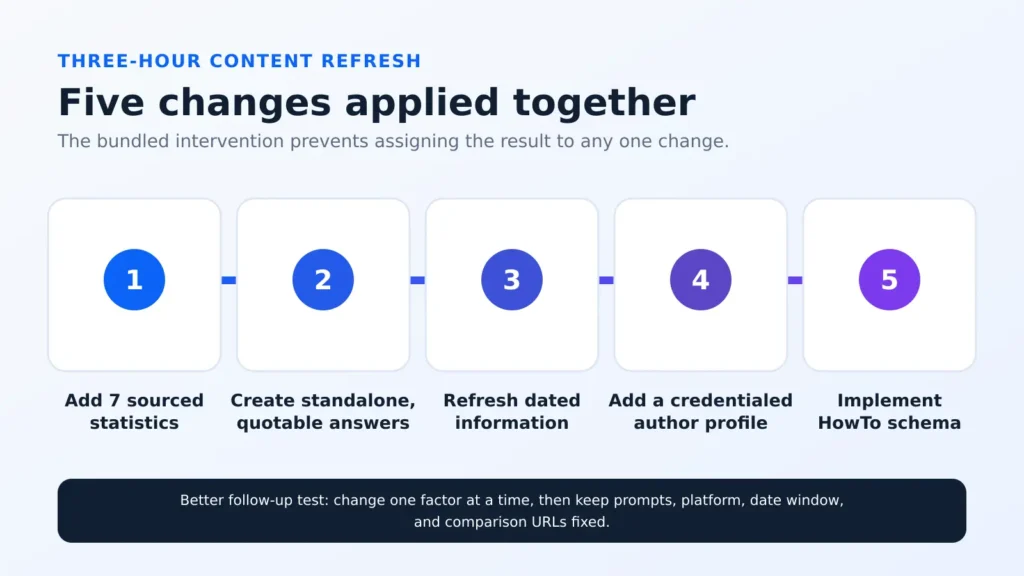
The practitioner did not diagnose a single technical fault. Instead, the update targeted five overlapping weaknesses: evidence density, passage clarity, recency, authorship, and markup. This was a practical production decision, but it makes causal interpretation difficult because every variable changed in the same window.
That distinction is important. Ahrefs later tracked 1,885 pages that introduced JSON-LD and compared them with 4,000 controls. Its strongest analysis found no meaningful citation lift in ChatGPT or Google AI Mode from schema alone. The study does not prove schema is useless; it shows that adding markup to already cited pages was not an independent citation shortcut. See the Ahrefs controlled schema analysis.
What the diagnosis does—and does not—show: The case supports a bundled content-quality hypothesis: a more current, specific, attributable, and answer-shaped page became more citeable. It does not show that HowTo schema, freshness, statistics, or author credentials alone produced seven citations.
Intervention plan: five changes applied together
The reported refresh took approximately three hours and combined the following edits:
- Added seven relevant, sourced statistics. Concrete numbers gave the page claims that could be checked and attributed.
- Rewrote dense passages as standalone answers. Key points were made understandable without requiring several surrounding paragraphs.
- Refreshed outdated material. The guide was brought forward from an 18-month-old state with current references and context.
- Replaced generic authorship. A named, credentialed author profile supplied experience and accountability.
- Implemented HowTo schema. The markup described the instructional structure already visible on the page.
Notice what was deliberately absent from the report: no claim of buying links, publishing dozens of near-duplicate pages, changing the domain, or stuffing an “AI keyword” into every paragraph. The work concentrated on the quality and extractability of one existing resource.
Implementation timeline
| Stage | Reported action | Measurement implication |
|---|---|---|
| Before update | Record citation outcome for 10 target queries | Creates an absolute baseline of 0/10 |
| Three-hour refresh | Apply all five content and markup changes | Fast execution, but no factor isolation |
| Weeks 1–4 | Repeat citation checks | Allows time for recrawl and platform variation |
| End of window | Compare the same reported query panel | Result reported as 7/10 |
The source did not publish exact edit and retest dates, who approved the changes, or whether the 10 prompts were run at a fixed frequency. Those missing fields limit reproducibility.
Measurement method: what was fixed and what remains unknown
The strongest element of the report is its denominator: 10 tracked queries before and after. Absolute counts are easier to audit than a vague statement such as “AI visibility improved.” The practitioner also stated that the result was measured over four weeks rather than after a single favorable response.
However, several controls remain unknown: which platforms were tested, whether browsing was enabled, the exact prompt wording, model versions, location, account state, response reruns, cited URL matching rules, and whether competing pages changed during the same period. AI answers are probabilistic and their retrieval systems change, so a single run per prompt can exaggerate movement.
A stronger replication protocol: Freeze 10–20 prompts and their wording; record model, mode, location, date, cited URL, and screenshot; run multiple repetitions; keep at least one similar page unchanged as a control; and compare equal 28-day windows. Measure both citation rate and the number of unique cited URLs.
Results: before and after with absolute counts
| Metric | Before refresh | After refresh | Change |
|---|---|---|---|
| Tracked prompts | 10 | 10 | No reported change |
| Prompts citing the page | 0 | 7 | +7 |
| Citation rate | 0% | 70% | +70 percentage points |
| Observation window | Baseline not dated | Four weeks | Not fully comparable from published detail |
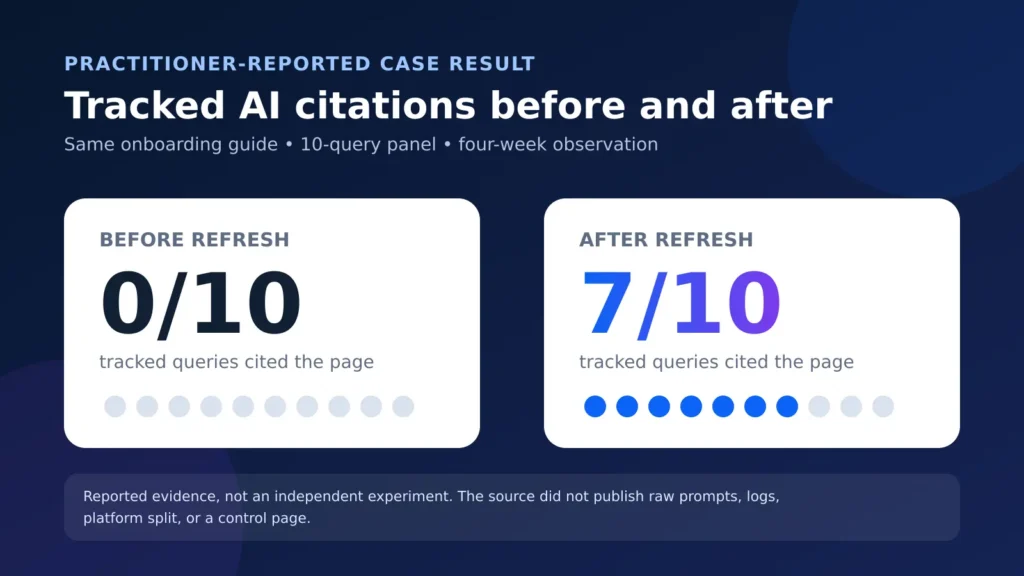
The arithmetic is straightforward: seven cited outcomes divided by 10 tracked prompts equals a 70% observed citation rate. The relative percentage increase is not meaningful because the baseline was zero. Reporting “infinite growth” or an exaggerated percentage would misrepresent the result.
What likely caused the improvement—and what cannot be proven
The most plausible explanation is the combined improvement in passage utility. The revised guide contained current facts, externally supportable numbers, clearer answer units, and identifiable expertise. Those qualities make it easier for retrieval systems—and readers—to determine what a passage claims and why it is credible.
Large-sample evidence supports the freshness part only as an association. Ahrefs analyzed 16.975 million cited URLs across several AI platforms and found that AI-cited pages were, on average, more recently published and updated than ordinary organic results. Its authors explicitly cautioned that freshness is only one factor and that changing dates without substantive edits is not a strategy. Review the 17-million-citation freshness study.
The case cannot establish which of the five changes mattered most. It also cannot rule out recrawling, query demand, competitor movement, model updates, or chance. The original account appears in a public practitioner post and was summarized by ZipTie, but neither source provides raw logs for independent verification.
The defensible conclusion: A substantive content refresh preceded a change from 0/10 to 7/10 cited prompts in one reported case. The result justifies testing the method on your own pages; it does not justify promising the same outcome or crediting one tactic.
Lessons readers can transfer to another website
- Start with a fixed prompt panel. If the test changes, the before/after comparison loses meaning.
- Improve claims, not just formatting. Add specific facts, sources, dates, definitions, and named expertise where they genuinely help.
- Make important passages self-contained. A useful answer should state the subject, claim, context, and limitation clearly.
- Use schema to describe visible content. Do not expect markup to compensate for weak evidence or unclear writing.
- Record absolute counts. Save the number of prompts tested, citations found, platforms used, and exact cited URLs.
- Retest after recrawl. A same-day check may only measure whether the old version is still in an index.
For a broader framework, use Visible Pilot’s guide to making website content citeable by AI. If you are deciding which evidence asset to publish next, compare the original research formats most cited by AI.
Evidence to capture in your own case study
Save the old and new page versions, change log, prompt sheet, model and mode, run timestamps, screenshots, full answer text, cited URLs, and competitor citations. Record author and reviewer changes, source additions, crawl evidence, index status, and any schema diff. Without that record, a successful result becomes a marketing anecdote rather than a reusable experiment.
Common interpretation mistake: Do not assume that adding schema or several short answers automatically earns citations. The page still needs factual support, clear entities, original value, accessible HTML, and sourceworthiness. In this case, five changes happened together; presenting HowTo schema as the proven cause would go beyond the evidence.
Frequently asked questions
Can a content update make a page appear in AI citations?
It can improve the conditions for citation, and this case reported a move from 0/10 to 7/10 cited prompts. Results vary by query, platform, authority, competing sources, and whether the updated page is recrawled.
How long should I measure after an update?
Four weeks is a practical minimum for a small test. Use equal before and after windows, repeat prompts several times, and record model and date information so platform changes are visible.
Does FAQ or HowTo schema directly increase AI citations?
Current evidence does not support treating schema as a direct citation switch. Use valid markup when it accurately describes visible content, but prioritize clear, factual, well-sourced passages.
What is the best success metric?
Use citation rate with a disclosed denominator: cited prompt runs divided by total comparable prompt runs. Also track unique cited URLs, platform, citation position, referral visits, and conversions.
Next step: request a Visible Pilot audit
A credible AI citation case study begins with a repeatable baseline. Request a Visible Pilot audit to identify access, rendering, content, entity, and evidence issues before you invest in a large refresh.