

An AI search readiness audit for SaaS websites should answer one practical question: can AI-powered search experiences reliably discover, understand, retrieve, and cite the pages that influence a software purchase? The audit is useful for SaaS founders, growth teams, SEO leads, and agencies that need a defensible improvement plan rather than another unexplained visibility score.
A SaaS site is not one page type. Product pages describe capabilities, integration pages prove compatibility, documentation resolves implementation questions, security pages reduce risk, comparison pages support evaluation, and pricing pages affect the final decision. A credible audit tests these journeys separately because a healthy homepage does not prove that deeper, higher-intent pages are accessible or useful.
What you should receive:
A page-level diagnosis with reproducible evidence, an issue inventory ordered by business impact and effort, exact fix guidance, and a retest plan. The audit may identify conditions that improve eligibility and usefulness, but it cannot guarantee a mention, citation, or ranking in an external AI system.
What an AI search readiness audit for SaaS websites should reveal
The first output is a failure map. It should show where the journey breaks: URL discovery, crawler access, server delivery, rendering, index controls, entity understanding, retrieval for a target question, brand mention, or source citation. These stages are related, but they are not interchangeable.
For example, a pricing page can return a clean 200 response yet expose only an empty application shell in its initial HTML. An integration page can be fully rendered but carry a canonical tag that points elsewhere. A documentation article can be indexed and still fail to answer the exact setup question used by prospects. A comparison page can be useful but lack independently verifiable evidence. Each condition needs a different fix.
- Which commercial and support pages are discoverable through crawlable internal links and XML sitemaps.
- Whether representative URLs return stable status codes without login walls, consent gates, bot challenges, or rate-limit failures.
- Whether essential text, headings, links, canonical tags, and structured data are present in the delivered HTML.
- Whether the site identifies the company, product, category, audience, capabilities, integrations, and proof consistently.
- Which buyer questions the current page inventory answers well, weakly, or not at all.
- Where the brand is mentioned or cited in a fixed prompt sample, which URL is cited, and how results vary across repeated tests.
Scope: pages, platforms, technical layers, content signals, and evidence
Begin with a representative inventory instead of crawling thousands of URLs without a hypothesis. A compact SaaS audit usually samples the homepage; product and feature pages; pricing; integrations; solutions by role or industry; documentation; changelog; security and compliance; customer stories; comparison pages; and high-intent educational content. Large sites should stratify the sample by template, subdomain, language, and lifecycle stage.
The technical scope should cover DNS and transport, HTTP responses, redirects, robots.txt, relevant bot controls, CDN and WAF behavior, canonicalization, robots meta directives, JavaScript delivery, raw HTML, rendered output, crawlable links, sitemaps, structured data, and page performance where delivery failures may affect access. Separate a search crawler, training crawler, and user-triggered fetcher when a platform documents different controls.
The content scope should examine direct answers, information gain, claim support, dates, authorship, customer evidence, product terminology, entity consistency, and the path from a broad category question to a specific buying decision. Google’s official generative AI guidance emphasizes strong SEO foundations and valuable, non-commodity content rather than special markup tricks.
SaaS sampling rule:
Test at least one URL from every template that can influence acquisition, evaluation, onboarding, retention, or trust. A ten-page sample across ten meaningful templates is usually more revealing than fifty URLs from one blog template.
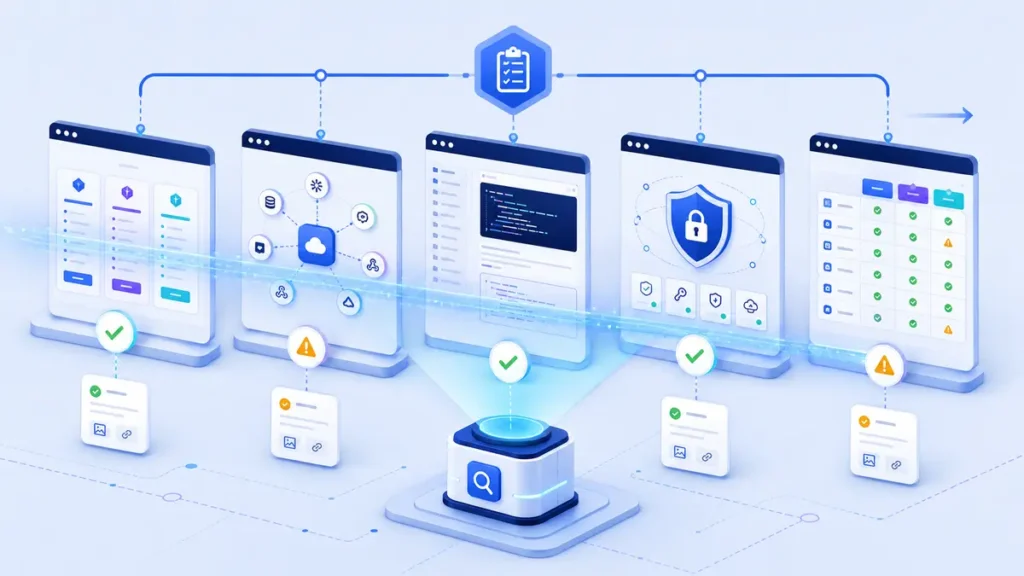
Audit process: baseline, tests, findings, prioritization, and retest
1. Define the commercial baseline
Choose the products, customer segments, competitors, regions, and AI experiences that matter. Build a versioned prompt panel from real buyer journeys: problem discovery, category education, shortlist creation, vendor comparison, integration requirements, security review, pricing, implementation, and switching. Record the exact prompt, date, platform, model or experience where visible, location, account state, and result.
2. Test representative URLs
For each sampled page, save the final URL, response status, headers, raw HTML, rendered output, canonical, index directives, internal-link source, sitemap presence, and any CDN or firewall event. Then inspect whether the page answers its intended question clearly and supports product claims with evidence a reviewer can verify.
3. Separate symptoms from causes
A missing citation is a symptom, not a root cause. Possible causes include access failure, weak page targeting, duplicate or conflicting URLs, missing proof, unclear entities, insufficient external corroboration, or simple selection variance in the platform. Document what the evidence proves, what it suggests, and what remains unknown.
4. Prioritize changes
Score each finding by business importance, confidence, reach, effort, and implementation risk. A blocked pricing or documentation template normally deserves attention before rewriting a low-traffic article. Group related template defects into one engineering ticket instead of creating hundreds of duplicate URL-level tasks.
5. Retest under controlled conditions
Freeze the baseline, make the smallest meaningful change, and repeat the same technical tests and prompt panel. Keep mentions and citations separate. A successful fetch proves delivery; it does not prove retrieval or citation. A cited answer proves one observed outcome; it does not prove permanence.
Deliverables that make the audit actionable
A useful report connects every recommendation to proof. The issue inventory should include the affected template and URLs, observed behavior, reproduction steps, evidence file, likely consequence, confidence level, recommended fix, owner, effort, priority, and pass condition. Screenshots are helpful, but raw responses, log events, HTML captures, and dated output records make the result auditable.
- An executive summary that explains the largest commercial risks in plain language.
- A representative page inventory mapped to acquisition, evaluation, onboarding, retention, and trust journeys.
- Technical evidence for access, delivery, rendering, directives, discovery, and structured data.
- A content and entity review tied to real SaaS questions and differentiated product evidence.
- A versioned platform test log with prompts, eligible responses, mentions, citations, cited URLs, and competitors.
- A 30-, 60-, and 90-day roadmap with owners, dependencies, effort, confidence, and measurable pass conditions.
Minimum evidence standard:
Someone outside the audit team should be able to reproduce a finding from the recorded URL, request conditions, timestamp, and pass/fail rule. If a provider cannot show how a score was produced, treat the score as a presentation layer—not as proof.

What changes by site size, stack, and SaaS business model
Early-stage or single-product SaaS
Focus on the handful of pages that explain the problem, product, pricing, proof, and onboarding path. The largest gaps are often missing category language, vague feature claims, thin integrations, and limited third-party corroboration. A small fixed prompt panel and ten to twenty representative URLs can create a useful baseline.
Multi-product, international, or enterprise SaaS
Sampling must cover product lines, subdomains, locales, documentation versions, partner ecosystems, and security requirements. Look for conflicting canonicals, inconsistent naming, duplicate solution pages, obsolete documentation, inaccessible gated resources, and regional delivery differences. Governance, ownership, and regression monitoring become as important as the initial findings.
JavaScript-heavy applications and headless stacks
Audit direct routes and anonymous sessions, not only navigation inside an already loaded application. Check what the server returns before scripts run, whether important APIs require a token, whether hashed assets exist after deployments, and whether feature, pricing, and documentation copy remains available when JavaScript fails. The guide to technical issues affecting AI search visibility provides a wider diagnostic sequence.
Marketplace, freemium, and product-led models
Include template-generated integration, app, use-case, and user-generated pages. Review quality thresholds, duplication, crawl paths, canonical rules, thin combinations, and the path from an informational answer to product activation. Product-led sites should also inspect public help content and the boundary between open documentation and authenticated application screens.
When a checklist is enough—and when expert help is justified
A checklist is enough when the site is small, the stack is conventional, the owner can access Search Console and server or CDN settings, and the suspected problem is limited. Teams can verify status codes, robots rules, canonicals, raw HTML, internal links, sitemaps, key schema, and a small prompt sample themselves.
Specialist help is justified when results differ by crawler or geography, the WAF blocks requests intermittently, JavaScript or edge rendering is complex, several subdomains conflict, migrations introduced routing problems, or leadership needs a repeatable measurement system. It is also useful when engineering effort must be prioritized across many templates and every recommendation needs a defensible business case.
Small businesses can use the broader AI visibility audit for small business guide. SaaS teams should go deeper because documentation, integrations, security reviews, comparison journeys, and product-led conversion paths create additional failure points.
How to compare audit providers without relying on proprietary scores
| Evaluation question | Strong evidence | Warning sign |
|---|---|---|
| What was tested? | Named URLs, templates, platforms, prompts, dates, and request conditions | “We scanned your site” without a sample or method |
| How is a finding reproduced? | Raw response, HTML capture, log event, screenshot, and clear pass rule | A colored score with no underlying evidence |
| Are stages separated? | Access, processing, retrieval, mention, and citation measured independently | One score presented as proof of every stage |
| Is the SaaS model reflected? | Pricing, integrations, docs, security, comparison, and lifecycle journeys included | A generic blog checklist copied across industries |
| How are recommendations prioritized? | Business impact, confidence, reach, effort, risk, owner, and pass condition | A long issue list ordered only by severity label |
| What happens after fixes? | Controlled retest using the same URLs and prompt set | No baseline, versioning, or verification plan |
Ask providers to explain the denominator behind every percentage and the limits of their tests. AI outputs vary by prompt, platform, model, location, time, and account context. A trustworthy auditor reports that variability instead of selecting the most favorable screenshot.
Evidence and screenshots to include
The evidence pack should show industry-specific page types and conversion journeys, not only technical test screens. Capture the path from a category question to a feature page, integration proof, security review, pricing evaluation, and signup or demo action. For each stage, show the page’s visible answer, delivered HTML, entity signals, access result, and any observed citation opportunity.
- A page inventory labeled by template and buyer journey.
- Raw and rendered views of pricing, integration, documentation, security, and comparison pages.
- Robots, canonical, noindex, redirect, sitemap, and internal-link evidence.
- Verified CDN or WAF events for blocked, challenged, or rate-limited requests.
- Structured data validation matched against the visible page content.
- Dated prompt outputs with brand mentions, citations, cited URLs, competitors, and notes on variation.
- Before-and-after captures tied to a deployment or content revision.
OpenAI’s crawler documentation distinguishes OAI-SearchBot, GPTBot, and ChatGPT-User, so a provider should not treat one robots rule as a universal visibility control. Google likewise states that eligibility for AI features depends on normal Search requirements and does not guarantee selection.
Common interpretation mistake: using a generic AI SEO checklist
The most common mistake is to copy a generic checklist and mark the entire SaaS domain “ready” because the homepage loads, robots.txt is open, and schema exists. That conclusion ignores the pages where prospects make decisions and the different systems that may fetch, index, retrieve, mention, or cite them.
Adapt the audit to the business model and inventory. A developer API company may depend on documentation and code examples. A security platform may depend on compliance, methodology, and trust pages. A vertical SaaS product may need clear industry terminology and integration proof. A freemium tool may need public templates, use cases, and activation paths. Readiness is not one universal configuration; it is the ability of the right public pages to support the right customer questions.
Avoid changing robots rules, rendering, schema, content, and prompt wording simultaneously. When many variables move together, a later improvement cannot be attributed confidently. Preserve the baseline, change one meaningful layer, and retest.
Frequently asked questions
How long does a SaaS AI search readiness audit take?
A small single-product site can often be sampled in several working days, while a multi-product, multilingual, or documentation-heavy platform may require several weeks. Duration depends on URL and template count, stack complexity, platform coverage, log access, and whether the work includes implementation or only diagnosis.
Does allowing AI crawlers guarantee that a SaaS site will be cited?
No. Access removes one possible barrier. Citation also depends on discovery, indexing or retrieval systems, relevance to the prompt, content quality, evidence, competition, freshness, and platform-specific selection. Report crawler access and citation outcomes as separate measurements.
Should an audit include llms.txt?
It can check whether an existing file is valid and useful for the workflows that consume it, but it should not treat llms.txt as a universal ranking requirement. Google’s current guidance says it does not use llms.txt for Search, including generative AI features. Core crawlability, indexability, page quality, and evidence deserve priority.
Which SaaS pages should be audited first?
Start with pricing, core product or feature pages, high-value integrations, documentation for purchase-blocking questions, security or compliance, comparison pages, and the strongest customer proof. Then add the educational pages that introduce the problem and category.
How often should the audit be repeated?
Retest affected templates immediately after important fixes. Repeat a compact baseline after major migrations, framework changes, CDN or WAF changes, product launches, documentation restructures, or material shifts in results. Ongoing monthly or quarterly sampling is more useful than an uncontrolled daily check.
Next step: build a SaaS-specific baseline
Begin with ten to twenty representative URLs and a small, versioned set of buyer prompts. Record access, delivered content, entity clarity, mentions, citations, and the exact evidence behind every result. Then prioritize the highest-impact template problem and retest it under the same conditions.
If competitors appear while your brand does not, use why AI answers mention competitors but not your brand to separate access, discovery, entity, and citation causes before rewriting pages at random.