

AI visibility for B2B service websites depends on whether AI-assisted search experiences can access your pages, understand what you do, connect your claims to credible evidence, and select your site for a relevant buyer question. It is not simply a question of adding schema or publishing more generic blog posts. For a consultancy, agency, legal practice, IT provider, recruiter, or other service firm, the strongest visibility often starts on the pages that explain a specific service, buyer problem, industry, method, and proven outcome.
Quick answer: Build AI visibility around real buying questions. Make each important service page crawlable, technically stable, explicit about audience and scope, and supported by named expertise, methodology, examples, and evidence. Test the same pages and prompts before and after changes. No tactic guarantees an AI mention or citation, but this process makes failures observable and improvements defensible.
What AI visibility for B2B service websites means in practical terms
A B2B service website is visible when its information can participate in discovery and answer generation at the moment a buyer asks a relevant question. That may appear as a cited source, a linked recommendation, an uncited brand mention, or a referral visit from an AI search experience. These outcomes are different, so they should be measured separately.
Google’s current guidance says its generative search features continue to rely on core search systems: useful content, crawlability, indexing eligibility, clear technical structure, and a good page experience. It also says there is no special AI markup required. OpenAI separately documents OAI-SearchBot and ChatGPT referral tracking, including the utm_source=chatgpt.com parameter. Bing Webmaster Tools now includes AI Performance reporting with citation counts, cited pages, and grounding-query information. Together, these sources support a simple principle: eligibility comes first, but selection must still be earned.
| Stage | Question to answer | Evidence to capture |
|---|---|---|
| Access | Can an approved crawler request the canonical URL? | robots.txt rule, HTTP status, firewall/CDN log |
| Delivery | Does the response contain the intended page? | headers, canonical tag, rendered HTML, main content |
| Understanding | Is the service, audience and entity relationship explicit? | visible copy, headings, internal links, Organization details |
| Selection | Does the page directly satisfy a buyer question? | prompt, response, competing sources, cited passage |
| Business value | Did the visibility create a useful visit or enquiry? | referral session, landing page, assisted conversion |
Important distinction: Crawlability is an eligibility condition, not proof that an AI system will recommend your company. A successful fetch should lead to a content and evidence review—not to a guarantee claim.
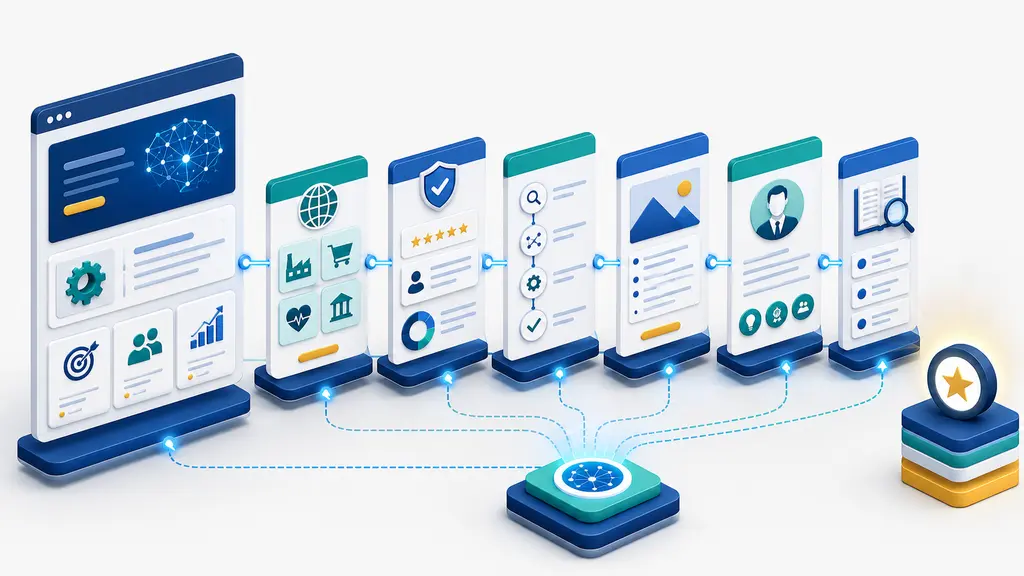
Step 1 — establish a clean baseline and choose representative URLs
Do not audit only the homepage. A homepage usually describes the company at a high level, while a buyer asks questions such as “Which cybersecurity firm performs SOC 2 readiness assessments for SaaS companies?” or “What should a CRM migration consultancy include in its discovery phase?” Choose pages that can answer those questions with useful specificity.
- One core service page that explains the problem, scope, deliverables, process, exclusions, and next step.
- One industry or use-case page showing how the service changes for a particular buyer context.
- One case study or proof page with a dated situation, intervention, evidence, and limitations.
- One About or expert page that identifies responsible people, credentials, and experience.
- One commercial page covering engagement model, qualification criteria, pricing approach, or consultation process.
- One knowledge article that answers a narrow pre-purchase question better than the service page can.
For every URL, record the canonical address, intended buyer question, HTTP status, indexability, server and rendered word count, last meaningful update, and the evidence expected on the page. Save this as baseline version 1.0. If you cannot describe what a page should be selected for, it is not ready for a useful visibility test.
| URL type | Baseline test | Pass condition |
|---|---|---|
| Service page | Fetch as browser and approved crawler | HTTP 200; same canonical; key offer visible |
| Industry page | Inspect entity and audience wording | Industry, problem and service relationship are explicit |
| Case study | Check proof and context | Named method, dates, scope, evidence and caveats are visible |
| Expert page | Check authorship and identity | Person, role, qualifications and organization are consistent |
| Commercial page | Check conversion path | Clear next step works without hidden or blocked content |
Step 2 — audit buying-question pages for AI visibility for B2B service websites
A strong service page should resolve the buyer’s uncertainty without forcing an AI system—or a human—to infer the essentials. State who the service is for, the triggering problem, what is included, what is excluded, how delivery works, which evidence the buyer receives, and what makes your approach different. Replace vague claims such as “tailored, world-class solutions” with verifiable details.
Map one main buying question to each page. Then add supporting questions that naturally belong on that URL: implementation time, prerequisites, deliverables, risk, comparison criteria, expertise, and expected decision. Avoid creating a thin page for every wording variation. Google advises creating valuable, non-commodity content rather than scaling pages around query variants.
- Define the service: use the language customers and practitioners use, then explain specialist terms.
- Show the process: identify stages, inputs, outputs, owners, and decision gates.
- Publish proof: include original examples, anonymized patterns, screenshots, benchmarks, or case-study evidence where permitted.
- Make expertise inspectable: connect the author or service lead to relevant experience and first-hand knowledge.
- Clarify fit: say who benefits, who may not, and when another solution is more appropriate.
- Support claims: link statistics and technical statements to primary sources, and date time-sensitive assertions.
Content test: Give the page to a colleague who does not work on the account. Ask them to identify the target buyer, problem, deliverables, proof, and next step in two minutes. Missing answers are content gaps before they are “AI SEO” gaps.
Step 3 — separate failures affecting AI visibility for B2B service websites
Diagnose in layers because the same symptom can have different causes. If a platform never surfaces an important page, first test access. A robots rule may allow the crawler while a CDN challenge still returns 403. A browser may show complete content while the initial HTML contains only a shell. A page may render correctly but remain too generic to support a recommendation.
| Symptom | Likely failure layer | First safe test |
|---|---|---|
| Crawler receives 401, 403, 429 or 5xx | Access or delivery | Check robots, verified bot handling, rate limits and edge logs |
| Important text appears only after interaction | Rendering | Compare raw HTML, rendered DOM and accessibility tree |
| Several URLs compete for the same service | Discovery or canonicalization | Check canonical tags, redirects, sitemap and internal links |
| Company is mentioned but wrong service is associated | Entity or content clarity | Align visible facts, Organization data, About and service copy |
| Page is fetched but not selected | Relevance, evidence or competition | Compare the exact answer passage with cited alternatives |
| Tools report conflicting visibility | Measurement design | Normalize prompts, platform, region, dates and denominator |
Use the CDN settings checklist for AI crawler access when an edge or firewall layer is suspect. If different systems confuse your company, service, location, or leadership, use the brand facts page for AI search as a controlled first-party reference. Keep visible content and structured data consistent; Google’s Organization documentation says the markup can help disambiguate administrative details, but it is not a recommendation guarantee.
Step 4 — apply the smallest safe fix and document the change
Change one failure layer at a time. If the crawler is blocked, fix access before rewriting copy. If the key answer is absent from stable HTML, correct delivery before adding more schema. If the page is technically healthy but generic, add the missing scope and evidence instead of rebuilding the entire template.
| Priority | Smallest useful change | Risk control |
|---|---|---|
| Critical | Remove unintended noindex, blocked paths, challenge pages, broken redirects, or persistent error responses | Retest security behavior and restricted areas |
| High | Put the service definition, audience, deliverables, and proof in stable visible HTML | Keep conversion design and accessibility intact |
| High | Consolidate duplicate service URLs and strengthen canonical internal links | Map redirects and preserve valuable URLs |
| Important | Align organization, expert, service, and contact facts across pages and structured data | Validate that markup matches visible content |
| Improvement | Add a dated case example, method, comparison table, or original evidence | State scope and limitations; do not invent results |
| Avoid | Publish dozens of near-duplicate “AI-optimized” pages | Focus on buyer usefulness and a clear page purpose |
Change log rule: Record the URL, date, hypothesis, exact edit, owner, expected pass condition, and rollback plan. Without a change log, a later improvement cannot be separated from unrelated model, index, competitor, or website changes.
Step 5 — retest AI visibility for B2B service websites with fixed inputs
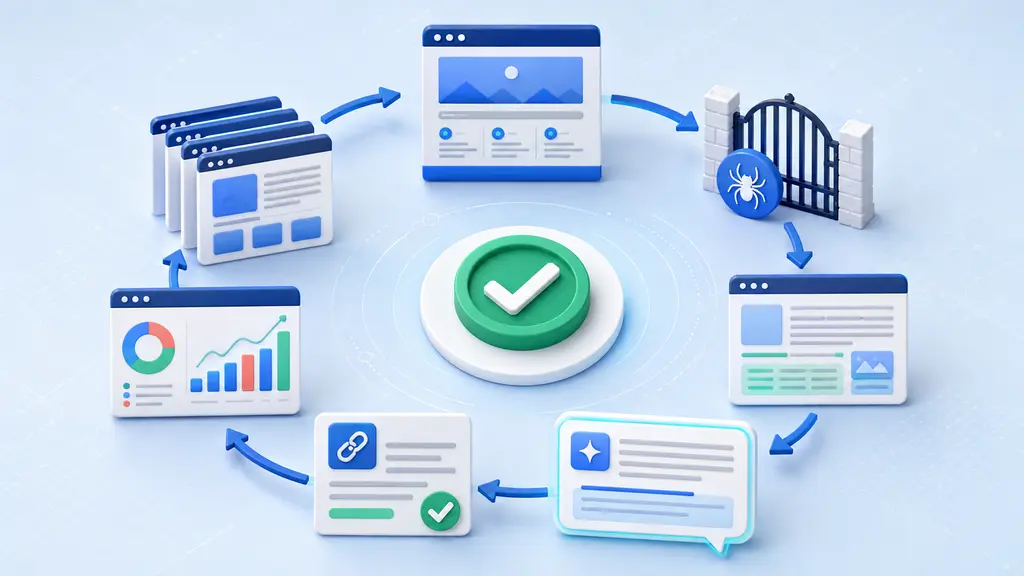
Retest the same URLs first. Confirm status codes, canonical tags, index controls, rendered content, primary facts, internal links, and structured data. Then rerun the same versioned prompt panel on the same platforms, region, language, and schedule. Do not change the prompts at the same time as the pages if you want a clean comparison.
Track raw observations before creating a score: eligible responses, brand mentions, cited-domain appearances, cited URLs, referral visits, and qualified actions. The guide to why AI visibility scores differ between tools explains why two dashboards can disagree even when both are functioning correctly.
| Metric | Transparent definition | Suggested reporting |
|---|---|---|
| Access pass rate | Representative URLs returning the intended response ÷ URLs tested | By crawler and URL type |
| Mention rate | Eligible responses naming the brand ÷ eligible responses | By buyer intent and platform |
| Citation rate | Eligible responses citing the tracked domain ÷ eligible responses | Separate from mentions |
| Cited-page coverage | Unique cited target URLs ÷ important URLs tested | Show the actual URLs |
| Referral quality | Engaged or converting AI-referred visits ÷ AI referrals | Use landing page and conversion context |
| Retest stability | Runs meeting the pass condition ÷ scheduled runs | Report a range, not one lucky result |
Worked example — diagnose before you rewrite
This is an illustrative diagnostic example, not a claimed customer result. Imagine a B2B compliance consultancy whose browser tests look healthy, but a service page never appears in a fixed group of purchase-intent prompts. The page returns HTTP 200 for a normal browser, yet verified crawler tests show intermittent 403 responses from the CDN. Its most important description is also loaded inside an interactive tab after JavaScript runs.
The team defines two technical pass conditions: approved crawler requests must consistently receive the canonical 200 response, and the service scope must be present in the initial or reliably rendered HTML without interaction. It adjusts the narrow firewall rule, moves the essential scope and deliverables into the main page body, records the change, and retests the same URL. Access and delivery now pass. Only then does the team continue the prompt panel for several scheduled runs.
That result proves the website failure was corrected; it does not prove that a mention or citation must follow. If selection remains weak, the next comparison is editorial: does the page provide more specific scope, methodology, expert identity, and evidence than the sources currently being cited? The workflow keeps a technical fix from being confused with a selection guarantee.
Evidence and screenshots to include
A useful AI visibility report should let another person reconstruct the test. Capture complete evidence rather than a cropped vendor badge or a single answer screenshot.
- The representative URL inventory and the buyer question assigned to each page.
- robots.txt output, HTTP status, response headers, CDN/WAF event, and time of the request.
- Raw HTML and rendered content showing where the service definition and evidence appear.
- Canonical, index-control, sitemap, and internal-link evidence for each important URL.
- The exact prompt panel, platform or surface, region, language, date, and eligible-response count.
- Full responses with brand mentions and cited URLs preserved in context.
- Referral landing pages and qualified actions, separated from general direct or organic traffic.
- A versioned change log and repeated pass/fail results after implementation.
Common interpretation mistake — copying a generic checklist
The most common mistake is applying the same checklist to every B2B service business. A law firm, cybersecurity consultancy, recruiting agency, and commercial cleaning provider have different buyer questions, proof standards, regulated claims, conversion journeys, and location requirements. The audit should follow the business model and page inventory.
Start with the pages that influence evaluation: core services, industry fit, experts, case evidence, commercial terms, and contact routes. Then adapt the evidence standard. A technical consultancy may need architecture diagrams and implementation constraints; a professional practice may need named qualifications and jurisdiction; an agency may need methodology, deliverables, and transparent case-study scope. The underlying diagnostic layers stay consistent, but the content proof should not be generic.
Frequently asked questions
How long does AI visibility for B2B service websites take to improve?
Technical fixes can be verified as soon as the site serves the corrected response, but indexing, retrieval, mentions, citations, and referrals follow external systems and may change on different timelines. Use scheduled retests and report ranges rather than promising a date.
Does schema markup improve AI visibility?
Relevant structured data can help search systems understand entities and can support eligible search features, but Google states that there is no special structured data required for its generative AI features. Markup should match visible page content and should not replace clear service explanations or evidence.
Should every service have its own page?
Create a separate page when the service has a distinct buyer problem, scope, evidence, and conversion decision. If pages would repeat nearly the same information, consolidate them and use clear sections or supporting examples instead of producing thin variants.
Which AI crawler should a B2B website allow?
Decide by business goal and crawler purpose, then use each provider’s current documentation. OpenAI distinguishes OAI-SearchBot from other crawlers, while Google’s AI search features use Google Search infrastructure. Check robots rules, verified bot handling, firewall behavior, and applicable policies; do not rely only on a copied user-agent string.
Can a B2B service firm measure ChatGPT traffic?
Yes. OpenAI says referral links from ChatGPT include utm_source=chatgpt.com, which can be tracked in analytics. Treat referral sessions and qualified enquiries as separate business metrics from mentions or citations.
Do AI mentions guarantee leads?
No. A mention can occur without a link, and a citation can send a visitor who is not a qualified buyer. Connect visibility reporting to the landing page, engagement, consultation request, pipeline stage, and revenue outcome where your privacy and attribution setup permits.
Next step — build a defensible B2B visibility baseline
Improving AI visibility for B2B service websites starts with a defensible baseline. Choose six representative pages and write one real buying question beside each. Test access, delivery, understanding, selection, and business value in that order. Document the baseline, make the smallest evidence-backed change, and rerun the same tests. To extend the review across crawler access, rendering, entity clarity, citations, and measurement, start with the Visible Pilot AI Search Readiness checklist.