
The AI visibility tool accuracy benchmark needs to answer a harder question than “Which dashboard shows the highest score?” It should reveal whether a tool finds real access, rendering, content, entity and citation problems consistently—and whether another practitioner can verify the evidence. This 2026 methodology edition defines that test before Visible Pilot publishes vendor-level results.
That sequencing is intentional. AI search outputs vary by platform, prompt, location, account state and time. A ranking built from one prompt run or an undisclosed sample would look precise while measuring very little. The framework below shows the denominators, pass conditions and limitations required for a credible comparison.
Research status: This page publishes the benchmark protocol, not invented vendor scores. No tool is ranked until the test set has been completed, checked and released with auditable fields. The results table and downloadable dataset will be added as a dated edition.
Key findings from designing the benchmark
Before the full dataset is available, the protocol already produces several practical findings about what “accuracy” must mean. These are design conclusions, not performance claims about any vendor.
- One score is insufficient. Detection precision, recall, repeatability, evidence quality and workflow value measure different things.
- Raw evidence matters. A correct warning should identify the URL, response, rule, passage or prompt result that triggered it.
- Repeatability is a separate metric. A tool may be correct on one run but unstable across identical tests.
- False positives create real cost. An alert that cannot be reproduced sends teams toward unnecessary technical or editorial changes.
- Coverage changes by stack. WordPress, Shopify, Wix and JavaScript-heavy sites expose different failure modes.
- AI answer visibility must use fixed prompts. Results are not comparable when vendors test different questions, models or dates.
Methodology: how the AI visibility tool accuracy benchmark works
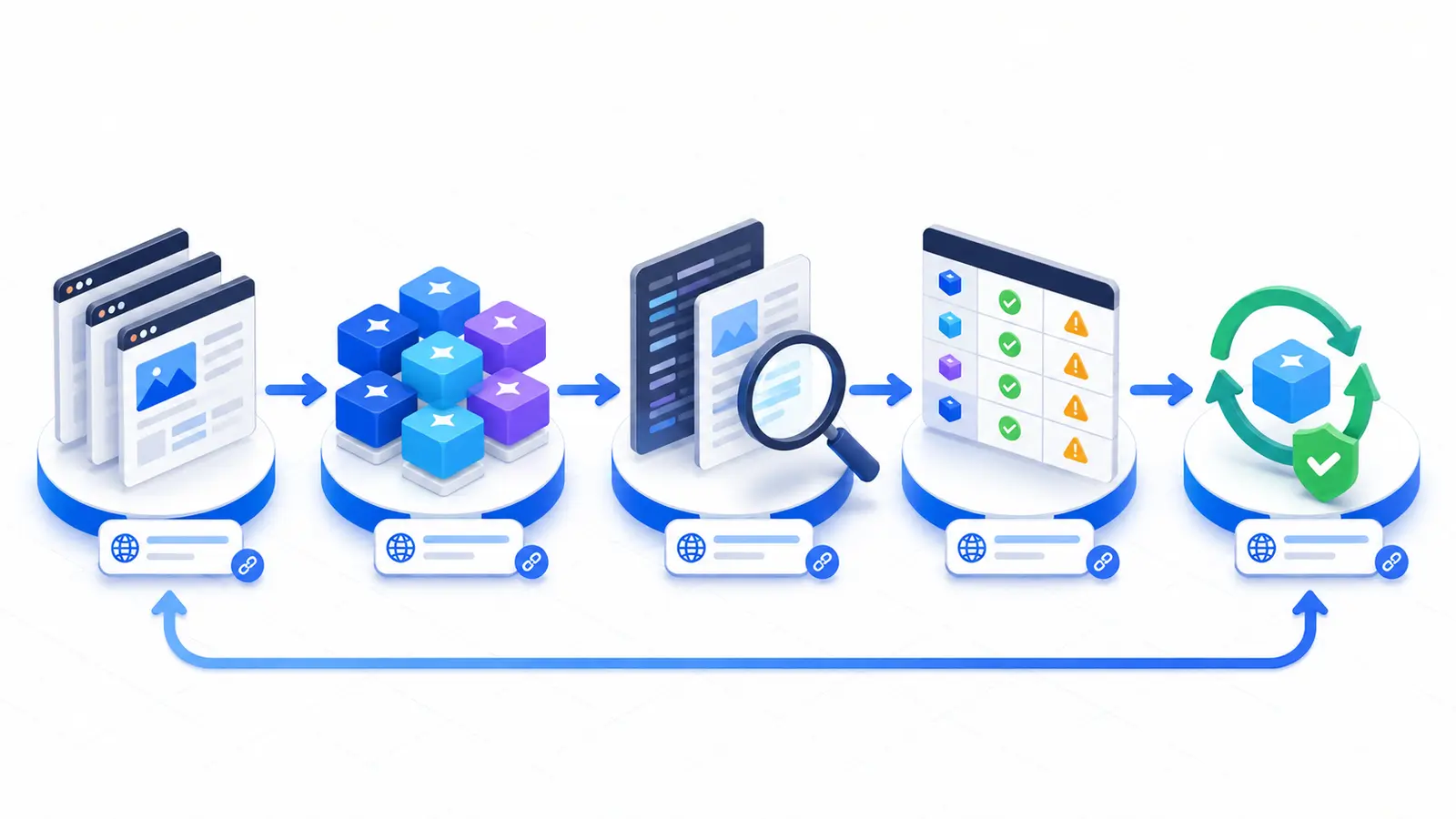
The benchmark begins with a controlled website set containing known conditions. Each site contributes representative public URLs: homepage, product or service page, article, category page, JavaScript-dependent page and a page with a deliberately documented technical or content fault. Inclusion rules, platform, stack, page type and ground-truth condition are recorded before any tool is run.
Every participating tool receives the same submitted domain or URL set within the same testing window. Default settings are recorded, and optional settings are changed only in a separate configuration test. Researchers export the full findings, preserve screenshots and follow evidence links. Two reviewers then compare each alert with server responses, raw HTML, rendered output, directives, structured data and visible page content.
| Metric | Transparent calculation | What a strong result means |
|---|---|---|
| Detection precision | Verified findings ÷ all sampled findings | Most reported issues are real |
| Detection recall | Known issues found ÷ known issues in scope | Important planted or documented issues are not missed |
| Repeatability | Matching results ÷ identical repeated runs | The same input produces stable findings |
| Evidence validity | Findings with reproducible proof ÷ findings reviewed | Another person can verify the alert |
| False-positive rate | Unverified alerts ÷ alerts sampled | Teams are not sent toward unnecessary fixes |
| Workflow completion | Actionable findings completed without manual reconstruction | The output supports a real audit process |
Scoring rule: Publish absolute counts beside every percentage. “18 verified findings out of 20 reviewed” is useful; “90% accurate” without the sample, scope and definition is not.
Overall results: what will count as accurate
The overall result will not crown a winner from a blended proprietary score. Each tool will receive a metric profile. A product could lead on technical recall while producing weaker content evidence; another might cover fewer checks but document them more reliably. The benchmark will also separate automated detections from recommendations that require human judgment.
A finding passes only when its core claim matches the recorded ground truth and the cited evidence supports it. Severity labels are scored separately because a tool can detect a real issue yet exaggerate its business impact. Recommendations do not receive credit merely for sounding plausible; they must point to an appropriate corrective action and a clear acceptance test.
Breakdown by site type and technical stack
Aggregate results can hide where tools fail, so the public release will segment WordPress, Shopify, Wix and custom or JavaScript-heavy sites. Within each platform, results will be broken down by access controls, status and redirect behavior, canonical and index rules, rendering, internal discovery, structured data, entity clarity, citation-ready passages and repeated AI-answer tests.
Company size will not be treated as a technical quality signal. It may be used to describe workflow fit—such as whether findings support a single-site owner or an agency managing many properties—but accuracy remains tied to verifiable site conditions.
Failure-pattern analysis
The most useful errors often cluster. A firewall challenge can lead to missing rendered content, which can then trigger weak content or entity warnings. If every downstream warning is counted as an independent discovery, a noisy tool appears more comprehensive than it is. The benchmark therefore records a likely root cause and related symptoms.
- Access failures: blocked crawlers, authentication, unstable status codes or WAF challenges.
- Rendering failures: essential text or links absent from initial HTML and unavailable to the tested fetch path.
- Interpretation failures: the tool misreads canonical, robots, schema or visible content.
- Evidence failures: the warning has no affected URL, raw response, selector, passage or reproduction step.
- Measurement failures: prompts, models, locations, run counts or denominators change between comparisons.
Implications for website owners and agencies
Use any benchmark as a buying aid, not a substitute for a pilot. Select a small set of your own sites, including one with known problems, and compare raw findings before comparing dashboards. Ask whether findings can be exported, assigned, retested and traced to evidence. For a practical audit structure, see our AI visibility audit for small business.
Agencies should also measure review time. A lower-priced tool can become expensive when specialists must reconstruct every finding. Conversely, a focused tool may be valuable when it reliably identifies the earliest failing layer and provides an acceptance test. The right decision depends on coverage, evidence, repeatability, false positives and the cost of acting.
Buyer warning: Do not equate dashboard polish, prompt volume or a single proprietary visibility score with accuracy. Verify several findings and several “all clear” results on sites you understand.
Reproducibility: fields the dataset will include
The downloadable release will include a benchmark version, research window, tool and version, plan tier, configuration, tested URL, site type, technical stack, known condition, finding category, tool result, reviewer verdict, evidence location, severity agreement, repeat-run result and notes. Prompt tests will additionally store the full prompt, platform, model or product label, date, run identifier, cited domain, cited URL and whether the cited page supports the answer.
Personal data, credentials and private customer information will not be included. When a live site changes during the research window, that observation will be flagged rather than silently forced into the original ground truth.
Update policy and comparability
Visible Pilot will date every edition and preserve the scoring definitions used for it. A tool update, model change or material methodology change will trigger a new version. Results from different editions will not be presented as a trend unless the site set, prompts, conditions and calculations remain comparable. Corrections will include the affected records and reason.
Downloadable charts and benchmark dataset
The first dataset release will provide machine-readable records plus charts for precision, recall, repeatability, evidence validity and false-positive rate. Until those checks are complete, this page remains the public specification for the AI visibility tool accuracy benchmark. That makes the eventual results easier to audit and harder to manipulate.
You can also review JavaScript rendering issues for AI crawlers to understand one high-impact test category, or read why AI answers mention competitors but not my brand for a diagnostic sequence behind visibility differences.
AI visibility tool accuracy benchmark: final takeaway
A reliable AI visibility tool accuracy benchmark should reward tools that find known problems, avoid inventing new ones, show their evidence and reproduce the result. The strongest benchmark is not the one with the most dramatic leaderboard; it is the one another team can repeat. Visible Pilot will publish vendor results only after that standard is met.