

A free AI brand mention checker helps you discover whether systems such as ChatGPT, Google AI experiences, Claude, and Perplexity name your company when people ask relevant questions. The useful output is not a vanity score. It is a dated record of the queries tested, the wording returned, whether your brand appeared, which competitors appeared, and whether the answer linked to a source. This guide gives you a repeatable manual method you can use now while Visible Pilot prepares its automated checker.
Pre-launch note: Visible Pilot’s automated URL and prompt workflow is still being finalized. You can use the process below today or request an early manual check. We will not present an unfinished scanner as a live tool.
What the free AI brand mention checker checks
A brand mention test begins with customer language, not your company name. If you ask an AI system directly about your brand, the answer proves awareness of a branded query; it does not show whether the brand is discoverable during a neutral buying journey. The checker therefore starts with non-branded prompts that describe the problem, category, location, audience, feature, or comparison your prospects actually care about.
- Brand mention: does the answer name your organization, product, or a recognized variation of the name?
- Linked citation: is the mention accompanied by a clickable link, footnote, or source card that leads to your site?
- Source ownership: does the answer rely on your domain, a third-party review, a directory, a news page, or no visible source?
- Context: is the brand recommended, neutrally listed, incorrectly described, confused with another entity, or mentioned with a warning?
- Competitor share: which alternatives appear in the same response, and how often do they appear across the test set?
- Repeatability: does the result persist across a second run, another phrasing, a clean session, or a later date?
Keep mentions, citations, and referral visits as separate measurements. A system can name a company without linking to it, cite a page without prominently naming the brand, or send traffic only when a user opens a source. OpenAI currently states that publishers allowing OAI-SearchBot can track ChatGPT referral traffic because outbound URLs include utm_source=chatgpt.com. That makes analytics useful evidence, but absence of a referral does not prove absence from every answer.
How it works: request path, tests, scoring rules, and limits
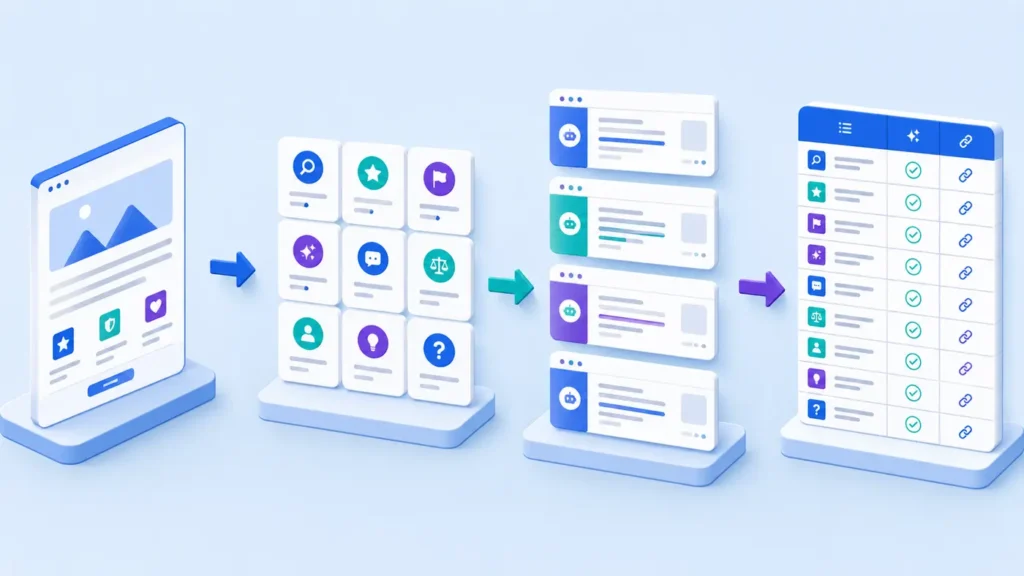
The most reliable free workflow uses a fixed prompt matrix. Choose one market, one language, and one audience. Write 10 to 20 neutral questions spanning discovery, comparison, problem-solving, and purchase intent. Run the same set on each platform, capture the complete answer, and record the date, account state, location if relevant, visible sources, and exact brand spelling. Repeat the baseline before changing your website so you have something meaningful to compare.
- Define the brand name, common abbreviations, product names, domain, and likely misspellings that count as a match.
- Select a focused topic set: five discovery prompts, five comparison prompts, five problem prompts, and five high-intent prompts is a practical starting sample.
- Test in a clean session where possible. Do not mention your brand in the prompt unless you are deliberately testing branded accuracy.
- Save the answer and source URLs. Screenshots help with presentation, but copied text and links are easier to audit.
- Score each result using the same rules, then repeat a sample on another day to expose unstable results.
- Investigate the pages and third-party sources behind competitors’ mentions before deciding what to publish or fix.
| Measure | How to calculate it | What it tells you |
|---|---|---|
| Mention rate | Prompts with your brand ÷ prompts tested | How often the brand enters the answer set |
| Citation rate | Prompts linking your domain ÷ prompts tested | How often your owned pages appear as visible sources |
| Positive-context rate | Accurate positive or neutral mentions ÷ all mentions | Whether visibility is useful rather than merely present |
| Competitor gap | Leading competitor mention rate minus your mention rate | The size of the observable category gap |
| Repeat rate | Matches reproduced ÷ prompts retested | How stable the finding is across runs |
Results explained: pass, warning, fail, and evidence
A useful result must show the evidence behind its label. “Pass” should never mean that the platform guarantees future visibility. It means only that the tested prompt produced the stated observable outcome at the recorded time. The report should preserve enough context for another person to reproduce or challenge the finding.
- Pass: the exact brand or accepted variation appears accurately, and the evidence includes the full prompt, answer, platform, and timestamp.
- Warning: the brand appears, but the description is incomplete, the entity is ambiguous, the wording is negative, or a third party receives the source link instead of your site.
- Fail: the brand does not appear while relevant competitors do, or the answer contains a demonstrably incorrect claim about the brand.
- Inconclusive: the platform refuses the query, provides no answer, times out, varies by unavailable location settings, or the result cannot be reproduced.
Important: AI answers are dynamic. A checker can document what happened during a controlled test; it cannot prove universal visibility across every user, model, region, account, or future response. Treat the output as a measurement sample, not a permanent ranking position.
Example result for a healthy brand and a missing brand
Imagine two SaaS products serving the same audience. The healthy brand has clear product pages, consistent organization and product names, useful comparison content, independent reviews, and accessible source pages. The missing brand has a thin homepage, inconsistent naming, no focused category pages, and a firewall that sometimes challenges automated requests. The following numbers are illustrative; they demonstrate the method rather than a customer claim.
| Check | Healthy brand | Missing/problem brand |
|---|---|---|
| Prompts tested | 20 fixed prompts | 20 fixed prompts |
| Brand mentions | 13 of 20 | 2 of 20 |
| Owned-domain citations | 8 of 20 | 0 of 20 |
| Accurate context | 12 of 13 mentions | 1 of 2 mentions |
| Repeat sample | 4 of 5 reproduced | 0 of 5 reproduced |
| First action | Expand the strongest cited topics | Fix access and clarify category/entity pages |
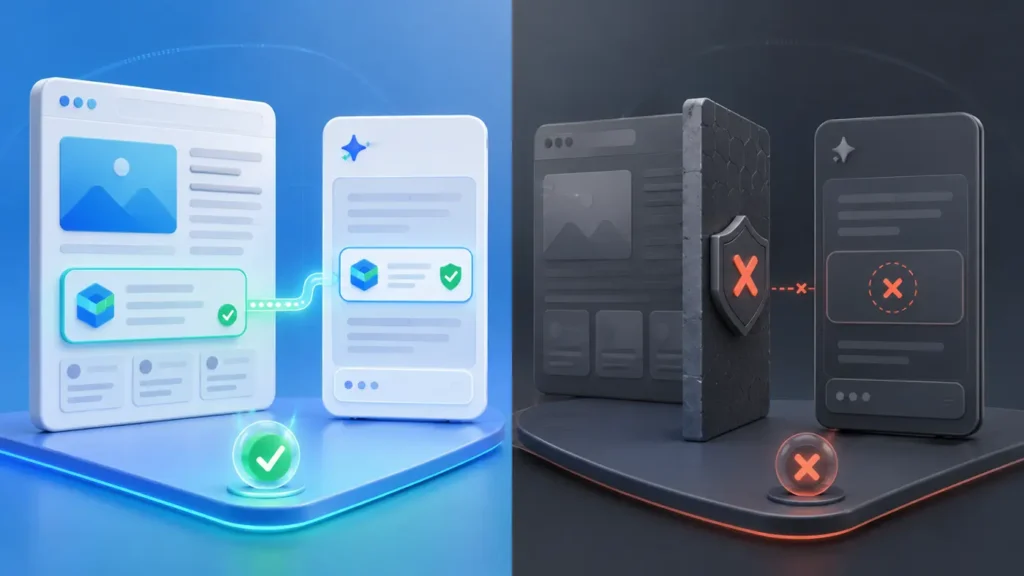
The table points to different actions. The healthy brand should study which pages and third-party sources support its mentions, then strengthen adjacent high-intent topics. The missing brand should not begin by producing dozens of generic articles. First verify that public pages can be reached, that the company and product are unambiguous, and that each priority page gives a direct, evidence-backed answer to a specific buyer question.
Privacy and data handling
A public checker should request only the information needed for the test: the public brand name, domain, target category, market, and prompt set. It should not ask for passwords, private analytics access, customer records, unpublished documents, payment information, or private AI conversations. If a manual review needs Search Console or analytics evidence, the owner should share only the minimum exported data required and understand exactly how it will be handled.
Prompt logs can reveal strategy, locations, products, or customer segments. A responsible service explains what it stores, how long it retains results, who can access them, and whether anonymized findings may be used for aggregate research. Public AI responses may also contain errors or sensitive claims, so reports should limit unnecessary redistribution and include a clear correction path.
Safe submission rule: provide only a public website you own or are authorized to assess. Exclude account, checkout, admin, staging, preview, and authenticated URLs from a free public check.
Troubleshooting invalid URLs, bot protection, timeouts, and inconclusive tests
- Invalid URL: use the canonical HTTPS homepage or the most relevant public product/category page. Remove tracking parameters and do not submit an editor preview.
- Bot protection: review CDN and WAF logs before creating an exception. Verify both user-agent and official IP information when a platform publishes it. Perplexity’s current crawler guidance recommends combining user-agent matching with its published IP ranges.
- Blocked search crawler: check robots.txt against the platform you intend to support. OpenAI says sites seeking inclusion in ChatGPT summaries and snippets should not block OAI-SearchBot.
- Timeout or challenge: record the timestamp, response status, redirect chain, and edge-provider event. Retest from a normal browser and an approved diagnostic request before concluding that every crawler is blocked.
- Name mismatch: add legitimate aliases to the matcher, but do not count broad generic terms as brand mentions. Review ambiguous matches manually.
- No sources shown: label the citation field unavailable. Do not invent the system’s source from wording alone.
- Volatile answers: increase the prompt sample and retest later. Report a range or repeat rate instead of selecting the most favorable screenshot.
Related manual checks you can run today
- Search each AI platform with the same neutral category prompts and record the answer before asking follow-up questions.
- Run a branded accuracy test: ask what the company does, who it serves, and which official website belongs to it.
- Review your server and CDN logs for verified search-related crawler activity. A lack of logs is evidence about your server sample, not proof that no platform knows the brand.
- Inspect robots.txt, status codes, canonicals, raw HTML, rendered content, organization details, author information, dates, and internal links on the pages you expect to support mentions.
- Check whether competitor mentions are supported by official sites, reviews, directories, communities, news coverage, or datasets. That source pattern should guide your evidence plan.
- Track ChatGPT referrals separately in analytics and preserve landing pages and campaign parameters where available.
- Repeat the test after meaningful changes and compare the same prompts rather than changing both the website and measurement method at once.
For the broader diagnostic model, read Visible Pilot’s AI Visibility Audit and Measurement Framework. Small teams can also follow the prioritized workflow in AI visibility audit for small business. If competitors appear while your company does not, use why AI answers mention competitors but not my brand to separate authority, access, entity, content-fit, and evidence gaps.
Why mentions, citations, and traffic need separate tracking
Google describes AI Overviews as snapshots that include links for exploring the web, while Perplexity states that PerplexityBot is intended to surface and link websites in its search results. Those product descriptions show why a visible source link matters, but a brand mention is still a different event. Your name may appear because of a marketplace profile, a review site, a press article, or model knowledge even when your domain is not cited.
Measure the full path: mention, accurate context, owned-domain citation, click, and conversion. That sequence tells you whether the visibility is merely noticeable or commercially useful. It also prevents an increase in unlinked mentions from being reported as an increase in website traffic. When you preserve the query and source evidence, teams can improve the pages and external proof that actually influence the journey.
Frequently asked questions
How accurate is a free AI brand mention checker?
It can be accurate about the prompts and answers it actually captures when matching rules and evidence are visible. It cannot guarantee the same answer for every user or future date. Accuracy improves with a defined brand dictionary, neutral prompts, manual review of ambiguous matches, repeated samples, and clear handling of inconclusive results.
Which AI platforms should I check?
Begin with the platforms your customers use and that are available in your target market. A practical baseline may include ChatGPT search, Google AI search experiences, Claude, and Perplexity, but availability and behavior can differ. Keep each platform’s results separate rather than merging them into one unsupported universal score.
How often should brand mentions be checked?
For a new baseline, run the full prompt set once and repeat a smaller stability sample within a week. Retest after a major website migration, robots or WAF change, product-positioning update, important campaign, or new evidence asset. A monthly sample and quarterly full review is a reasonable starting cadence for many small teams.
Does a mention mean the AI system recommends my company?
No. The name may appear in a neutral list, comparison, warning, citation, or unrelated context. Always classify the surrounding language and verify important claims. A mention becomes more useful when it is accurate, relevant to the buyer’s question, supported by trustworthy evidence, and connected to a source the reader can inspect.
Can I improve results by asking branded questions repeatedly?
Branded prompts are useful for checking factual accuracy, but they do not measure discovery for category questions. Repeated self-searching can also encourage selective reporting. Use a frozen non-branded prompt set, record every result, and separate branded accuracy from neutral discovery.
Next step: run the free Visible Pilot check
Visible Pilot’s automated free AI brand mention checker is being prepared. Until it opens, request a free manual brand-mention check for one public website. We will return the clearest mention, citation, competitor, access, and evidence gaps without promising an artificial “guaranteed visibility” score.
Sources reviewed 6 August 2026: OpenAI Publishers and Developers FAQ, Perplexity crawler documentation, and Google AI Overviews.